Hemodynamic adaptation after spinal anesthesia in cesarean section
Keywords:
Cesarean section, hemodynamic adaptation, post-spinal hypotension, spinal anesthesiaAbstract
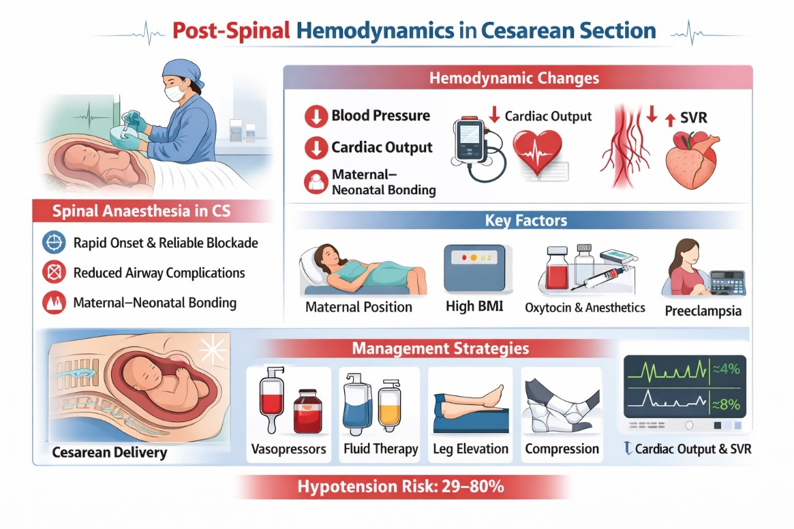
Neuraxial anesthesia is the preferred technique for cesarean section (CS), as recommended by the National Institute for Health and Care Excellence. Among these, spinal anesthesia (SA) is preferred over general anesthesia for its rapid onset, reliable blockade, and improved maternal safety. In addition, it minimizes airway-related complications such as failed intubation and aspiration while allowing maternal consciousness and early maternal–neonatal bonding. CS involves the surgical delivery of the fetus, placenta, and amniotic fluid through abdominal and uterine incisions and is typically indicated in maternal or fetal compromise. Despite its advantages, SA is commonly associated with considerable hemodynamic changes, particularly post-spinal hypotension, which is a major concern in obstetric anesthesia. Previous studies have primarily focused on hypotension management using vasopressors or fluid therapy, often in isolation. As a result, a comprehensive understanding of the overall hemodynamic adaptation following SA remains limited. The incidence of hypotension varies widely (29.0%–80.0%), thus reflecting the complexity of maternal cardiovascular responses. Moreover, dynamic parameters such as cardiac output, systemic vascular resistance, and maternal–fetal circulatory interactions have been insufficiently explored. The objective of this review is to critically synthesize contemporary evidence regarding the physiological mechanisms, determinants, and management strategies underlying hemodynamic adaptation following SA in CS. This narrative review was conducted through a comprehensive literature search across major electronic databases, including PubMed, Google Scholar, and the Cochrane Library, focusing on studies that address hemodynamic changes and management strategies associated with SA during CS. It examines the mechanisms and determinants of SAinduced hypotension, including maternal positioning, body mass index, and drug effects (oxytocin, propofol, thiopental, opioids, and local anesthetics). Furthermore, it discusses preventive and management strategies, including vasopressors, mechanical measures, and optimized fluid therapy, with special consideration for pre-eclampsia. In conclusion, hemodynamic adaptation following SA is multifactorial. It requires an individualized, multimodal management approach to preserve maternal cardiovascular stability and optimize fetal outcomes, and future research should focus on establishing standardized, evidence-based preventive strategies. Early identification of high-risk patients and optimized vasopressor-based management strategies may improve maternal hemodynamic stability and fetal outcomes during CS delivery under SA.
Downloads
References
Baron EL, Katz D. Neuraxial techniques and medications for cesarean delivery. In: Kaye AD, Urman RD, editors. Obstetric Anesthesia Practice. Oxford: Oxford University Press; 2021. p. 203-13.
https://doi.org/10.1093/med/9780190099824.003.0017
Betran AP, Ye J, Moller AB, Souza JP, Zhang J. Trends and projections of caesarean section rates: global and regional estimates. BMJ Glob Health 2021;6:e005671.
https://doi.org/10.1136/bmjgh-2021-005671
Elgzar WT, Alshahrani MS, Ibrahim HA. Mode of delivery preferences: the role of childbirth fear among nulliparous women. Front Psychol. 2023;14:1221133.
https://doi.org/10.3389/fpsyg.2023.1221133
Chen Y, Guo L, Qin R, Xi N, Wang S, Ma Y, Ni X. Dose-response study of norepinephrine infusion for maternal hypotension in preeclamptic patients undergoing cesarean delivery under spinal anesthesia. Clin Pharmacokinet 2024;63:847-56.
https://doi.org/10.1007/s40262-024-01381-4
Hassabelnaby YS, Hasanin AM, Shamardal M, Mostafa M, Zaki RM, Elsherbiny M, Refaat S. Epinephrine vs phenylephrine infusion for prophylaxis against maternal hypotension after spinal anesthesia for cesarean delivery: a randomized controlled trial. J Anesth 2024;38:500-7.
https://doi.org/10.1007/s00540-024-03344-2
Kinsella SM, Carvalho B, Dyer RA, Fernando R, McDonnell N, Mercier FJ, et al; Consensus Statement Collaborators. International consensus statement on the management of hypotension with vasopressors during caesarean section under spinal anaesthesia. Anaesthesia 2018;73:71-92.
https://doi.org/10.1111/anae.14080
Massoth C, Töpel L, Wenk M. Hypotension after spinal anaesthesia for CS: approach to iatrogenic sympathectomy. Curr Opin Anaesthesiol 2020;33:291-8.
https://doi.org/10.1097/ACO.0000000000000848
Mathew M, Manah YM, Ahuja P, Shetty AR, Taye TE, et al. Managing spinal anaesthesia-induced hypotension in CS: a narrative review. Ann Med Surg (Lond) 2025;87:7338-46.
https://doi.org/10.1097/MS9.0000000000003911
Babul A, Ashraf S, Desai J, Free L, Hussain M, Babul N . Intraoperative hypotension after neuraxial anaesthesia: systematic review of vasopressors. Cureus 2025;17:e94900.
Lorente JV, Hervías Sanz M, Ripollés-Melchor J, Hahn RG. Perioperative fluid therapy in adults and children: a narrative review. Front Med (Lausanne) 2025 ;12:1607670.
https://doi.org/10.3389/fmed.2025.1607670
Mohamed S, Befkadu A, Mohammed A, Neme D, Ahmed S, Yimer Y, Girma T. Effectiveness of prophylactic ondansetron in preventing spinal anesthesia induced hypotension and bradycardia in pregnant mother undergoing elective cesarean delivery: A double blinded randomized control trial, 2021. Int J Surg Open 2021;35:100401.
https://doi.org/10.1016/j.ijso.2021.100401
Chen S, Wu L, Jiang X. Aortocaval compression resulting in sudden loss of consciousness and severe bradycardia and hypotension during cesarean section in a patient with subvalvular aortic stenosis. BMC Anesthesiol 2019;19:116.
https://doi.org/10.1186/s12871-019-0791-x
Kim HJ, Choi YS, Kim SH, Lee W, Kwon JY, Kim DH. Predictability of preoperative carotid artery-corrected flow time for hypotension after spinal Anaesthesia in patients undergoing caesarean section: a prospective observational study. Obstet Anesth Dig 2022;42:44-5.
https://doi.org/10.1097/01.aoa.0000816916.10650.95
Shitemaw T, Jemal B, Mamo T, Akalu L. Incidence and associated factors for hypotension after spinal anesthesia during cesarean section at Gandhi Memorial Hospital Addis Ababa, Ethiopia. PLoS One 2020;15:e0236755.
https://doi.org/10.1371/journal.pone.0236755
Lorato SS, Agide FD, Getahun GK, Seid K, Wondimagne YA, Desalegn M, Rundasa DT, et al. Incidence and predictors of post spinal anesthesia-induced hypotension for cesarean section in Ethiopia: A systematic review and meta-analysis. Perioper Care Oper Room Manag 2025;40:100541.
https://doi.org/10.1016/j.pcorm.2025.100541
Kee WD. Prevention of maternal hypotension after regional anaesthesia for caesarean section. Curr Opin Anaesthesiol 2010;23:304-9.
https://doi.org/10.1097/ACO.0b013e328337ffc6
Basso L, Lacassie HJ. Vasoactive drugs for the management of maternal arterial hypotension after spinal anesthesia for cesarean section. an updated integrative narrative review. Trends Anaesth Crit Care 2024;58:101491.
https://doi.org/10.1016/j.tacc.2024.101491
Huang Q, Wen G, Hai C, Zheng Z, Li Y, Huang Z, et al. A height-based dosing algorithm of bupivacaine in spinal anesthesia for decreasing maternal hypotension in cesarean section without prophylactic fluid preloading and vasopressors: a randomized-controlled non-inferiority trial. Front Med 2022;9:858115.
https://doi.org/10.3389/fmed.2022.858115
Jelting Y, Klein C, Harlander T, Eberhart L, Roewer N, Kranke P. Preventing nausea and vomiting in women undergoing regional anesthesia for cesarean section: challenges and solutions.Local Reg Anesth 2017;10:83-90.
https://doi.org/10.2147/LRA.S111459
Bajwa SP, Hussain A, Akram M, Shahzad S, Khan U. Comparison of hemodynamic effects and patient satisfaction between lateral versus sitting maternal positions for cesarean deliveries in spinal anesthesia. Pak Armed Forces Med J 2024;74:965.
https://doi.org/10.51253/pafmj.v74i4.3160
Manouchehrian N, Moradi A, Torkashvand L. Comparative study of effect of spinal anaesthesia in sitting and lateral positions on onset of sensory block and hemodynamic condition in CS: a randomized clinical trial. Anesth Pain Med 2021;11:e111483.
https://doi.org/10.5812/aapm.111483
Samuel S, Kasahun B, Demeke T, Reshad S, Shemsu N, Kedir A, et al. Impact of lateral versus sitting position for spinal anesthesia on maternal hemodynamic variability and timing of hypotension among cesarean section patients: a prospective cohort study. Ann Med Surg 2025;87:62-9.
https://doi.org/10.1097/MS9.0000000000002754
Šklebar I, Bujas T, Habek D. Spinal anesthesia-induced hypotension in obstetrics: prevention and therapy. Acta Clin Croat 2019;58 Suppl 1:90-5.
https://doi.org/10.20471/acc.2019.58.s1.13
Abadi KK, Jama AH, Legesse AY, Gebremichael AK. Prevalence of hypothyroidism in pregnancy and its associations with adverse pregnancy outcomes: a cross-sectional study. Int J Womens Health 2023;15:1481-90.
https://doi.org/10.2147/IJWH.S429611
Algarni RA, Albakri HY, Albakri LA, Alsharif RM, Alrajhi RK, Makki RM, et al. Incidence and risk factors of spinal anesthesia-related complications after elective cesarean section: a retrospective cohort study. Cureus 2023;15:e34198.
https://doi.org/10.7759/cureus.34198
Nivatpumin P, Lertbunnaphong T, Maneewan S, Vittayaprechapon N. Comparison of perioperative outcomes and anesthetic-related complications of morbidly obese and super-obese parturients delivering by cesarean section. Ann Med 2023;55:1037-46.
https://doi.org/10.1080/07853890.2023.2187877
Lawson J, Howle R, Popivanov P, Sidhu J, Gordon C, Leong M, et al. Gastric emptying in pregnancy and its clinical implications: a narrative review. Br J Anaesth 2025;134:124-67.
https://doi.org/10.1016/j.bja.2024.09.005
Oliveira-Paula GH, Pinheiro LC, Ferreira GC, Garcia WNP, Lacchini R, Garcia LV, et al. ACE inhibitors enhance hypotensive effects of propofol via nitric oxide. Free Radic Biol Med 2018;115:10-7.
https://doi.org/10.1016/j.freeradbiomed.2017.11.010
Pozza DH, Tavares I, Cruz CD, Fonseca S. Spinal cord injury and complications related to neuraxial anaesthesia: a systematic review. Int J Mol Sci 2023;24:4665.
https://doi.org/10.3390/ijms24054665
Jeevan R, Kundra P, Mishra S, Maurya DK, Keepanasseril A. Effect of preoperative oxytocin infusion on haemodynamics in elective CS under spinal anaesthesia. Indian J Anaesth 2025;69:343-9.
https://doi.org/10.4103/ija.ija_1062_24
Torloni MR, Siaulys M, Riera R, Cabrera Martimbianco AL, Leite Pacheco R, Latorraca CD, et al. Timing of oxytocin to prevent post-partum hemorrhage in women delivered by cesarean section: a systematic review and metaanalysis. PLoS One 2021;16:e0252491.
https://doi.org/10.1371/journal.pone.0252491
Giorgione V, O'Driscoll J, Coutinho CM, Di Fabrizio C, Sharma R, Khalil A, et al. Peripartum echocardiographic changes in women with hypertensive disorders of pregnancy. Ultrasound Obstet Gynecol 2022;59:365-70.
https://doi.org/10.1002/uog.23745
Saugel B, Bebert EJ, Briesenick L, Hoppe P, Greiwe G, Yang D, et al. Mechanisms contributing of hypotension after anesthetic induction with sufentanil, propofol, and rocuronium: a prospective observational study. J Clin Monit Comput 2022;36:341-7.
https://doi.org/10.1007/s10877-021-00653-9
Küçük RS, Uzman S. A comparison of propofol and etomidate for anesthesia induction in patients with diabetic autonomic neuropathy. Injector 2023;2:16-22.
Belin O, Casteres C, Alouini S, Le Pape M, Dupont A, Boulain T. Continuous infusion of phenylephrine or norepinephrine for maintenance of blood pressure during spinal anesthesia for cesarean delivery: a randomized study. Anesth Analg 2023;136:540-50.
https://doi.org/10.1213/ANE.0000000000006244
Hedawy S, Labeeb EE, Aldalahmeh S, Elswaf A, AlManaseer GM, Shehab MA, et al. Hypnotics as induction agents for general anaesthesia in cesarean section patients: updated systematic review and meta-analysis of randomized controlled trials. J Anesth 2025;39:948-75.
https://doi.org/10.1007/s00540-025-03524-8
Taware M, Sonkusale M, Kuthe S. Comparison of hemodynamic effects of intravenous etomidate versus thiopentone during induction and intubation using entropy-guided hypnosis levels in coronary artery bypass surgery cases. J Datta Meghe Inst Med Sci Univ 2021;16:704-10.
https://doi.org/10.4103/jdmimsu.jdmimsu_319_21
Abd-Elsayed A, editor. Basic anaesthesia review. Oxford: Oxford University Press; 2024.
https://doi.org/10.1093/med/9780197584569.001.0001
Norman E, Westrin P, Fellman V. Placental transfer and pharmacokinetics of thiopentone in newborns. Arch Dis Child Fetal Neonatal Ed 2010;95:F277-82.
https://doi.org/10.1136/adc.2009.177626
Hao X, Yang Y, Liu J, Zhang D, Ou M, Ke B, et al. The Modulation by anesthetics and analgesics of Respiratory Rhythm in the Nervous System. Curr Neuropharmacol 2024; 22:217-40.
https://doi.org/10.2174/1570159X21666230810110901
Sorout D, Mahajan N, Singh RK, Saiyad SS, Sharma M. Lower limb orthopedic anaesthesia: randomized trial comparing ropivacaine and bupivacaine for sensory-motor block and hemodynamic stability. Cureus 2025;17:e84377.
https://doi.org/10.7759/cureus.84377
Khalil RS, Mehmud A, Banerjee R, Malhotra R, Banerjee A. Intrathecal ropivacaine versus bupivacaine in a non-obstetric population: meta-analysis and trial sequential analysis. Indian J Anaesth 2024;68:129-41.
https://doi.org/10.4103/ija.ija_715_23
Manouchehrian N, Jeyriaee N, Hoseini S. Intravenous norepinephrine vs ephedrine for prevention of post-spinal hypotension in cesarean section: randomized double-blind trial. Maedica (Bucur) 2022;17:833-39.
https://doi.org/10.26574/maedica.2022.17.4.833
Kee WD, Lee SW, Ng FF, Tan PE, Khaw KS. Norepinephrine vs phenylephrine for maintaining blood pressure during spinal anaesthesia for cesarean delivery. Surv Anesthesiol 2015; 59:267-8.
https://doi.org/10.1097/SA.0000000000000180
Sharkey AM, Siddiqui N, Downey K, Ye XY, Guevara J, Carvalho JC. Comparison of intermittent intravenous boluses of phenylephrine and norepinephrine to prevent and treat spinal-induced hypotension in cesarean delivery: randomized controlled trial. Anesth Analg 2019; 129:1312-8.
https://doi.org/10.1213/ANE.0000000000003704
Elnabtity AM, Selim MF. Norepinephrine versus ephedrine to maintain arterial blood pressure during spinal anaesthesia for cesarean delivery: a prospective double-blinded trial. Anesth Essays Res 2018;12:92-7.
https://doi.org/10.4103/aer.AER_204_17
Minzter BH, Johnson RF, Paschall RL, Ramasubramanian R, Ayers GD, Downing JW. The diverse effects of vasopressors on the fetoplacental circulation of the dual perfused human placenta. Anesth Analg 2010;110:857-62.
https://doi.org/10.1213/ANE.0b013e3181c91ebc
Ngan Kee WD, Khaw KS, Tam YH, Ng FF, Lee SW. Performance of a closed-loop feedback computer-controlled infusion system for maintaining blood pressure during spinal anaesthesia for caesarean section: a randomized controlled comparison of norepinephrine versus phenylephrine. J Clin Monit Comput 2017; 31:617-23.
https://doi.org/10.1007/s10877-016-9883-z
Abdus Samad A, Allah Dad MS, Saeed Z. Assessing Neonatal Apgar Scores Following Propofol and Thiopental Induction in Cesarean Sections: A Systematic Review. Cureus 2025;17:e89548.
https://doi.org/10.7759/cureus.89548
Chao E, Sun HL, Huang SW, Liao JH, Ma PL, Chen HC. Metaraminol use during spinal anaesthesia for cesarean section: a meta-analysis of randomised controlled trials. Int J Obstet Anesth 2019;39:42-50.
https://doi.org/10.1016/j.ijoa.2019.01.009
Jain K, Makkar JK, Vp SS, Gander S, Kumar P. A randomized trial comparing prophylactic phenylephrine and ephedrine infusion during spinal anesthesia for emergency cesarean delivery in cases of acute fetal compromise. J Clin Anesth 2016;34:208-15.
https://doi.org/10.1016/j.jclinane.2016.03.015
George RB, McKeen DM, Dominguez JE, Allen TK, Doyle PA, Habib AS. A randomized trial of phenylephrine infusion versus bolus dosing for nausea and vomiting during Cesarean delivery in obese women. Can J Anesth 2018;65:254-62.
https://doi.org/10.1007/s12630-017-1034-6
Li S, Dai X, Wang Y, Shen L, Hao N. Effect of bupivacaine combined with fentanyl for simultaneous spinal-epidural anesthesia on hemodynamics, and maternal and infant outcomes in patients undergoing cesarean section. Trop J Pharm Res 2022;21:193-9.
Regmi BD, Deo GP, Shrestha S, Shrestha S, Mishra RT. Low dose hyperbaric bupivacaine with fentanyl in spinal anesthesia in elective cesarean Section . J Chitwan Med Coll 2019; 9:79-82.
https://doi.org/10.3126/jcmc.v9i2.24560
Li M, Xie G, Chu L, Li Y. Efficacy of low-dose hypobaric anesthetics in spinal anesthesia for cesarean delivery: a systematic review and meta-analysis. J Matern Fetal Neonatal Med 2025;38:2519655.
https://doi.org/10.1080/14767058.2025.2519655
Jain T. Evaluation of adjunctive analgesia with intrathecal fentanyl along with hyperbaric bupivacaine in spinal anesthesia for elective caesarean section. Int J Res Med Sci 2020;8:2924-7.
https://doi.org/10.18203/2320-6012.ijrms20203439
Bhat AD, Singh PM, Palanisamy A. Neuraxial anaesthesia-induced hypotension during cesarean section. BJA Educ 2024;24:113-20.
https://doi.org/10.1016/j.bjae.2024.01.003
Abdali K, Chen X, Ross S, Davis S, Zhou Z, Mallet RT, et al. Mechanisms maintaining cerebral perfusion during systemic hypotension are impaired in elderly adults. Exp Biol Med (Maywood) 2023;248:2464-72.
https://doi.org/10.1177/15353702231209416
Carravieri A, Müller MS, Yoda K, Hayama SI, Yamamoto M. Dominant Parasympathetic Modulation of Heart Rate and Heart Rate Variability in a Wild-Caught Seabird . Physiol Biochem Zool 2016;89:263-76.
https://doi.org/10.1086/686894
Sahoo SR, Raiguru D, Kakarla A, Das S. Estimation of the effective dose of phenylephrine infusion for preventing spinal anaesthesia-induced hypotension in elective cesarean deliveries: a randomized controlled trial. Cureus. 2025;17:e96873.
https://doi.org/10.7759/cureus.96873
Kinsella SM, Carvalho B, Dyer RA, Fernando R, McDonnell N, Mercier FJ, et al. International consensus statement on the management of hypotension with vasopressors during caesarean section under spinal anaesthesia. Anaesthesia 2018; 38:171-2.
https://doi.org/10.1097/01.aoa.0000547270.12467.06
Park HS, Choi WJ. Use of vasopressors to manage spinal anaesthesia-induced hypotension during cesarean delivery. Anesth Pain Med (Seoul) 2024;19:85-93.
https://doi.org/10.17085/apm.24037
Hasanin A, Soryal R, Kaddah T, Raouf SA, Abdelwahab Y, Elshafaei K, et al. Hemodynamic effects of lateral tilt before and after spinal anaesthesia during cesarean delivery: an observational study. BMC Anesthesiol 2018;18:8.
https://doi.org/10.1186/s12871-018-0473-0
Hirose N, Kondo Y, Maeda T, Matsui M, Matsuda M, Suzuki T. Prophylactic infusion of phenylephrine attenuates decrease in cerebral blood volume and oxygenation during spinal anaesthesia for cesarean section. Int J Obstet Anesth 2019;37:36-44.
https://doi.org/10.1016/j.ijoa.2018.09.006
Hans FP, Benning L, Pooth JS, Busch HJ. Unintentional high-dose adrenaline administration in anaphylaxis-induced cardiac arrest: a case report. Int J Emerg Med 2024;17:78.
https://doi.org/10.1186/s12245-024-00663-9
Biricik E, Ünlügenç H. Vasopressors for the Treatment and Prophylaxis of Spinal Induced Hypotension during Caesarean Section. Turk J Anaesthesiol Reanim 2020;49:3-10.
https://doi.org/10.5152/TJAR.2020.70
Younis MS, Salman SA, Khamees EN. Ephedrine infusion prevents hypotension and reduces nausea in Cesarean Section under spinal anaesthesia. Academia Open 2024;9:10.21070
https://doi.org/10.21070/acopen.9.2024.8794
Guo R, Xue Q, Qian Y, Hu Y, Tan J. The effects of ephedrine and phenylephrine on placental vascular resistance during cesarean section under epidual anesthesia. Cell Biochem Biophys 2015;73:687-93.
https://doi.org/10.1007/s12013-015-0676-7
Wang X, Mao M, Liu S, Xu S, Yang J. A comparative study of bolus norepinephrine, phenylephrine, and ephedrine for the treatment of maternal hypotension in parturients with preeclampsia during cesarean delivery under spinal anesthesia . Med Sci Monit 2019;25:1093-100.
https://doi.org/10.12659/MSM.914143
Shelke U, Yadav S, Vardhan V, Vyas V, Sadawarte S, Mulla S, et al. Phenylephrine and ephedrine for prevention of hypotension during CS under spinal anaesthesia: a randomized clinical study. J Clin Diagn Res 2023;17:2.
https://doi.org/10.7860/JCDR/2023/59684.17438
Song B, Fu K, Zheng X, Liu C. Fluid resuscitation in adults with severe infection and sepsis: a systematic review and network meta-analysis. Front Med (Lausanne) 2025;12:1543586.
https://doi.org/10.3389/fmed.2025.1543586
Ni HF, Liu HY, Zhang J, Peng K, Ji FH. Crystalloid coload reduced the incidence of hypotension in spinal anesthesia for cesarean delivery, when compared to crystalloid preload: a meta-analysis. Biomed Res Int 2017;2017:3462529.
https://doi.org/10.1155/2017/3462529
Zahid TR, Farooq U, Waraich AA, Bashir R, Ali I. Effect of crystalloid administration timing on hypotension in spinal anaesthesia for cesarean delivery: preload versus coload: a study at a Tertiary Care Hospital in Rawalpindi. Life Sci 2024;5:06.
https://doi.org/10.37185/LnS.1.1.468
Widodo K, Isnaini N. The effect of gelatine colloid preloading on hypotension prevention in cesarean section with spinal anesthesia at the central surgery installationof banyumas regional hospital. Proc Health Med Sci 2024;5:81-6.
https://doi.org/10.30595/pshms.v5i.966
Gong RS, Liu XW, Li WX, Zhao J. Effects of colloid preload on hypotension in spinal anaesthesia for CS: a meta-analysis. Chin Med J (Engl) 2021;134:1043-51.
https://doi.org/10.1097/CM9.0000000000001477
Marzouk SB, Fouzai B, Dhraief N, Amor FB, Hkiri T, Hamdi H, et al. Cardiac ultrasound-guided crystalloid preloading before spinal anesthesia vs standard coloading for cesarean delivery: a randomized controlled trial. Int J Obstet Anesth 2026:66;104840.
https://doi.org/10.1016/j.ijoa.2025.104840
Patel SD, Habib AS, Phillips S, Carvalho B, Sultan P. The effect of glycopyrrolate on the incidence of hypotension and vasopressor requirement during spinal anesthesia for cesarean delivery: a meta-analysis. Anesth Analg 2018;126:552-8.
https://doi.org/10.1213/ANE.0000000000002274
Dilawar M, Rasool B, Zahra F, Noor I, Adnan M, Siddique S, et al. Comparative analysis of bupivacaine versus ropivacaine in CS surgery. J Health Wellness Community Res 2025:5;e228.
https://doi.org/10.61919/26kk9p27
Simmons SW, Dennis AT, Cyna AM, Richardson MG, Bright MR. Combined spinal-epidural versus spinal anaesthesia for caesarean section. Cochrane Database Syst Rev 2019;10:CD008100.
https://doi.org/10.1002/14651858.CD008100.pub2
Rana S, Lemoine E, Granger JP, Karumanchi SA. Preeclampsia: pathophysiology, challenges, and perspectives. Circ Res 2019;124:1094-112.
Downloads
Published
How to Cite
Issue
Section
License
Copyright (c) 2026 Chulalongkorn Medical Journal

This work is licensed under a Creative Commons Attribution-NonCommercial-NoDerivatives 4.0 International License.