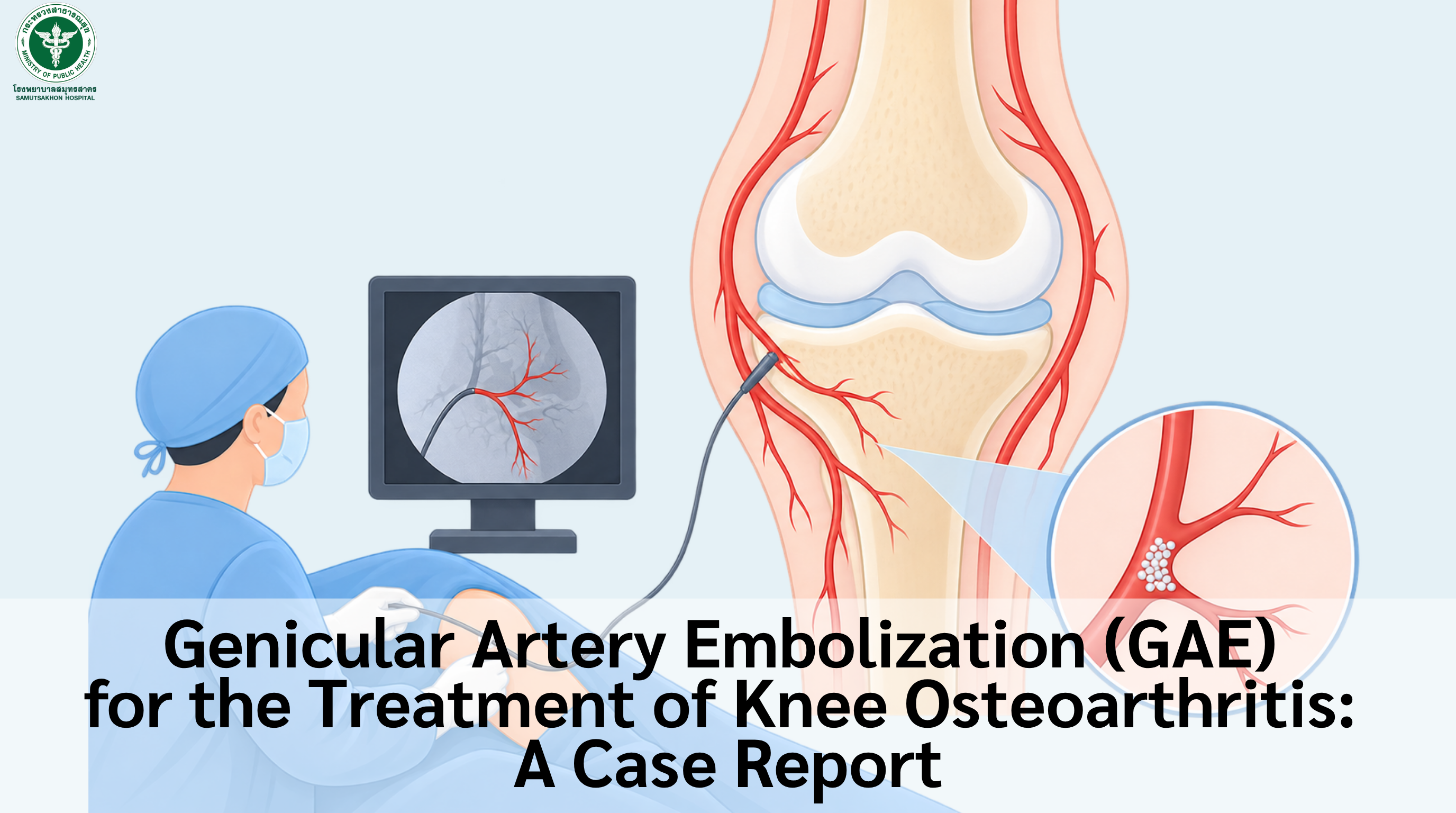
การรักษาโรคข้อเข่าเสื่อมด้วยหัตถการทางรังสีร่วมรักษา Genicular Artery Embolization (GAE): รายงานกรณีศึกษา
คำสำคัญ:
การอุดหลอดเลือดแดงรอบข้อเข่า, โรคข้อเข่าเสื่อม, รังสีร่วมรักษาบทคัดย่อ
โรคข้อเข่าเสื่อมเป็นสาเหตุสำคัญของอาการปวดเรื้อรังและการสูญเสียความสามารถในการใช้งานข้อเข่า ผู้ป่วยส่วนหนึ่งไม่ตอบสนองต่อการรักษาแบบประคับประคอง แต่ยังไม่พร้อมหรือไม่ประสงค์จะเข้ารับการผ่าตัดเปลี่ยนข้อเข่าเทียม การอุดหลอดเลือดแดงรอบข้อเข่า genicular artery embolization (GAE) เป็นหัตถการรังสีร่วมรักษาที่รุกล้ำน้อย ซึ่งอาศัยหลักการลดหลอดเลือดผิดปกติที่เยื่อบุข้ออักเสบเรื้อรัง บทความนี้รายงานผู้ป่วยหญิงไทย อายุ 47 ปี ที่มีภาวะข้อเข่าเสื่อมระดับ Kellgren–Lawrence (KL) grade 3 และมีอาการปวดเข่าซ้ายเรื้อรัง ซึ่งไม่ดีขึ้นหลังการรักษาด้วยยาและกายภาพบำบัด (ก่อนทำหัตถการ คะแนน WOMAC 77 จาก 96 และ คะแนน NRS 8 จาก 10) ผู้ป่วยได้รับการทำ GAE ที่เข่าซ้ายโดยใช้ imipenem/cilastatin sodium เป็นสารอุดผ่านหลอดเลือด descending genicular artery และ inferior medial genicular artery หลังทำหัตถการ อาการปวดลดลงอย่างชัดเจนตั้งแต่วันแรก คะแนน WOMAC ลดลงต่ำสุดเหลือ 4 จาก 96 ในช่วงเดือนที่ 3 ถึง 6 (ลดลงประมาณร้อยละ 94.8 จากค่าเริ่มต้น) และเพิ่มขึ้นเล็กน้อยเป็น 12 จาก 96 ที่เดือนที่ 9 (ลดลงประมาณร้อยละ 84.4) ขณะที่ค่า NRS คงอยู่ที่ 2 จาก 10 ตลอดระยะติดตาม 9 เดือน โดยไม่พบภาวะแทรกซ้อนจากหัตถการ และผู้ป่วยลดการใช้ยาแก้ปวดกลุ่ม NSAIDs ลงได้ ผลลัพธ์เบื้องต้นในผู้ป่วยรายนี้ชี้ให้เห็นว่า GAE อาจเป็นทางเลือกการรักษาระหว่างกลาง (bridging therapy) ที่มีแนวโน้มดีและสามารถทำได้จริงในโรงพยาบาลระดับจังหวัด อย่างไรก็ตาม เนื่องจากเป็นข้อมูลจากผู้ป่วยเพียงรายเดียวและไม่มีกลุ่มควบคุม จึงจำเป็นต้องมีการศึกษาที่มีกลุ่มเปรียบเทียบและจำนวนผู้ป่วยมากขึ้นเพื่อยืนยันประสิทธิผลและความปลอดภัยในระยะยาว
Downloads
เอกสารอ้างอิง
Cui A, Li H, Wang D, Zhong J, Chen Y, Lu H. Global, regional prevalence, incidence and risk factors of knee osteoarthritis in population-based studies. EClinicalMedicine. 2020;29-30:100587. https://doi.org/10.1016/j.eclinm.2020.100587
Kuptniratsaikul V, Tosayanonda O, Nilganuwong S, Thamalikitkul V. The epidemiology of osteoarthritis of the knee in elderly patients living in an urban area of Bangkok. J Med Assoc Thai. 2002;85(2):154-61.
Bannuru RR, Osani MC, Vaysbrot EE, Arden NK, Bennell K, Bierma-Zeinstra SMA, et al. OARSI guidelines for the non-surgical management of knee, hip, and polyarticular osteoarthritis. Osteoarthritis Cartilage. 2019;27(11):1578-89. https://doi.org/10.1016/j.joca.2019.06.011
Torkian P, Golzarian J, Chalian M, Clayton A, Rahimi-Dehgolan S, Tabibian E, et al. Osteoarthritis-related knee pain treated with genicular artery embolization: a systematic review and meta-analysis. Orthop J Sports Med. 2021;9(7):23259671211021356. https://doi.org/10.1177/23259671211021356
Landers S, Hely R, Hely A, Harrison B, Page RS, Maister N, et al. Genicular artery embolization for early-stage knee osteoarthritis: results from a triple-blind single-centre randomized controlled trial. Bone Jt Open. 2023;4(3):158-67. https://doi.org/10.1302/2633-1462.43.BJO-2022-0161.R2
Okuno Y, Matsumura N, Oguro S. Transcatheter arterial embolization using imipenem/cilastatin sodium for tendinopathy and enthesopathy refractory to nonsurgical management. J Vasc Interv Radiol. 2013;24(6):787-92. https://doi.org/10.1016/j.jvir.2013.02.033
Okuno Y, Korchi AM, Shinjo T, Kato S. Transcatheter arterial embolization as a treatment for medial knee pain in patients with mild to moderate osteoarthritis. Cardiovasc Intervent Radiol. 2015;38(2):336-43. https://doi.org/10.1007/s00270-014-0944-8
Okuno Y, Korchi AM, Shinjo T, Kato S, Kaneko T. Midterm clinical outcomes and MR imaging changes after transcatheter arterial embolization as a treatment for mild to moderate radiographic knee osteoarthritis resistant to conservative treatment. J Vasc Interv Radiol. 2017;28(7):995-1002. https://doi.org/10.1016/j.jvir.2017.02.033
Bagla S, Piechowiak R, Hartman T, Orlando J, Del Gaizo D, Isaacson A. Genicular artery embolization for the treatment of knee pain secondary to osteoarthritis. J Vasc Interv Radiol. 2020;31(7):1096-102. https://doi.org/10.1016/j.jvir.2019.09.018
World Health Organization. Obesity: preventing and managing the global epidemic. Report of a WHO consultation. World Health Organ Tech Rep Ser. 2000;894:i-xii, 1-253.
Kellgren JH, Lawrence JS. Radiological assessment of osteo-arthrosis. Ann Rheum Dis. 1957;16(4):494-502. https://doi.org/10.1136/ard.16.4.494
Bellamy N, Buchanan WW, Goldsmith CH, Campbell J, Stitt LW. Validation study of WOMAC: a health status instrument for measuring clinically important patient relevant outcomes to antirheumatic drug therapy in patients with osteoarthritis of the hip or knee. J Rheumatol. 1988;15(12):1833-40.
Kuptniratsaikul V, Rattanachaiyanont M. Validation of a modified Thai version of the Western Ontario and McMaster (WOMAC) osteoarthritis index for knee osteoarthritis. Clin Rheumatol. 2007;26(10):1641-5. https://doi.org/10.1007/s10067-007-0560-y
Hawker GA, Mian S, Kendzerska T, French M. Measures of adult pain: Visual Analog Scale for Pain (VAS Pain), Numeric Rating Scale for Pain (NRS Pain), McGill Pain Questionnaire (MPQ), Short-Form McGill Pain Questionnaire (SF-MPQ), Chronic Pain Grade Scale (CPGS), Short Form-36 Bodily Pain Scale (SF-36 BPS), and Measure of Intermittent and Constant Osteoarthritis Pain (ICOAP). Arthritis Care Res (Hoboken). 2011;63(Suppl 11):S240-52. https://doi.org/10.1002/acr.20543
Clement ND, Bardgett M, Weir D, Holland J, Gerrand C, Deehan DJ. What is the minimum clinically important difference for the WOMAC index after TKA? Clin Orthop Relat Res. 2018;476(10):2005–14. https://doi.org/10.1097/CORR.0000000000000444
Little MW, Gibson M, Briggs J, Speirs A, Yoong P, Ariyanayagam T, et al. Genicular artery embolization in patients with osteoarthritis of the knee (GENESIS) using permanent microspheres: interim analysis. Cardiovasc Intervent Radiol. 2021;44(6):931-40. https://doi.org/10.1007/s00270-020-02764-3
Guermazi A, Roemer FW, Hayashi D, Crema MD, Niu J, Zhang Y, et al. Assessment of synovitis with contrast-enhanced MRI using a whole-joint semiquantitative scoring system in people with, or at high risk of, knee osteoarthritis: the MOST study. Ann Rheum Dis. 2011;70(5):805-11. https://doi.org/10.1136/ard.2010.139618
Choi JW, Ro DH, Chae HD, Kim DH, Lee M, Hur S, et al. The value of preprocedural MR imaging in genicular artery embolization for patients with osteoarthritic knee pain. J Vasc Interv Radiol. 2020;31(12):2043-50. https://doi.org/10.1016/j.jvir.2020.08.012
van Zadelhoff TA, Okuno Y, Bos PK, Bierma-Zeinstra SMA, Krestin GP, Moelker A, et al. Association between baseline osteoarthritic features on MR imaging and clinical outcome after genicular artery embolization for knee osteoarthritis. J Vasc Interv Radiol. 2021;32(4):497-503. https://doi.org/10.1016/j.jvir.2020.12.008
Badar W, Alkhani L, Al-Qawasmi F, Varadhan A, Husnain A, Khan M, et al. Prognostication of three-month genicular artery embolization outcomes using pre-procedural MRIs. Cardiovasc Intervent Radiol. 2025;48(12):1818-27. https://doi.org/10.1007/s00270-025-04159-8
ดาวน์โหลด
เผยแพร่แล้ว
รูปแบบการอ้างอิง
ฉบับ
ประเภทบทความ
สัญญาอนุญาต
ลิขสิทธิ์ (c) 2026 วารสารวิทยาศาสตร์สุขภาพและการพยาบาล โรงพยาบาลสมุทรสาคร

อนุญาตภายใต้เงื่อนไข Creative Commons Attribution-NonCommercial-NoDerivatives 4.0 International License.
##default.contextSettings.thaijo.licenseTerms##