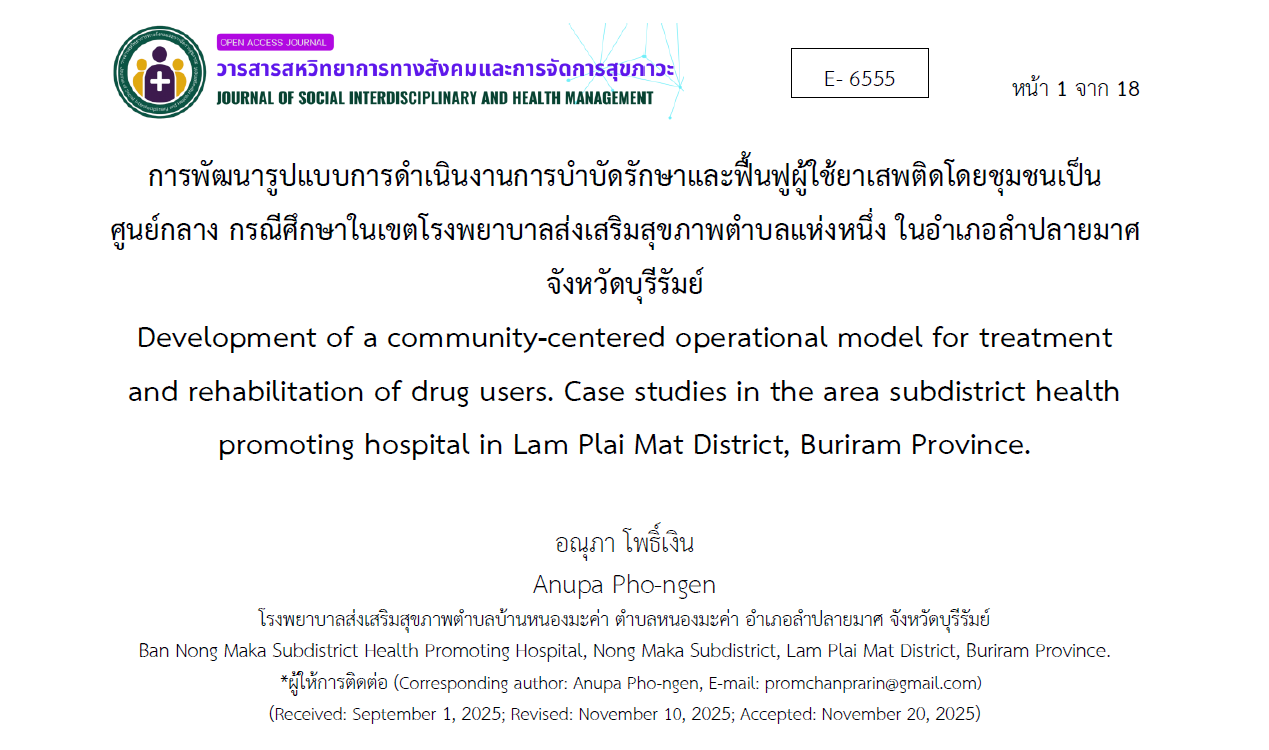
Development of a community-centered operational model for treatment and rehabilitation of drug users. Case studies in the area subdistrict health promoting hospital in Lam Plai Mat District, Buriram Province.
Keywords:
Treatment, Rehabilitation of Drug Users, Community ParticipationAbstract
This participatory action research aimed to study the situation of drug addiction care, develop a community-centered model for drug rehabilitation, and To evaluate the effectiveness of developing a community-centered model for the treatment and rehabilitation of drug users: A case study in a Subdistrict Health Promoting Hospital in Lamplaimat District, Buriram Province. The study involved 45 participants, including 10 voluntary drug users and 35 network partners. The research was conducted from April to September 2025. Research instruments included a drug user screening form,a stress assessment form, a quality of life questionnaire, a rehabilitation attendance record, and a follow-up form. Data were analyzed using descriptive statistics, including frequency distribution, percentage, mean, and standard deviation.
The results revealed that the developed community-based drug rehabilitation model consisted of four main steps: (1) case finding and screening, (2) rehabilitation and treatment, (3) occupational training, and (4) follow-up and support. Ninety percent of participants completed the rehabilitation program. The continuous abstinence rates at one, three, and six months were 80.00%, 66.66%, and 70.00%, respectively. The average stress score decreased from = 12.1, SD = 4.1 to = 7.4, SD = 2.0, while the average quality of life score increased from = 96.13, SD = 11.31 to = 106.0, SD = 7.72
The findings indicate that the community-centered rehabilitation model was effective in helping drug users reduce, abstain from, and eventually quit substance use. It also reduced stress levels and enhanced quality of life. Moreover, the model was consistent with the social and cultural context of the community, emphasizing religious principles, career development, and continuous follow-up. This approach contributed to the sustainable rehabilitation of drug users, enabling them to reintegrate into society as valuable and productive members.
References
กระทรวงสาธารณสุข. (2567). รายงานผลการดำเนินงานการบำบัดรักษาผู้เสพยาเสพติด เขตสุขภาพที่ 9. นนทบุรี.
กรมการแพทย์, กระทรวงสาธารณสุข. (2566). รายงานสถานการณ์ผู้ป่วยยาเสพติดประเทศไทย ปี 2565. นนทบุรี.
กรมสุขภาพจิต. (2551). คู่มือการใช้แบบวัดคุณภาพชีวิต (WHOQOL-BREF-THAI). นนทบุรี: ผู้แต่ง.
กรมสุขภาพจิต. (2553). คู่มือการใช้แบบประเมินความเครียด กรมสุขภาพจิต (DMH Stress Test). นนทบุรี.
นฤมล วัฒนจินดา. (2560). การสร้างและตรวจสอบคุณภาพเครื่องมือวิจัยทางสังคมศาสตร์และพฤติกรรมศาสตร์. กรุงเทพฯ: สำนักพิมพ์แห่งจุฬาลงกรณ์มหาวิทยาลัย.
นุชรีย์ ทองเจิม, และคณะ. (2566). การพัฒนารูปแบบการบำบัดและฟื้นฟูผู้ติดยาเสพติดโดยชุมชนมีส่วนร่วม: การวิจัยเชิงปฏิบัติการแบบมีส่วนร่วม (Participatory Action Research). วารสารวิจัยทางสาธารณสุข, 15(1), 12–26.
บุญชม ศรีสะอาด. (2563). การวิจัยเบื้องต้น (พิมพ์ครั้งที่ 11). กรุงเทพฯ: สุวีริยาสาส์น.
ระบบรายงาน บ.ส.ต. (2567). รายงานผลการคัดกรองผู้ใช้ยาเสพติด เขตสุขภาพที่ 9 ประจำปี 2567. นนทบุรี: กรมสุขภาพจิต กระทรวงสาธารณสุข.
สุกัญญา วัฒนประไพจิตร. (2567). ปัจจัยที่มีผลต่อความสำเร็จของการฟื้นฟูผู้ใช้ยาเสพติดในชุมชนภาคตะวันออกเฉียงเหนือ. วารสารสาธารณสุขชุมชน, 31(2), 45–59.
สำนักงานคณะกรรมการป้องกันและปราบปรามยาเสพติด. (2565). นโยบายและแนวทางการดำเนินงานป้องกันและแก้ไขปัญหายาเสพติด ตามประกาศคณะรักษาความสงบแห่งชาติ เรื่อง “ผู้เสพคือผู้ป่วย ไม่ใช่อาชญากร”. กรุงเทพฯ.
สำนักงานคณะกรรมการป้องกันและปราบปรามยาเสพติด. (2566). รายงานสถานการณ์ยาเสพติดประเทศไทย พ.ศ. 2566. กรุงเทพฯ: ผู้แต่ง.
สำนักงานคณะกรรมการป้องกันและปราบปรามยาเสพติด. (2567). รายงานสถานการณ์ยาเสพติดจังหวัดบุรีรัมย์ ประจำปีงบประมาณ 2567. กรุงเทพฯ.
สุชาติ พงษ์พิพัฒน์. (2561). การสร้างแบบสอบถามและการตรวจสอบคุณภาพเครื่องมือวิจัย. มหาสารคาม: มหาวิทยาลัยมหาสารคาม.
อัครพล คุรุศาสตรา, และจอมขวัญ รุ่งโชติ. (2562). แนวทางการบำบัดฟื้นฟูผู้ติดยาเสพติดโดยชุมชนเป็นศูนย์กลาง: กรณีศึกษาชุมชนวัดบางบัวทอง จังหวัดนนทบุรี. วารสารมนุษยศาสตร์และสังคมศาสตร์ มหาวิทยาลัยราชภัฏนครปฐม, 9(2), 101–115.
Nunnally, J. C. (1978). Psychometric theory (2nd ed.). New York: McGraw-Hill.
World Health Organization. (1996). WHOQOL-BREF: Introduction, administration, scoring and generic version of the assessment. Geneva: WHO.
World Health Organization. (2018). Community-based treatment and care for drug use and dependence: A comprehensive training package. Geneva: WHO.
Downloads
Published
How to Cite
Issue
Section
License
Copyright (c) 2025 Journal of Social Interdisciplinary and Health management

This work is licensed under a Creative Commons Attribution-NonCommercial-NoDerivatives 4.0 International License.
This article is published under a Creative Commons Attribution-NonCommercial-NoDerivatives 4.0 International License (CC BY-NC-ND 4.0), which allows others to share the article with proper attribution to the authors and prohibits commercial use or modification. For any other reuse or republication, permission from the journal and the authors is required.