
The Association Between the Timing of Continuous Positive Airway Pressure Initiation and Clinical Outcomes in Neonates with Respiratory Distress
Keywords:
Continuous positive airway pressure, Neonates, Respiratory distress, CPAP failure, Timing of initiationAbstract
Background: Respiratory distress is a major clinical problem in neonates, and continuous positive airway pressure (CPAP) is widely used as non-invasive respiratory support. However, evidence regarding the association between CPAP initiation timing and treatment failure remains limited.
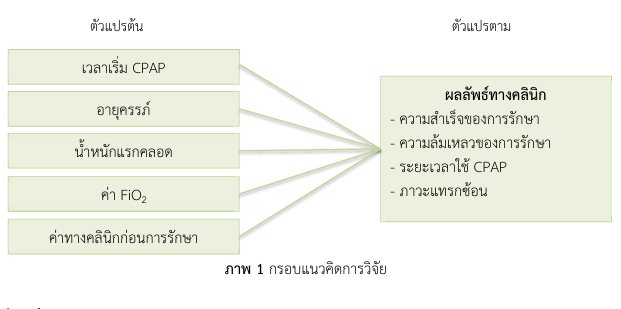
Objective: To examine the association between CPAP initiation timing and CPAP failure, compare clinical parameters before and after CPAP initiation, and identify factors associated with CPAP failure.
Methods: This retrospective analytical cohort study included 120 neonates with respiratory distress who received CPAP at Lang Suan Hospital between 2020 and 2025. CPAP failure was defined as endotracheal intubation for respiratory causes within 72 hours of CPAP initiation. Data were analysed using descriptive statistics, paired t-tests, chi-square tests, and logistic regression.
Results: Of the neonates, 62.5% were preterm, with a mean gestational age of 34.2 ± 3.1 weeks. Within 30–60 minutes after CPAP initiation, respiratory rate and FiO2 decreased, whereas SpO2 increased significantly (p < .001). CPAP treatment was successful in 72.5% of cases and failed in 27.5%. Neonates receiving CPAP within one hour had an 85.0% success rate; however, the overall association between initiation-time categories and treatment outcome was not statistically significant (p = .072). Multivariable analysis showed that each one-week increase in gestational age was associated with lower odds of CPAP failure (aOR = 0.80; 95% CI 0.68–0.95; p = .011). RDS was associated with higher odds of failure (aOR = 3.10; 95% CI 1.05–9.15; p = .040), as was each 0.1 increase in initial FiO2 (aOR = 1.88; 95% CI 1.02–3.46; p = .043). CPAP initiation time analysed continuously was not significantly associated with failure (aOR = 1.16; 95% CI 0.92–1.46; p = .209).
Conclusion: Gestational age, RDS diagnosis, and initial oxygen requirement were associated with CPAP failure, whereas CPAP initiation timing was not significantly associated with failure. Prospective studies are needed to confirm the potential benefit of earlier CPAP initiation.
References
World Health Organization. WHO recommendations for care of the preterm or low birth weight infant. Geneva: WHO; 2022.
World Health Organization. Trends in maternal mortality 2000 to 2023: estimates by WHO, UNICEF, UNFPA, World Bank Group and UNDESA/Population Division. Geneva: WHO; 2025.
Sweet DG, Carnielli VP, Greisen G, Hallman M, Klebermass-Schrehof K, Lavizzari A, et al. European consensus guidelines on the management of respiratory distress syndrome: 2025. Neonatology. 2026;123(4):1-26. doi: 10.1159/000551062.
Department of Health, Ministry of Public Health, Thailand. Annual report on maternal and child health in Thailand. Nonthaburi: Ministry of Public Health; 2023.
Liley HG, Weiner GM, Wyckoff MH, Rabi Y, Schmölzer GM, De Almeida MF, et al. Neonatal life support: 2025 international liaison committee on resuscitation consensus on science with treatment recommendations. Circulation. 2025;152(16 Suppl.1):S165–S204. doi: 10.1161/ CIR.0000000000001363.
Boel L, Hixson T, Brown L, Sage J, Kotecha S, Chakraborty M. Non-invasive respiratory support in preterm infants. Paediatr Respir Rev. 2022; 43:53–9. doi: 10.1016/j.prrv.2022.04.002.
Chandrasekaran A, Deorari AK, Gupta N, Murki S, Sankar MJ, Sivanandan S. Noninvasive respiratory support for newborns. J Neonatol. 2020;34(3):118–52.
Faul F, Erdfelder E, Lang A-G, Buchner A. G*Power 3: a flexible statistical power analysis program for the social, behavioral, and biomedical sciences. Behav Res Methods. 2007;39(2):175–91. doi: 10.3758/bf03193146.
Cohen J. Statistical power analysis for the behavioral sciences. New York: Routledge; 2013.
Srisatidnarakul B. The methodology in nursing research. 5th ed. Bangkok: U & I Inter Media; 2010.
Polit DF, Beck CT. Nursing research: generating and assessing evidence for nursing practice. Philadelphia: Lippincott Williams & Wilkins; 2008.
Tana M, Tirone C, Aurilia C, Lio A, Paladini A, Fattore S, et al. Respiratory management of the preterm infant: supporting evidence-based practice at the bedside. Children. 2023;10(3):535. doi: 10.3390/children10030535.
Hesami R, Sabzehei MK, Basiri B, Solgi MS, Jiryaee N. Predictors of nasal continuous positive airway pressure failure in preterm infants with respiratory distress syndrome. Acta Med Iran. 2024;62(1):35-39. doi: 10.18502/acta.v62i1.16884.
Tourneux P, Debillon T, Flamant C, Jarreau P-H, Serraz B, Guellec I. Early factors associated with continuous positive airway pressure failure in moderate and late preterm infants. Eur J Pediatr. 2023;182(12):5399–407. doi: 10.1007/s00431-023-05090-1.
Fatima K, Zulfiqar S, Farooq A, Aziz M. Outcome of nasal continuous positive airway pressure in neonates: a cross-sectional study. Pak J Med Sci. 2024;40(8):1831-6. doi: 10.12669/pjms. 40.8.8753.
Boix H, Fernández C, Serrano Martín MdM, Arruza L, Concheiro A, Gimeno A, et al. Failure of early non-invasive ventilation in preterm infants with respiratory distress syndrome in current care practice in Spanish level-III neonatal intensive care units: a prospective observational study. Front Pediatr. 2023;11:1098971. doi: 10.3389/fped.2023.1098971.
Downloads
Published
How to Cite
Issue
Section
License
Copyright (c) 2026 Ratchabhiwat Medical Journal

This work is licensed under a Creative Commons Attribution-NonCommercial-NoDerivatives 4.0 International License.
Articles in this journal are copyrighted by the x may be read and used for academic purposes, such as teaching, research, or citation, with proper credit given to the author and the journal.use or modification of the articles is prohibited without permission.
statements expressed in the articles are solely the opinions of the authors.
authors are fully responsible for the content and accuracy of their articles.
other reuse or republication requires permission from the journal."


