
ความสัมพันธ์ระหว่างเวลาเริ่มใช้เครื่องช่วยหายใจแรงดันบวกแบบต่อเนื่องกับผลลัพธ์ทางคลินิกในทารกแรกเกิดที่มีภาวะหายใจลำบาก
คำสำคัญ:
เครื่องช่วยหายใจแรงดันบวกแบบต่อเนื่อง, ทารกแรกเกิด, ภาวะหายใจลำบาก, ความล้มเหลวของ CPAP, เวลาเริ่มการรักษาบทคัดย่อ
ที่มาของปัญหา: ภาวะหายใจลำบากเป็นปัญหาสำคัญในทารกแรกเกิด และการใช้เครื่องช่วยหายใจแรงดันบวกแบบต่อเนื่อง (CPAP) เป็นการช่วยหายใจแบบไม่ลุกล้ำที่ใช้กันอย่างแพร่หลาย อย่างไรก็ตาม หลักฐานเกี่ยวกับความสัมพันธ์ระหว่างเวลาเริ่ม CPAP กับความล้มเหลวของการรักษายังมีจำกัด
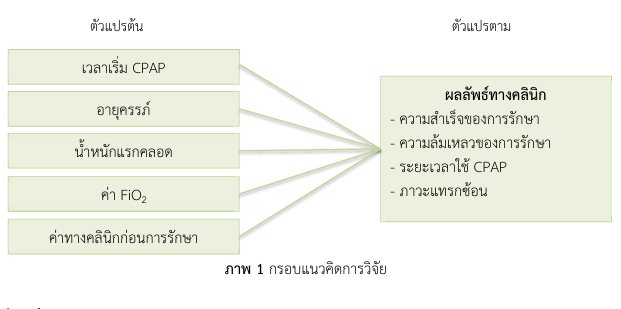
วัตถุประสงค์: เพื่อศึกษาความสัมพันธ์ระหว่างเวลาเริ่ม CPAP กับความล้มเหลวของ CPAP เปรียบเทียบค่าทางคลินิกก่อนและหลังการรักษา และศึกษาปัจจัยที่สัมพันธ์กับ CPAP failure
วิธีการศึกษา: การศึกษาเชิงวิเคราะห์แบบกลุ่มย้อนหลังในทารกแรกเกิดที่มีภาวะหายใจลำบากและได้รับ CPAP ณ โรงพยาบาลหลังสวน ระหว่างปี พ.ศ. 2563–2568 จำนวน 120 ราย กำหนด CPAP failure เป็นการใส่ท่อช่วยหายใจจากสาเหตุทางระบบหายใจภายใน 72 ชั่วโมงหลังเริ่ม CPAP วิเคราะห์ข้อมูลด้วยสถิติเชิงพรรณนา Paired t-test, Chi-square test และ Logistic regression
ผลการศึกษา: กลุ่มตัวอย่างร้อยละ 62.5 เป็นทารกคลอดก่อนกำหนด อายุครรภ์เฉลี่ย 34.2 ± 3.1 สัปดาห์ ภายใน 30–60 นาทีหลังเริ่ม CPAP อัตราการหายใจและ FiO2 ลดลง และ SpO2 เพิ่มขึ้นอย่างมีนัยสำคัญทางสถิติ (p < .001) การรักษาสำเร็จร้อยละ 72.5 และเกิด CPAP failure ร้อยละ 27.5 กลุ่มที่เริ่ม CPAP ภายใน 1 ชั่วโมงมีอัตราความสำเร็จร้อยละ 85.0 แต่ความสัมพันธ์โดยรวมระหว่างช่วงเวลาเริ่ม CPAP กับผลการรักษาไม่มีนัยสำคัญทางสถิติ (p = .072) การวิเคราะห์พหุตัวแปรพบว่าอายุครรภ์ที่เพิ่มขึ้นสัมพันธ์กับโอกาสเกิด CPAP failure ที่ลดลง (aOR = 0.80; 95% CI 0.68–0.95; p = .011) ขณะที่ RDS (aOR = 3.10; 95% CI 1.05–9.15; p = .040) และ FiO2 ขณะเริ่ม CPAP ที่เพิ่มขึ้นทุก 0.1 (aOR = 1.88; 95% CI 1.02–3.46; p = .043) สัมพันธ์กับโอกาสเกิด CPAP failure ที่สูงขึ้น ส่วนเวลาเริ่ม CPAP ไม่พบความสัมพันธ์อย่างมีนัยสำคัญทางสถิติ (aOR = 1.16; 95% CI 0.92–1.46; p = .209)
สรุป: อายุครรภ์ การวินิจฉัย RDS และความต้องการออกซิเจนขณะเริ่ม CPAP เป็นปัจจัยที่สัมพันธ์กับ CPAP failure ขณะที่เวลาเริ่ม CPAP ยังไม่พบความสัมพันธ์อย่างมีนัยสำคัญทางสถิติ
เอกสารอ้างอิง
World Health Organization. WHO recommendations for care of the preterm or low birth weight infant. Geneva: WHO; 2022.
World Health Organization. Trends in maternal mortality 2000 to 2023: estimates by WHO, UNICEF, UNFPA, World Bank Group and UNDESA/Population Division. Geneva: WHO; 2025.
Sweet DG, Carnielli VP, Greisen G, Hallman M, Klebermass-Schrehof K, Lavizzari A, et al. European consensus guidelines on the management of respiratory distress syndrome: 2025. Neonatology. 2026;123(4):1-26. doi: 10.1159/000551062.
Department of Health, Ministry of Public Health, Thailand. Annual report on maternal and child health in Thailand. Nonthaburi: Ministry of Public Health; 2023.
Liley HG, Weiner GM, Wyckoff MH, Rabi Y, Schmölzer GM, De Almeida MF, et al. Neonatal life support: 2025 international liaison committee on resuscitation consensus on science with treatment recommendations. Circulation. 2025;152(16 Suppl.1):S165–S204. doi: 10.1161/ CIR.0000000000001363.
Boel L, Hixson T, Brown L, Sage J, Kotecha S, Chakraborty M. Non-invasive respiratory support in preterm infants. Paediatr Respir Rev. 2022; 43:53–9. doi: 10.1016/j.prrv.2022.04.002.
Chandrasekaran A, Deorari AK, Gupta N, Murki S, Sankar MJ, Sivanandan S. Noninvasive respiratory support for newborns. J Neonatol. 2020;34(3):118–52.
Faul F, Erdfelder E, Lang A-G, Buchner A. G*Power 3: a flexible statistical power analysis program for the social, behavioral, and biomedical sciences. Behav Res Methods. 2007;39(2):175–91. doi: 10.3758/bf03193146.
Cohen J. Statistical power analysis for the behavioral sciences. New York: Routledge; 2013.
Srisatidnarakul B. The methodology in nursing research. 5th ed. Bangkok: U & I Inter Media; 2010.
Polit DF, Beck CT. Nursing research: generating and assessing evidence for nursing practice. Philadelphia: Lippincott Williams & Wilkins; 2008.
Tana M, Tirone C, Aurilia C, Lio A, Paladini A, Fattore S, et al. Respiratory management of the preterm infant: supporting evidence-based practice at the bedside. Children. 2023;10(3):535. doi: 10.3390/children10030535.
Hesami R, Sabzehei MK, Basiri B, Solgi MS, Jiryaee N. Predictors of nasal continuous positive airway pressure failure in preterm infants with respiratory distress syndrome. Acta Med Iran. 2024;62(1):35-39. doi: 10.18502/acta.v62i1.16884.
Tourneux P, Debillon T, Flamant C, Jarreau P-H, Serraz B, Guellec I. Early factors associated with continuous positive airway pressure failure in moderate and late preterm infants. Eur J Pediatr. 2023;182(12):5399–407. doi: 10.1007/s00431-023-05090-1.
Fatima K, Zulfiqar S, Farooq A, Aziz M. Outcome of nasal continuous positive airway pressure in neonates: a cross-sectional study. Pak J Med Sci. 2024;40(8):1831-6. doi: 10.12669/pjms. 40.8.8753.
Boix H, Fernández C, Serrano Martín MdM, Arruza L, Concheiro A, Gimeno A, et al. Failure of early non-invasive ventilation in preterm infants with respiratory distress syndrome in current care practice in Spanish level-III neonatal intensive care units: a prospective observational study. Front Pediatr. 2023;11:1098971. doi: 10.3389/fped.2023.1098971.
ดาวน์โหลด
เผยแพร่แล้ว
รูปแบบการอ้างอิง
ฉบับ
ประเภทบทความ
สัญญาอนุญาต
ลิขสิทธิ์ (c) 2026 ราชภิวัฒน์เวชสาร

อนุญาตภายใต้เงื่อนไข Creative Commons Attribution-NonCommercial-NoDerivatives 4.0 International License.
Articles in this journal are copyrighted by the x may be read and used for academic purposes, such as teaching, research, or citation, with proper credit given to the author and the journal.use or modification of the articles is prohibited without permission.
statements expressed in the articles are solely the opinions of the authors.
authors are fully responsible for the content and accuracy of their articles.
other reuse or republication requires permission from the journal."


