
Efficacy of Endovascular Treatment Versus Surgical Clipping for Rupture Intracranial Aneurysms
Keywords:
Ruptured intracranial aneurysm, endovascular treatment, surgical clipping, functional outcome, survival analysisAbstract
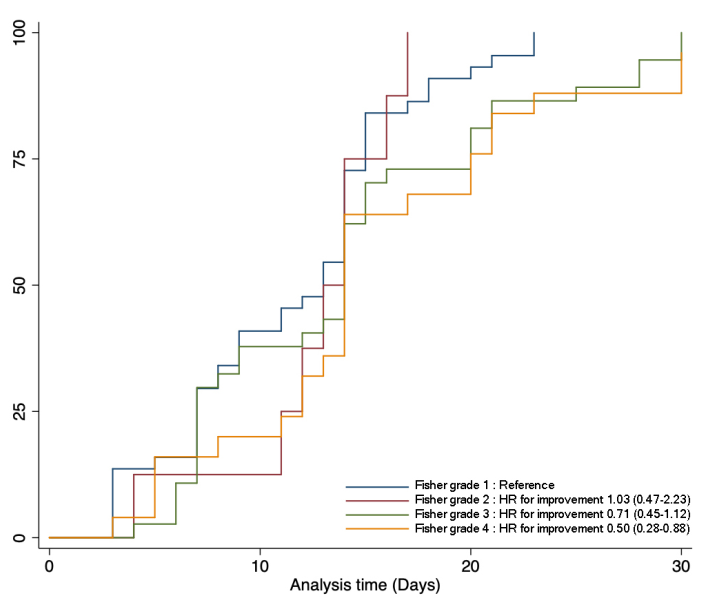
Background: Treatment options for intracranial aneurysms include surgical clipping and endovascular techniques such as coiling, stenting, and flow diversion. While clipping has been the traditional standard, it is associated with greater morbidity, whereas endovascular methods provide favorable perioperative outcomes but raise concerns regarding long-term durability. This study compares outcomes of these two modalities in ruptured intracranial aneurysms. Methods: A retrospective cohort study was conducted at Udonthani Hospital, Thailand, including 114 patients treated for ruptured intracranial aneurysms between 2022 and 2024. Patients were divided into surgical clipping (n=43) and endovascular treatment (n=71). Survival, perioperative factors, complications, and one-month functional outcomes were analyzed using Kaplan-Meier survival analysis and logistic regression. Results: Endovascular treatment showed superior one-month survival (91.55% vs. 58.14%, P<0.001) and better functional recovery (median mRS 1 [0–3] vs. 3 [1–4], P = 0.019). Clipping required longer operative time (170 ± 37.8 vs. 73.14 ± 30.77 minutes, P < 0.001) and higher blood loss (350 mL vs. 30 mL, P<0.001). Complication rates, including infarction, vasospasm, and hemorrhage, were comparable. Poorer outcomes correlated with higher Fisher grades, particularly grade 4. Logistic regression confirmed endovascular treatment as an independent predictor of favorable outcome (OR 1.38, P=0.019). Conclusions: Endovascular therapy provides better short-term survival and functional outcomes than surgical clipping for ruptured intracranial aneurysms, supporting its role as a preferred first-line approach in appropriate patients. Prospective studies are needed to evaluate long-term results and optimize treatment strategies.
Downloads
References
Molyneux AJ, Kerr RS, Yu LM, Clarke M, Sneade M, Yarnold JA, et al. International subarachnoid aneurysm trial (ISAT) of neurosurgical clipping versus endovascular coiling in 2143 patients with ruptured intracranial aneurysms: a randomised comparison of effects on survival, dependency, seizures, rebleeding, subgroups, and aneurysm occlusion. Lancet. 2005;366(9488):809-17. https://doi.org/10.1016/S0140-6736(05)67214-5. PMID: 16139655 PMCID: PMC9694826
Anxionnat R, Tonnelet R, Derelle AL, Liao L, Barbier C, Bracard S. Endovascular treatment of ruptured intracranial aneurysms: Indications, techniques and results. Diagn Interv Imaging. 2015;96(7-8):667-75. https://doi.org/10.1016/j.diii.2015.06.002. PMID: 26160704
Ogilvy CS, Crowell RM, Heros RC. Surgical management of middle cerebral artery aneurysms: experience with transsylvian and superior temporal gyrus approaches. Surg Neurol. 1995;43(1):15-22. https://doi.org/10.1016/0090-3019(95)80032-C. PMID: 7701417
Lv X, Ge H, Jin H, He H, Jiang C, Li Y. Endovascular treatment of unruptured posterior circulation intracranial aneurysms. Ann Indian Acad Neurol. 2016;19(3):302-6. https://doi.org/10.4103/0972-2327.186784. PMID: 27570378 PMCID: PMC4980949
Ries T, Siemonsen S, Thomalla G, Grzyska U, Zeumer H, Fiehler J. Long-term follow-up of cerebral aneurysms after endovascular therapy prediction and outcome of retreatment. AJNR Am J Neuroradiol. 2007;28(9):1755-61. https://doi.org/10.3174/ajnr.A0649. PMID: 17885238 PMCID: PMC8134224
Pyysalo LM, Keski-Nisula LH, Niskakangas TT, Kähärä VJ, Ohman JE. Long-term follow-up study of endovascularly treated intracranial aneurysms. Interv Neuroradiol. 2010;16(4):361-8. https://doi.org/10.1177/159101991001600402. PMID: 21162766 PMCID: PMC3278008
Sonobe M, Yamazaki T, Yonekura M, Kikuchi H. Small unruptured intracranial aneurysm verification study: SUAVe study, Japan. Stroke. 2010;41(9):1969-77. https://doi.org/10.1161/STROKEAHA.110.585059. PMID: 20671254
Taheri Z, Harirchian MH, Ghanaati H, Khoshnevisan A, Salamati P, Miri M, et al. Comparison of endovascular coiling and surgical clipping for the treatment of intracranial aneurysms: A prospective study. Iran J Neurol. 2015;14(1):22-8.
Adamou A, Alexandrou M, Roth C, Chatziioannou A, Papanagiotou P. Endovascular Treatment of Intracranial Aneurysms. Life (Basel). 2021;11(4):335. https://doi.org/10.3390/life11040335. PMID: 33920264 PMCID: PMC8070180
Hulscher F, Mine B, Elens S, Bonnet T, Suarez JV, Lubicz B. Endovascular Treatment of Patients with Ruptured Intracranial Aneurysms: A Series of 468 Patients Treated Over a 14-Year Period. J Belg Soc Radiol. 2022;106(1):11. https://doi.org/10.5334/jbsr.2550. PMID: 35434517 PMCID: PMC8973758
Rinkel GJ, Algra A. Long-term outcomes of patients with aneurysmal subarachnoid haemorrhage. Lancet Neurol. 2011;10(4):349-56. https://doi.org/10.1016/S1474-4422(11)70017-5. PMID: 21435599
Tollard É, Darsaut TE, Bing F, Guilbert F, Gevry G, Raymond J. Outcomes of endovascular treatments of aneurysms: observer variability and implications for interpreting case series and planning randomized trials. AJNR Am J Neuroradiol. 2012;33(4):626-31. https://doi.org/10.3174/ajnr.A2848. PMID: 22194386 PMCID: PMC8050430
Ruan C, Long H, Sun H, He M, Yang K, Zhang H, et al. Endovascular coiling vs. surgical clipping for unruptured intracranial aneurysm: A meta-analysis. Br J Neurosurg. 2015;29(4):485-92. https://doi.org/10.3109/02688697.2015.1023771. PMID: 26037936
Roquer J, Cuadrado-Godia E, Guimaraens L, Conesa G, Rodríguez-Campello A, Capellades J, et al. Short- and long-term outcome of patients with aneurysmal subarachnoid hemorrhage. Neurology. 2020;95(13):e1819-e1829. https://doi.org/10.1212/WNL.0000000000010618. PMID: 32796129 PMCID: PMC7682825
Li H, Pan R, Wang H, Rong X, Yin Z, Milgrom DP, et al. Clipping versus coiling for ruptured intracranial aneurysms: a systematic review and meta-analysis. Stroke. 2013;44(1):29-37. https://doi.org/10.1161/STROKEAHA.112.663559. PMID: 23238862
Duangprasert G, Noiphitak R, Yindeedej V, Tantongtip D. Treatment Outcome of Ruptured Intracranial Aneurysms: A Retrospective Comparison Study, Clipping Versus Coiling. J Med Assoc Thai. 2022;105(1). https://doi.org/10.35755/jmedassocthai.2022.01.13226.
Park J, Woo H, Kang DH, Kim YS, Kim MY, Shin IH, et al. Formal protocol for emergency treatment of ruptured intracranial aneurysms to reduce in-hospital rebleeding and improve clinical outcomes. J Neurosurg. 2015;122(2):383-91. https://doi.org/10.3171/2014.9.JNS131784. PMID: 25403841
Sasidharan GM, Sastri SB, Pandey P. Aneurysm clips: what every resident should know. Neurol India. 2015;63(1):96-100. https://doi.org/10.4103/0028-3886.152666. PMID: 25751477
Deshmukh AS, Priola SM, Katsanos AH, Scalia G, Costa Alves A, Srivastava A, et al. The Management of Intracranial Aneurysms: Current Trends and Future Directions. Neurol Int. 2024;16(1):74-94. https://doi.org/10.3390/neurolint16010005. PMID: 38251053 PMCID: PMC10801587
Tjoumakaris SI, Hanel R, Mocco J, Ali-Aziz Sultan M, Froehler M, Lieber BB, et al. ARISE I Consensus Review on the Management of Intracranial Aneurysms. Stroke. 2024;55(5):1428-37. https://doi.org/10.1161/STROKEAHA.123.046208. PMID: 38648283
Rinkel GJE, Ruigrok YM, Krings T, Etminan N, Vergouwen MDI. Advances in screening and management of unruptured intracranial aneurysms. Lancet Neurol. 2025;24(11):958-68. https://doi.org/10.1016/S1474-4422(25)00265-0. PMID: 41109236
Rice-Canetto TE, Ueno A, Whitney E, Reier L, Houston R, Siddiqi J. A Review of the Current Literature on Cerebral Aneurysms. Cureus. 2025;17(3):e80223. https://doi.org/10.7759/cureus.80223.
Ding D. Endovascular Management of Intracranial Aneurysms: Advances in Stenting Techniques and Technology. J Cerebrovasc Endovasc Neurosurg. 2015;17(4):331-3. https://doi.org/10.7461/jcen.2015.17.4.331. PMID: 27066443 PMCID: PMC4823431
Brilstra EH, Rinkel GJ, van der Graaf Y, van Rooij WJ, Algra A. Treatment of intracranial aneurysms by embolization with coils: a systematic review. Stroke. 1999;30(2):470-6. https://doi.org/10.1161/01.STR.30.2.470. PMID: 9933290
Britz GW. ISAT trial: coiling or clipping for intracranial aneurysms? Lancet. 2005;366(9488):783-5. https://doi.org/10.1016/S0140-6736(05)67190-5. PMID: 16139637
Lempert TE, Malek AM, Halbach VV, Phatouros CC, Meyers PM, Dowd CF, et al. Endovascular treatment of ruptured posterior circulation cerebral aneurysms. Clinical and angiographic outcomes. Stroke. 2000;31(1):100-10. https://doi.org/10.1161/01.STR.31.1.100. PMID: 10625723
Peng F, Feng X, Tong X, Zhang B, Wang L, Guo E, et al. Endovascular Treatment of Small Ruptured Intracranial Aneurysms (<5 mm) : Long-term Clinical and Angiographic Outcomes and Related Predictors. Clin Neuroradiol. 2020;30(4):817-26. https://doi.org/10.1007/s00062-019-00835-8. PMID: 31696281 PMCID: PMC7728636
Sedat J, Dib M, Lonjon M, Litrico S, Von Langsdorf D, Fontaine D, et al. Endovascular treatment of ruptured intracranial aneurysms in patients aged 65 years and older: follow-up of 52 patients after 1 year. Stroke. 2002;33(11):2620-5. https://doi.org/10.1161/01.STR.0000034788.70971.14. PMID: 12411651
Sukun A, Cetin M, Alparslan A, Uyar R, Gediz T, Cekic B, et al. Mortality Outcomes of Endovascular Treatment and Surgical Clipping in Patients with Cerebral Aneurysms: A Single-Center Study. Turk Neurosurg. 2022;32(2):221-7. https://doi.org/10.5137/1019-5149.JTN.33877-21.2. PMID: 34751422
Spetzler RF, McDougall CG, Zabramski JM, Albuquerque FC, Hills NK, Russin JJ, et al. The Barrow Ruptured Aneurysm Trial: 6-year results. J Neurosurg. 2015;123(3):609-17. https://doi.org/10.3171/2014.9.JNS141749. PMID: 26115467
Lanzino G, Murad MH, d'Urso PI, Rabinstein AA. Coil embolization versus clipping for ruptured intracranial aneurysms: a meta-analysis of prospective controlled published studies. AJNR Am J Neuroradiol. 2013;34(9):1764-8. https://doi.org/10.3174/ajnr.A3515. PMID: 23578672 PMCID: PMC7965621
Peng C, Diao YH, Cai SF, Yang XY. Endovascular coiling versus microsurgical clipping for ruptured intracranial aneurysms: a meta-analysis and systematic review. Chin Neurosurg J. 2022;8(1):17. https://doi.org/10.1186/s41016-022-00283-3. PMID: 35879784 PMCID: PMC9310462
Claassen J, Bernardini GL, Kreiter K, Bates J, Du YE, Copeland D, et al. Effect of cisternal and ventricular blood on risk of delayed cerebral ischemia after subarachnoid hemorrhage: the Fisher scale revisited. Stroke. 2001;32(9):2012-20. https://doi.org/10.1161/hs0901.095677. PMID: 11546890
Findlay JM, Nisar J, Darsaut T. Cerebral Vasospasm: A Review. Can J Neurol Sci. 2016;43(1):15-32. https://doi.org/10.1017/cjn.2015.288. PMID: 26332908
Van Gijn J, Kerr RS, Rinkel GJ. Subarachnoid haemorrhage. Lancet. 2007;369(9558):306-18. https://doi.org/10.1016/S0140-6736(07)60153-6. PMID: 17258671
Fatania K, Patankar DT. Comprehensive review of the recent advances in devices for endovascular treatment of complex brain aneurysms. Br J Radiol. 2022;95(1129):20210538. https://doi.org/10.1259/bjr.20210538. PMID: 34609898 PMCID: PMC8722252
Downloads
Published
How to Cite
Issue
Section
License
Copyright (c) 2026 Thai Journal of Neurological Surgery

This work is licensed under a Creative Commons Attribution-NonCommercial-NoDerivatives 4.0 International License.
Articles in this journal are copyrighted by the x may be read and used for academic purposes, such as teaching, research, or citation, with proper credit given to the author and the journal.use or modification of the articles is prohibited without permission.
statements expressed in the articles are solely the opinions of the authors.
authors are fully responsible for the content and accuracy of their articles.
other reuse or republication requires permission from the journal."


