
Characteristics of Blunt Cerebrovascular Injury in Khon Kaen Hospital: A Descriptive Study
Keywords:
multiple trauma, blunt cerebrovascular injury, traumatic brain injuryAbstract
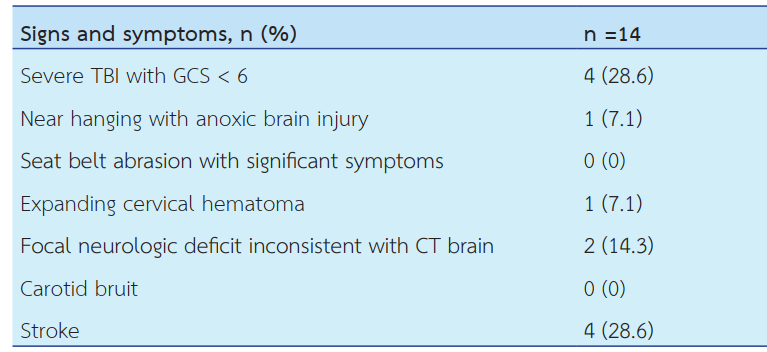
Background: Evidence on blunt cerebrovascular injury (BCVI) remains limited. This study aimed to describe the characteristics of BCVI in a tertiary care referral hospital and trauma center in northeastern Thailand. Methods: This retrospective descriptive study was conducted in the trauma ward and trauma intensive care unit (TICU) at Khon Kaen Hospital from 2020 to 2025. The eligible criteria were the patients sustained blunt trauma and were diagnosed BCVI by computed tomography of 4 vessels of the neck (CTA neck). Baseline data were recorded, including injury characteristics, clinical signs symptoms, and risk factors following standard screening criteria including Denver and Memphis group. Potential endpoints including mortality and in-hospital stroke were also collected. Results: A total of 14 patients were included in this study. Most were male 71.4%. The mean age was 47.9±17.5 years. The mean injury severity score (ISS) was 18.9±7.0. The potential parameters for BCVI were severe TBI with GCS < 6 (28.6%) and stroke as a primary presentation (28.6%). Relevant CT findings suggestive of BCVI were cervical spine fracture (42.9%) and complex skull fracture, respectively (28.6%). Most of the patients were presented with total occlusion (grade 4) BCVI with prevalence of 42.9%. The locations of BCVI were equal between common carotid and vertebral arteries. There were 3 (21.4%) patients with in-hospital stroke and 28.6% in-hospital mortality. Median hospital cost was 96,884.5 [45,090.5, 268,775.5] baht. Conclusion: BCVI was prevalent in tertiary care referral hospital and trauma center. Serious in-hospital complications especially stroke and death were not uncommon. The best way to prevent complications is early detection with high index of suspicious.
Downloads
References
Parks NA, Croce MA. Use of Computed Tomography in the Emergency Room to Evaluate Blunt Cerebrovascular Injury. Adv Surg. 2012 Sep 1;Advances in Surgery46(1):205–17. https://doi.org/10.1016/j.yasu.2012.03.003
Tunthanathip T, Phuenpathom N, Saehaeng S, Oearsakul T, Sakarunchai I, Kaewborisutsakul A. Traumatic cerebrovascular injury: Prevalence and risk factors. Am J Emerg Med. 2020 Feb 1;38(2):182–6. https://doi.org/10.1016/j.ajem.2019.01.055
Shahan CP, Stavely TC, Croce MA, Fabian TC, Magnotti LJ. Long-Term Functional Outcomes after Blunt Cerebrovascular Injury: A 20-Year Experience. Am Surg. 2018 Apr 1;84(4):551–6. PMID: 29712605.
Azad TD, Raj D, Ahmed K, Ran K, Materi J, Dardick J, et al. Predictors of Blunt Cerebrovascular Injury, Stroke, and Mortality in Patients with Cervical Spine Trauma. World Neurosurg. 2023 Jan 1;169:e251–9. https://doi.org/10.1016/j.wneu.2022.10.120
Kenney K, Amyot F, Haber M, Pronger A, Bogoslovsky T, Moore C, et al. Cerebral Vascular Injury in Traumatic Brain Injury. Exp Neurol. 2016 Jan 1;Traumatic Brain Injury275:353–66. https://doi.org/10.1016/j.expneurol.2015.05.019
Suzuki H, Funaba M, Imajo Y, Yokogawa N, Sasagawa T, Ando K, et al. Blunt Cerebrovascular Injury in the Elderly With Traumatic Cervical Spine Injuries: Results of a Retrospective Multi-Center Study of 1512 Cases in Japan. J Neurotrauma. 2023 Jun;40(11–12):1164–72. https://doi.org/10.1089/neu.2022.0180 PMID: 36719766; PMCID: PMC10259607.
Kim DY, Biffl W, Bokhari F, Brakenridge S, Chao E, Claridge JA, et al. Evaluation and management of blunt cerebrovascular injury: A practice management guideline from the Eastern Association for the Surgery of Trauma. J Trauma Acute Care Surg. 2020 Jun;88(6):875. https://doi.org/10.1097/TA.0000000000002668
Schauer SG, April MD, Fisher AD, Rizzo JA. Blunt Cerebrovascular Injury in Trauma—Fixed or Modifiable Risk Factor for Stroke? J Surg Res. 2026;317:167–72. https://doi.org/10.1016/j.jss.2025.11.029
Stanislaus V, Zhang WW, Chen Z, Richardson TE, Ng N, Picker B, et al. Inpatient stroke outcomes in patients with blunt cerebrovascular injuries according to risk factors and treatment. Trauma U K. 2025;27(4):317–23. https://doi.org/10.1177/14604086251333569
Bensch FV, Varjonen EA, Pyhältö TT, Koskinen SK. Augmenting Denver criteria yields increased BCVI detection, with screening showing markedly increased risk for subsequent ischemic stroke. Emerg Radiol. 2019 Aug;26(4): 365–72.https://doi.org/10.1007/s10140-019-01677-0 PMID: 30756247; PMCID: PMC6647420.
Ciapetti M, Circelli A, Zagli G, Migliaccio ML, Spina R, Alessi A, et al. Diagnosis of carotid arterial injury in major trauma using a modification of Memphis criteria. Scand J Trauma Resusc Emerg Med. 2010 Nov 22;18:61. https://doi.org/10.1186/1757-7241-18-61 PMID: 21092211; PMCID: PMC2998450.
Hopkins B, Wang A, McKendy K, Deckelbaum D, Fata P, Khwaja K, et al. A Retrospective Analysis of the Clinical Use and Utility of Advanced Imaging in the Evaluation of Near-Hanging and Strangulation Injuries at a Canadian Level One Trauma Centre. Injury. 2023 Oct;54(10):110978. https://doi.org/10.1016/j.injury.2023.110978 PMID: 37599191.
Biffl WL, Ray CE, Moore EE, Franciose RJ, Aly S, HeyrosaMG,etal.Treatment-RelatedOutcomes From Blunt Cerebrovascular Injuries. Ann Surg. 2002 May;235(5):699–707. https://doi.org/10.1097/00000658-200205000-00012 PMID: 11981216; PMCID: PMC 1422496.
Hwang PYK, Lewis PM, Balasubramani YV, Madan A, Rosenfeld JV. The epidemiology of BCVI at a single state trauma centre. Injury. 2010 Sep 1;41(9):929–34. https://doi.org/10.1016/j.injury.2010.03.006
Wu X, Malhotra A, Forman HP, Nunez D, Sanelli P. The Use of High-Risk Criteria in Screening Patients for Blunt Cerebrovascular Injury: A Survey. Acad Radiol. 2017 Apr 1;24(4):456–61. https://doi.org/10.1016/j.acra.2016.11.010
Black JA, Abraham PJ, Abraham MN, Cox DB, Griffin RL, Holcomb JB, et al. Universal screening for blunt cerebrovascular injury. J Trauma Acute Care Surg. 2021 Feb 1;90(2):224–31. https://doi.org/10.1097/TA.0000000000003010 PMID: 33502144.
Müther M, Sporns PB, Hanning U, Düsing H, Hartensuer R, Raschke M, et al. Diagnostic accuracy of different clinical screening criteria for blunt cerebrovascular injuries compared with liberal state of the art computed tomography angiography in major trauma. J Trauma Acute Care Surg. 2020 Jun;88(6):789. https://doi.org/10.1097/TA.0000000000002682
Abraham PJ, Black JA, Griffin RL, Abraham MN, Liptrap EJ, Thaci B, et al. Imaging analysis of ischemic strokes due to blunt cerebrovascular injury. J Trauma Acute Care Surg. 2022 Jun1;92 (6):990–6. https://doi.org/10.1097/A.0000000000003522 PMID: 35067527.
Mitra B, Ruggles T, Seah J, Miller C, Fitzgerald MC. Delayed intracranial hemorrhage after trauma. Brain Inj. 2021 Mar 21;35(4):484–9. https://doi.org/10.1080/02699052.2021.1887520 PMID: 33606557.
Rutherford’s Vascular Surgery and Endovascular Therapy, 2-Volume Set: 9780323427913: Medicine & Health Science Books @ Amazon.com [Internet]. [cited 2022 Jan 9]. Available from: https://www.amazon.com/RutherfordsVascular-Surgery-Endovascular-Therapy/dp/032342791X
Li A, Durr K, Fernando SM, Rochwerg B, Inaba K, Biffl WL, et al. Rates of healing and timing of repeat imaging after blunt cerebrovascular injury: A systematic review and meta-analysis. J Trauma Acute Care Surg. 2025 Oct;99(4):643. https://doi.org/10.1097/TA.0000000000004748
Asaadi S, Rosenthal MG, Radulescu A, Mukherjee K, Luo-Owen X, Dubose JJ, et al. Pediatric Versus Adult Blunt Cerebrovascular Injuries: Patients Characteristics, Management, and Outcomes. Ann Vasc Surg. 2025;116:1–8. https://doi.org/10.1016/j.avsg.2025.02.016
Casado-Ruiz J, Castaño-Leon AM, García-Escudero L, Huerta-Carrascosa M, Vidal-Terrancle M, Lagares A. Transition from classic to expanded Denver screening criteria for blunt cerebrovascular injury: lessons from a high-volume level I trauma center. J Neurosurg. 2025;143(2): 461–71. https://doi.org/10.3171/2024.12.JNS241294
Downloads
Published
How to Cite
Issue
Section
License
Copyright (c) 2026 Thai Journal of Neurological Surgery

This work is licensed under a Creative Commons Attribution-NonCommercial-NoDerivatives 4.0 International License.
Articles in this journal are copyrighted by the x may be read and used for academic purposes, such as teaching, research, or citation, with proper credit given to the author and the journal.use or modification of the articles is prohibited without permission.
statements expressed in the articles are solely the opinions of the authors.
authors are fully responsible for the content and accuracy of their articles.
other reuse or republication requires permission from the journal."


