
Cerebral hyperperfusion syndrome after STA-MCA bypass in moyamoya disease
Keywords:
Cerebral hyperperfusion syndrome, STA-MCA bypass, Direct bypass, Moyamoya disease, Intracranial Internal carotid artery stenosAbstract
Moyamoya disease (MMD) is a condition characterized by stenosis or occlusion of the internal carotid artery (ICA) at its bifurcation into the middle cerebral artery (MCA) and anterior cerebral artery (ACA). Patients may present with either cerebral ischemia or intracranial hemorrhage. The current standard treatment is cerebral revascularization surgery using direct bypass between the superficial temporal artery (STA) and the middle cerebral artery (MCA), often combined with indirect bypass procedures.One of the major complications of direct bypass surgery is cerebral hyperperfusion syndrome (CHS), which results from excessive cerebral blood flow following the operation. Clinical manifestations may occur immediately after surgery and include headache, seizures, neurological deficits, or altered consciousness. At present, there are still no clearly established guidelines for the diagnosis and management of CHS. Therefore, the authors reviewed the clinical manifestations, risk factors, diagnostic approaches, treatment, and prevention strategies of CHS in this article.
Downloads
References
Okada Y, Kawamata T, Kawashima A, Yamaguchi K, Ono Y, Hori T. The efficacy of superficial temporal artery-middle cerebral artery anastomosis in patients with moyamoya disease complaining of severe headache: clinical article. J Neurosurg. 2012;116(3):672-9. https://doi.org/10.3171/2011.11.JNS11944
Zhao WG, Luo Q, Jia JB, Yu JL. Cerebral hyperperfusion syndrome after revascularization surgery in patients with moyamoya disease. Br J Neurosurg. 2013;27(3):321-5. https://doi.org/10.3109/02688697.2012.757294
Suzuki J, Kodama N. Moyamoya disease--a review. Stroke. 1983;14(1):104-9. https://doi.org/10.1161/01.STR.14.1.104
Dusick JR, Gonzalez NR, Martin NA. Clinical and angiographic outcomes from indirect revascularization surgery for moyamoya disease in adults and children: a review of 63 procedures. Neurosurgery. 2011;68(1):34-43. https://doi.org/10.1227/NEU.0b013e3181fc5ec2
Houkin K, Kamiyama H, Abe H, Takahashi A, Kuroda S. Surgical therapy for adult moyamoya disease. Stroke. 1996;27(8):1342-6. https://doi.org/10.1161/01.STR.27.8.1342
Patel NN, Mangano FT, Klimo P Jr. Indirect revascularization techniques for treating moyamoya disease. Neurosurg Clin N Am. 2010;21(3):553-63. https://doi.org/10.1016/j.nec.2010.03.008
Baaj AA, Agazzi S, Sayed ZA, Toledo M, Spetzler RF, van Loveren H. Surgical management of moyamoya disease: a review. Neurosurg Focus. 2009;26(4):E7. https://doi.org/10.3171/2009.01.FOCUS08293
Kim T, Oh CW, Bang JS, Kim JE, Cho WS. Moyamoya disease: treatment and outcomes. J Stroke. 2016;18(1):21-30. https://doi.org/10.5853/jos.2015.01739
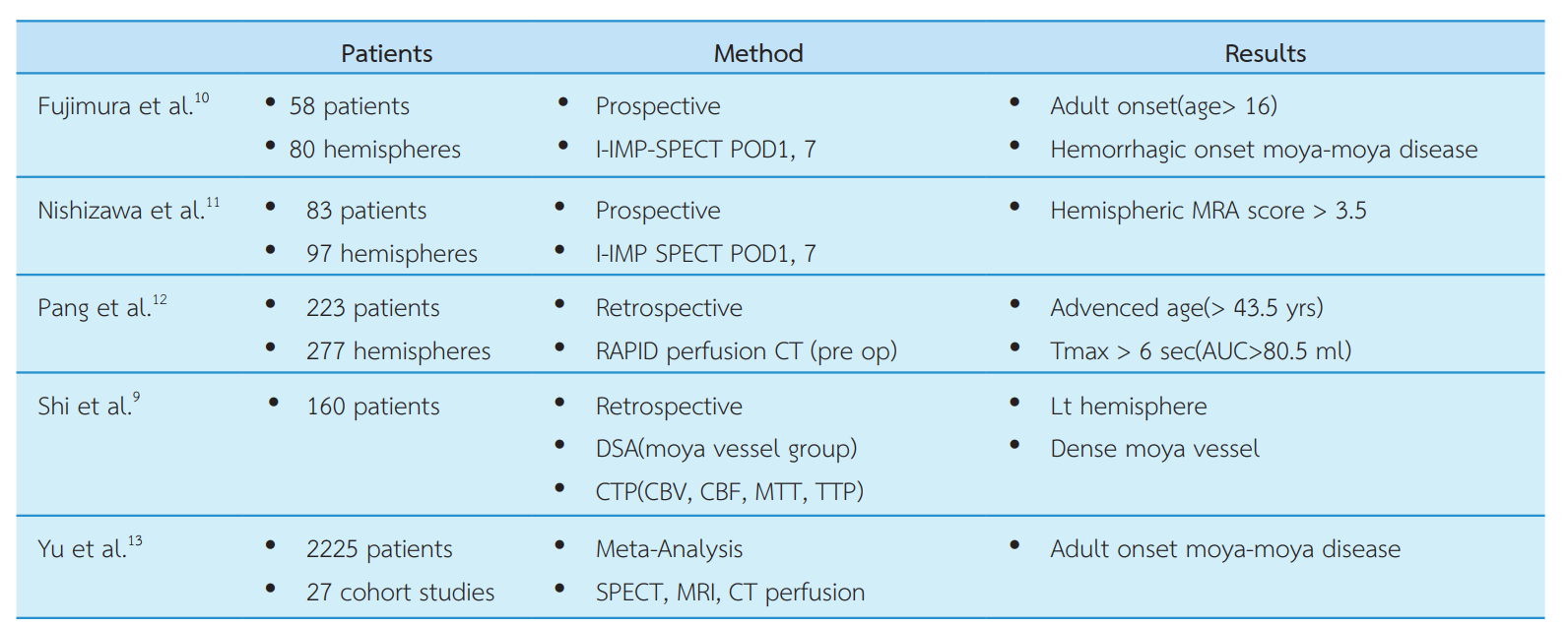
Shi Z, Wu L, Wang Y, Zhang H, Yang Y, Hang C. Risk factors of postoperative cerebral hyperperfusion syndrome and its relationship with clinical prognosis in adult patients with moyamoya disease. Chin Neurosurg J. 2023;9(1):10. https://doi.org/10.1186/s41016-023-00321-8
Fujimura M, Mugikura S, Kaneta T, Shimizu H, Tominaga T. Incidence and risk factors for symptomatic cerebral hyperperfusion after superficial temporal artery-middle cerebral artery anastomosis in patients with moyamoya disease. Surg Neurol. 2009;71(4):442-7. https://doi.org/10.1016/j.surneu.2008.02.031
Nishizawa T, Fujimura M, Katsuki M, Mugikura S, Tashiro R, Sato K, et al. Prediction of cerebral hyperperfusion after superficial temporal artery-middle cerebral artery anastomosis by three-dimensional-time-of-flight magnetic resonance angiography in adult patients with moyamoya disease. Cerebrovasc Dis. 2020;49(4):396-403. https://doi.org/10.1159/000509740
Pang CH, Lee SU, Lee Y, Kim WB, Kwon MY, Sunwoo L, et al. Prediction of hemorrhagic cerebral hyperperfusion syndrome after direct bypass surgery in adult nonhemorrhagic moyamoya disease: combining quantitative parameters on RAPID perfusion CT with clinically related factors. J Neurosurg. 2023;138(3):683-92. https://doi.org/10.3171/2022.5.JNS212838
Yu J, Zhang J, Li J, Zhang J, Chen J. Cerebral hyperperfusion syndrome after revascularization surgery in patients with moyamoya disease: systematic review and meta-analysis. World Neurosurg. 2020;135:357-66.e4. https://doi.org/10.1016/j.wneu.2019.11.065
Bai J, Zhao YL, Zhao JZ, Wang R, Zhang D, Lin S, et al. Possible factors influencing postoperative temporary neurologic deterioration following standard superficial temporal artery-middle cerebral artery (STA-MCA) bypass surgery: diameter of STA and MCA (M4). J Exp Stroke Transl Med. 2012;5(1):11-21. https://doi.org/10.6030/1939-067X-5.1.11
Kim JH, Hong N, Kim H, Choi YH, Lee HC, Ha EJ, et al. Autoregulatory dysfunction in adult moyamoya disease with cerebral hyperperfusion syndrome after bypass surgery. Sci Rep. 2024;14(1):26451. https://doi.org/10.1038/s41598-024-76559-8
Fujimura M, Kaneta T, Mugikura S, Shimizu H, Tominaga T. Temporary neurologic deterioration due to cerebral hyperperfusion after superficial temporal artery-middle cerebral artery anastomosis in patients with adult-onset moyamoya disease. Surg Neurol. 2007;67(3):273-82. https://doi.org/10.1016/j.surneu.2006.07.017
Fujimura M, Gasche Y, Morita-Fujimura Y, Massengale J, Kawase M, Chan PH. Early appearance of activated matrix metalloproteinase-9 and blood-brain barrier disruption in mice after focal cerebral ischemia and reperfusion. Brain Res. 1999;842(1):92-100. https://doi.org/10.1016/S0006-8993(99)01843-0
Fujimura M, Niizuma K, Inoue T, Sato K, Endo H, Shimizu H, et al. Minocycline prevents focal neurological deterioration due to cerebral hyperperfusion after extracranial-intracranial bypass for moyamoya disease. Neurosurgery. 2014;74(2):163-70. https://doi.org/10.1227/NEU.0000000000000238
Kawamata T, Kawashima A, Yamaguchi K, Hori T, Okada Y. Usefulness of intraoperative laser Doppler flowmetry and thermography to predict a risk of postoperative hyperperfusion after superficial temporal artery-middle cerebral artery bypass for moyamoya disease. Neurosurg Rev. 2011;34(3):355-62. https://doi.org/10.1007/s10143-011-0331-8
Fujimura M, Inoue T, Shimizu H, Saito A, Mugikura S, Tominaga T. Efficacy of prophylactic blood pressure lowering according to a standardized postoperative management protocol to prevent symptomatic cerebral hyperperfusion after direct revascularization surgery for moyamoya disease. Cerebrovasc Dis. 2012;33(5):436-45. https://doi.org/10.1159/000336765
Turpin J, Lynch DG, White T, Shah KA, Yang K, Katz JM, et al. Hyperperfusion syndrome after superficial temporal artery-middle cerebral artery bypass for non-moyamoya stenoocclusive disease. J Stroke Cerebrovasc Dis. 2023;32(8):107222. https://doi.org/10.1016/j.jstrokecerebrovasdis.2023.107222
Uno M, Nakajima N, Nishi K, Shinno K, Nagahiro S. Hyperperfusion syndrome after extracranial-intracranial bypass in a patient with moyamoya disease: case report. Neurol Med Chir (Tokyo). 1998;38(7):420-4. https://doi.org/10.2176/nmc.38.420
Matano F, Murai Y, Mizunari T, Adachi K, Kobayashi S, Morita A. Intracerebral hemorrhage caused by cerebral hyperperfusion after superficial temporal artery to middle cerebral artery bypass for atherosclerotic occlusive cerebrovascular disease. NMC Case Rep J. 2017;4(1):27-32. https://doi.org/10.2176/nmccrj.cr.2016-0043
Kawamata T, Okada Y, Kawashima A, Yoneyama T, Yamaguchi K, Ono Y, et al. Postcarotid endarterectomy cerebral hyperperfusion can be prevented by minimizing intraoperative cerebral ischemia and strict postoperative blood pressure control under continuous sedation. Neurosurgery. 2009;64(3):447-54. https://doi.org/10.1227/01.NEU.0000339110.73385.8A
Farooq MU, Goshgarian C, Min J, Gorelick PB. Pathophysiology and management of reperfusion injury and hyperperfusion syndrome after carotid endarterectomy and carotid artery stenting. Exp Transl Stroke Med. 2016;8:7. https://doi.org/10.1186/s13231-016-0021-2
Hu M, Yu J, Zhang J, Chen J. Designing a flow-controlled STA-MCA anastomosis based on the Hagen-Poiseuille law for preventing postoperative hyperperfusion in adult moyamoya disease. Ther Adv Chronic Dis. 2023;14:20406223231181492. https://doi.org/10.1177/20406223231181492
Downloads
Published
How to Cite
Issue
Section
License
Copyright (c) 2026 Thai Journal of Neurological Surgery

This work is licensed under a Creative Commons Attribution-NonCommercial-NoDerivatives 4.0 International License.
Articles in this journal are copyrighted by the x may be read and used for academic purposes, such as teaching, research, or citation, with proper credit given to the author and the journal.use or modification of the articles is prohibited without permission.
statements expressed in the articles are solely the opinions of the authors.
authors are fully responsible for the content and accuracy of their articles.
other reuse or republication requires permission from the journal."


