
Peer Review Process
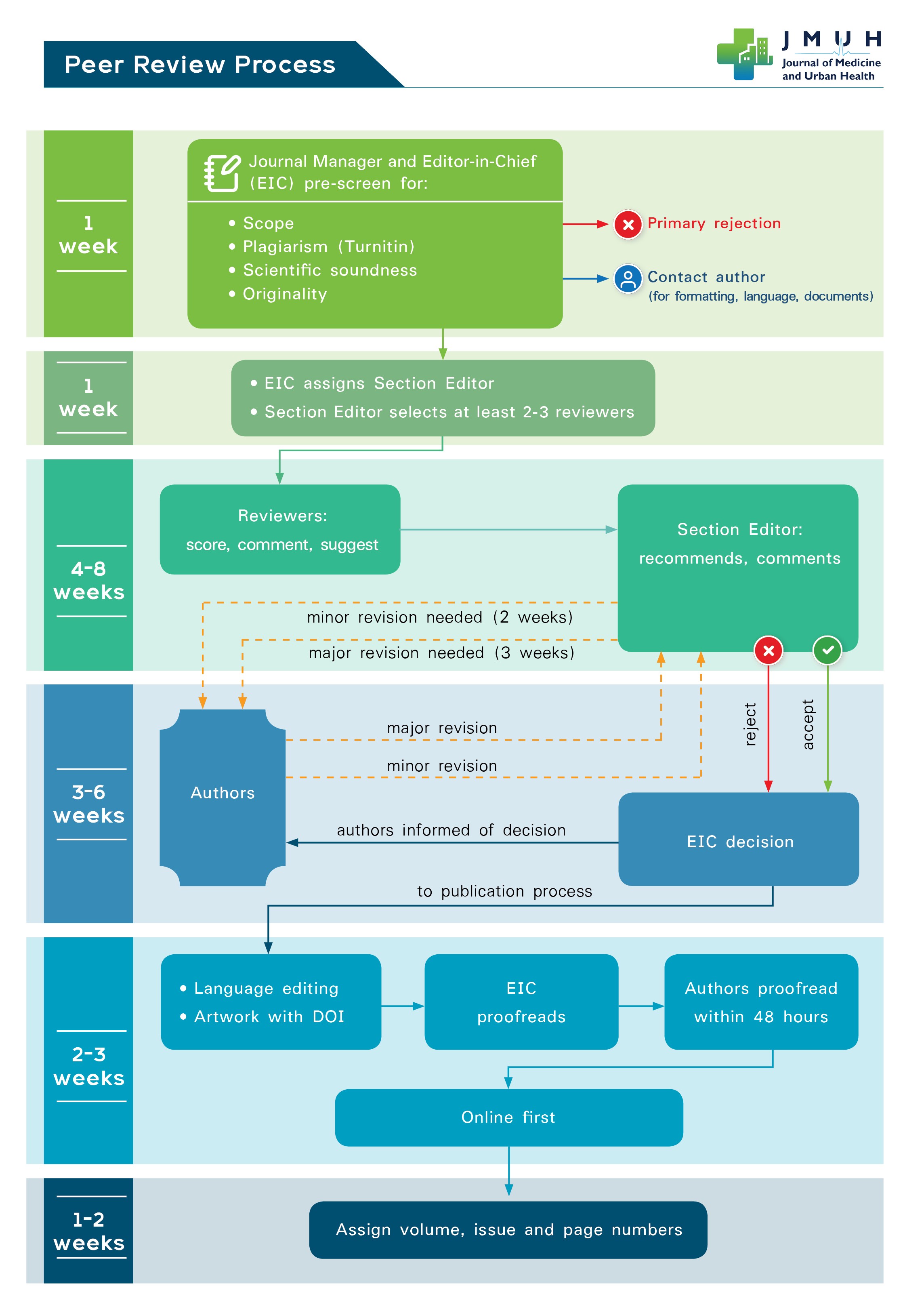
Peer Review Process
The Journal of Medicine and Urban Health (JMUH) adheres to a rigorous, transparent, and structured peer-review process designed to uphold the highest standards of scientific integrity and clinical relevance. Through meticulous editorial oversight, timely author revisions, and comprehensive post-acceptance copyediting and proofreading, JMUH ensures that all published articles meet stringent scientific benchmarks to advance knowledge at the intersection of medicine and public health (especially urban health). The step-by-step peer review process for JMUH is detailed below:
Step 1
Submission
Authors must prepare and submit their manuscript along with all required documentation via JMUH’s ScholarOne online submission system. Required materials include:
- Signed Cover Letter to Editor
- Certificate of Language Editing (mandatory for non-native English speakers)
- Signed Checklist Guideline
- Signed License to Publish Agreement
- Ethics Certificate (required for original article or systematic review and meta-analysis, and case report).
Step 2
1 week Initial Assessment
Upon submission, the journal manager and the editor-in-chief conduct a preliminary assessment of the manuscript's scope, scientific soundness, originality, and adherence to journal guidelines. All submissions are screened for similarity using Turnitin plagiarism detection software; manuscripts must maintain an overall similarity index below 25% (For more information, please refer to the Publication Ethics). Submissions with substantial formatting errors, structural deficiencies, language issues, or missing documentation will be returned to authors for correction before editorial assignment. Manuscripts that fail to meet the basic standards or scope of the journal will be desk-rejected as primary rejection without external review.
Step 3
1 week Section Editor Assignment
Generally, the editor-in-chief assigns the section editor with relevant subject expertise to oversee the evaluation process. The section editor selects independent peer reviewers from diverse institutions.
- Original Article or Systematic Review and Meta-Analysis, Review Article, and Case Report are assigned to a minimum of two qualified peer reviewers.
- Invited Special Articles are managed and reviewed directly by the editor-in-chief, and assigned to at least one external expert reviewer.
Reviewers are selected based on subject expertise, publication record, and lack of affiliations with authors' institutions to prevent conflicts of interest and ensure unbiased evaluation.
Step 4
4-8 weeks Reviewer Invitation and Peer Review
JMUH enforces a double-blind peer review policy, ensuring that the identities of both authors and reviewers remain confidential throughout the process. Reviewers evaluate the manuscript’s methodology, scientific rigor, and clinical significance, providing detailed comments and selecting one of the following recommendations:
- Accept
- Minor Revision
- Major Revision
- Reject
The evaluations are submitted to the section editor to recommend the decision to the editor-in-chief. In the event of conflicting reviewer recommendations, the section editor may solicit an additional reviewer.
Step 5
2-3 weeks Author Revision
When revisions are required, the section editor returns the manuscript to authors alongside the reviewers' feedback:
- Minor Revisions are 2 weeks allowed for resubmission.
- Major Revisions are 3 weeks allowed for resubmission.
Authors must submit a revised manuscript that modified text must be clearly indicated using yellow text highlighting along with a point-by-point response letter detailing all modifications made in response to reviewers' comments. Revisions undergo secondary review by the section editor or external reviewers as necessary. If authors require additional time beyond the specified timeframe, they must notify the editor-in-chief as early as possible to request a reasonable extension prior to the deadline.
Step 6
1-2 weeks Final Decision by the Editor-in-Chief
Following the revision phase, the section editor submits a final recommendation (accept or reject) to the editor-in-chief. The editor-in-chief holds the sole authority for final acceptance, and the official decision is communicated formally to the corresponding author via ScholarOne.
Step 7
2–3 weeks total for steps 7 & 8 Copyediting and Artwork
Accepted manuscripts enter the production phase. The text undergoes professional language copyediting, figure/table formatting, visual layout, and assignment of a Digital Object Identifier (DOI) via Crossref.
Step 8
Proofreading
The editor-in-chief conducts a preliminary check of the edited proofs. Subsequently, galley proofs are sent to the corresponding author, who must complete final proofreading within 48 hours to confirm accuracy prior to publication.
Step 9
1–2 weeks Publication
Once proofreading is complete, the article is published as an Online First article as soon as possible on the journal’s website. When a full issue set of articles (typically 7–8 articles) is finalized, the articles are assigned to a specific volume and issue number, completing the formal publication process.
ScholarOne Manuscript Submission Statuses
1 Awaiting Admin Processing
The manuscript has been successfully submitted and is undergoing initial administrative screening by the journal manager. This check verifies adherence to journal policies, including scope alignment, plagiarism screening (via Turnitin), formatting compliance, and required documentation. Scientific peer review has not yet commenced.
2 Awaiting Editor-in-Chief Assignment / Decision
The editor-in-Chief is reviewing the submission to evaluate its overall fit, scientific quality, and suitability for the journal. The editor-in-chief will either make an initial desk decision (e.g., desk reject) or assign the manuscript to an appropriate section editor.
3 Awaiting Section Editor Assignment
The manuscript is queued for assignment to the section editor with specialized expertise in the manuscript's subject area by the editor-in-chief. Once assigned, the section editor will manage the peer-review process.
4 Awaiting Reviewer Selection
The section editor is identifying potential peer reviewers (typically 2 to 3 independent experts) with relevant academic or clinical expertise and no conflicts of interest.
5 Awaiting Reviewer Invitation
Formal invitations have been dispatched to prospective reviewers. The section editor is waiting for the invited reviewers to either accept or decline the invitation to review.
6 Awaiting Reviewer Assignment
Invited reviewers have accepted the invitation, and the system is finalizing their assignment and granting them access to the manuscript files so they can begin evaluation.
7 Under Review
The manuscript is actively being evaluated by the assigned peer reviewers, who are assessing its scientific rigor, methodology, clarity, and overall contribution to the field.
8 Awaiting Reviewer Scores
One or more peer reviewers have submitted their comments, but the manuscript remains pending additional required scores, detailed evaluations, or outstanding reports from remaining reviewers.
9 Awaiting Section Editor Recommendation
All required reviewer reports have been successfully submitted. The section editor is synthesizing the feedback and preparing a formal recommendation (e.g., accept, minor revision, major revision, or reject) for the editor-in-chief.
10 Manuscripts Awaiting Revision
The editor-in-chief has rendered a decision requesting revisions (minor or major revision). The manuscript is now in the hands of authors, who must address the peer reviewers' comments, make necessary manuscript modifications, and submit a revised version using yellow text highlighting along with a point-by-point response letter within 2 weeks for minor revision and 3 weeks for major revision.
11 Awaiting Production Checklist
The manuscript has been formally accepted for publication and transferred to the production team. During this stage, the journal manager and the editor-in-chief verifies that all high-resolution figures, editable source files, copyright forms, and author details comply with publication standards before copyediting, typesetting, and DOI assignment.
