Supervised learning algorithms for subject- and textlevel classification of depression-related context among Thai-language Facebook users
Keywords:
Depression severity, Facebook text, machine learning, natural language processing, ThaiAbstract
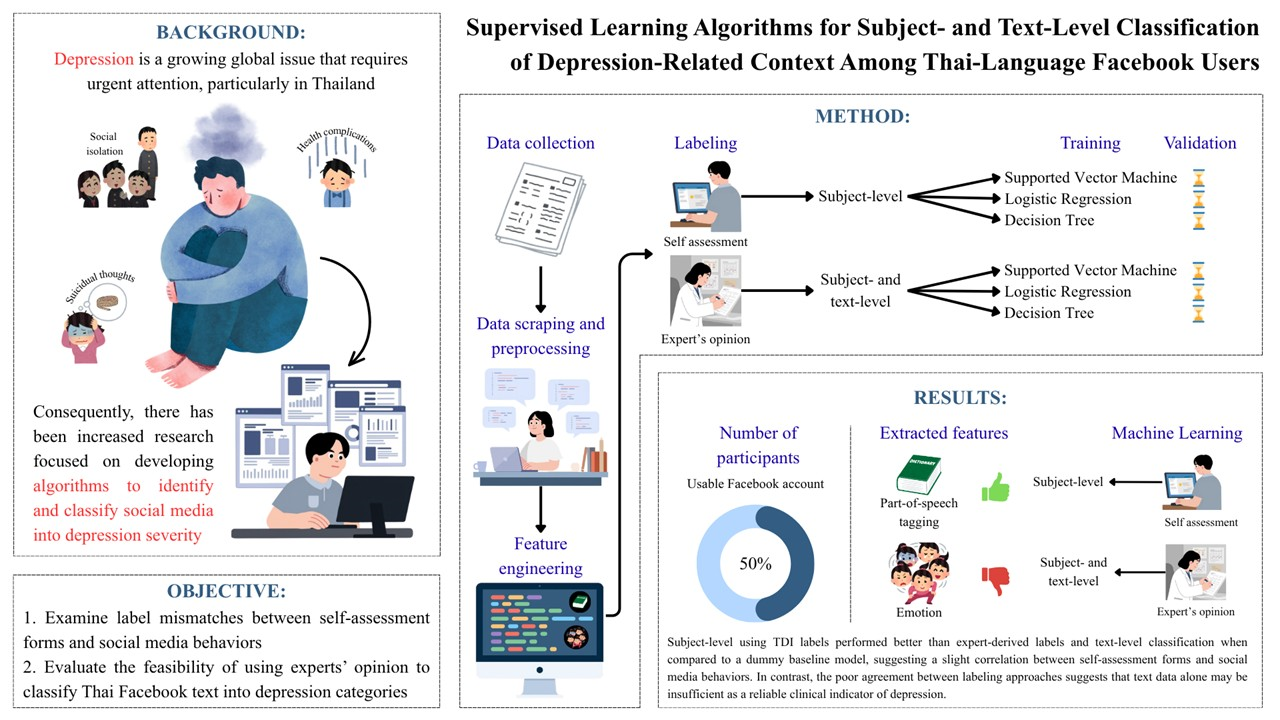
Background: Depression is an increasing concern worldwide that requires urgent attention, particularly in Thailand. Without timely intervention, it can lead to serious consequences, such as health complications, reduced social participation, and even suicide. Consequently, research has increasingly focused on developing algorithms to identify and classify social media data into depression severity.
Objectives: This study aimed to examine label mismatches between self-assessment forms and social media behaviors and to evaluate the feasibility of using experts’ opinions to classify Thai Facebook text into depression categories.
Methods: The methodology involved data collection through surveys and Facebook scraping, followed by data preprocessing, feature engineering, and model training and validation. The models employed included the support vector machine, logistic regression, and decision tree, applied at the subject and text levels. Labels were derived from the Thai Depression Inventory (TDI) and experts’ evaluations.
Results: Only 30 out of 60 participants actively used Facebook during the study period, with substantial variation in posting behavior. Subject-level classification using TDI labels yielded better, more balanced performance metrics than classifications based on experts’ opinions at the subject and text levels. Part-ofspeech tagging showed slight correlations with depression severity, whereas emotions did not.
Conclusion: Subject-level classification using self-assessment labels performed better than expert-derived labels and text-level classification when compared to a dummy baseline model. This suggests a slight correlation between the self-assessment forms and social media behaviors. In contrast, the poor agreement between labeling approaches suggests that text data alone may be insufficient as a reliable clinical indicator of depression.
Downloads
References
Wu Y, Fan L, Xia F, Zhou Y, Wang H, Feng L, et al. Global, regional, and national time trends in incidence for depressive disorders, from 1990 to 2019: an age-period-cohort analysis for the GBD 2019. Ann Gen Psychia 2024;23:28.
https://doi.org/10.1186/s12991-024-00513-1
Tuarob S, Noraset T, Tawichsri T. Using large-scale social media data for population-level mental health monitoring and public sentiment assessment: a case study of Thailand. Bangkok: Puey Ungphakorn Institute for Economic Research; 2021.
Siriwanarangsan P, Liknapichitkul D, Khandelwal SK. Thailand mental health country profile. Int Rev Psychiatry 2004;16:150-8.
https://doi.org/10.1080/09540260310001635195
N, Klaywong K, Piwsaart R, Inrueng S. A study of stress and depression in health science students at a university in Bangkok, Thailand. J Health Sci Med Res 2025;43:1-9.
Udomratn P. Mental health and psychiatry in Thailand. Int Psychiatry 2007;4:11-4.
https://doi.org/10.1192/S1749367600005105
Doll CM, Michel C, Rosen M, Osman N, Schimmelmann BG, Schultze-Lutter F. Predictors of help-seeking behaviour in people with mental health problems: a 3-year prospective community study. BMC Psychiatry 2021;21:432.
https://doi.org/10.1186/s12888-021-03435-4
Henderson C, Evans-Lacko S, Thornicroft G. Mental illness stigma, help seeking, and public health programs. Am J Public Health 2013;103:777-80.
https://doi.org/10.2105/AJPH.2012.301056
Santor DA, Gregus M, Welch A. Eight decades of measurement in depression. Measurement 2006;4:135-55.
https://doi.org/10.1207/s15366359mea0403_1
Kalibatseva Z, Leong FTL. Depression among Asian Americans: review and recommendations. Depress Res Treat 2011;2011:1-9.
https://doi.org/10.1155/2011/320902
Lotrakul M, Sukanich P. Development of the Thai Depression Inventory. J Med Assoc Thai 2000;82:1200-7.
Brandao PR. The impact of artificial intelligence on modern society. AI 2025;6:190.
https://doi.org/10.3390/ai6080190
Tsugawa S, Kikuchi Y, Kishino F, Kosuke N. Recognizing depression from Twitter activity. Proceedings of the 33rd Annual ACM Conference on Human Factors in Computing Systems (CHI 2015); 2015 Apr 18-23; Seoul, Republic of Korea: Association for Computing Machinery; 2015. p. 3187-96.
https://doi.org/10.1145/2702123.2702280
Kumnunt B, Sornil O. Detection of depression in Thai social media messages using deep learning. Proceedings of the 1st International Conference on Deep Learning Theory and Applications (DeLTA 2020); 2020 Jul 8-10; Online. Setúbal (PT): SciTePress; 2020.
https://doi.org/10.5220/0009970501110118
Musleh D, Alkhales TA, Almakki RA, Elnajim SE. Twitter Arabic sentiment analysis to detect depression using machine learning. Comput Mater Continua 2021;71:3463-77
https://doi.org/10.32604/cmc.2022.022508
Eichstaedt JC, Smith RJ, Merchant RM, Ungar LH, Crutchley P, Preoțiuc-Pietro D, Asch DA, Schwartz HA. Facebook language predicts depression in medical records. Proc Natl Acad Sci U S A 2018;115:11203-8.
https://doi.org/10.1073/pnas.1802331115
National Collaborating Centre for Mental Health (UK). Appendix 12, The classification of depression and depression rating scales/questionnaires. In: National Collaborating Centre for Mental Health (UK). Depression in adults with a chronic physical health problem. Leicester: British Psychological Society; 2010.
Hämäläinen M, Patpong P, Alnajjar K, Partanen N, Rueter J. Detecting depression in Thai blog posts: a dataset and a baseline. In: Xu W, Ritter A, Baldwin T, Rahimi A, editors. Proceedings of the Seventh Workshop on Noisy User-generated Text (W-NUT 2021); 2021 Nov 11; Online. Association for Computational Linguistics; 2021
https://doi.org/10.18653/v1/2021.wnut-1.3
McHugh LM. Interrater reliability: the kappa statistic. Biochem Med (Zagreb) 2012;22:276-82.
https://doi.org/10.11613/BM.2012.031
Phatthiyaphaibun W, Chaovavanich K, Polpanumas C, Suriyawongkul A, Lowphansirikul L, Chormai P, et al. PyThaiNLP: Thai natural language processing in Python. In: Tan L, Milajevs D, Chauhan G, Gwinnup J, Rippeth E, editors. Proceedings of the 3rd Workshop for Natural Language Processing Open Source Software (NLP-OSS 2023); 2023 Dec 6; Singapore: Association for Computational Linguistics; 2023. p. 25-36.
https://doi.org/10.18653/v1/2023.nlposs-1.4
Xiao M, Liu B, Li H, Huang J, Xie Q, Zong X, et al. MoodAngels: a retrieval-augmented multi-agent framework for psychiatry diagnosis. In: Belgrave D, Zhang C, Lin H, Pascanu R, Koniusz P, Ghassemi M, Chen N, editors. Advances in Neural Information Processing Systems 38 NeurIPS 2025; 2025 Dec 2-7; San Diego, CA: Neural Information Processing Systems Foundation; 2025.
Hendra H, Deris MM, Windiarti IS. Mental health classification using machine learning with pca and logistics regression approaches for decision making. Eng Proc 2025;84:47.
https://doi.org/10.3390/engproc2025084047
Chasombat P, Karuchit W. Digitally depressed: the effects of digital media usage in regard to depression and approaches for alleviation for individuals and the society. Commun Media Asia Pac 2020;3:1-15
Mahasiriakalayot S, Senivongse T, Taephant N. Predicting signs of depression from twitter messages. Proceedings of the 19th International Joint Conference on Computer Science and Software Engineering (JCSSE 2022); 2022 Jun 22-25; Bangkok, Silpakorn University; 2022. p. 1-6.
https://doi.org/10.1109/JCSSE54890.2022.9836287
Hemtanon S, Kittiphattanabawon N. An automatic screening for major depressive disorder from social media in Thailand. Proceedings National & International Conference 2019;10:103-13.
Wongpakaran N, Wongpakaran T, Wannarit K, Saisavoey N, Pinyopornpanish M, Lueboonthavatchai P, et al. Level of agreement between self-rated and clinician-rated instruments when measuring major depressive disorder in the Thai elderly: a 1-year assessment as part of the THAISAD study. Clin Interv Aging 2014;9:377-82.
https://doi.org/10.2147/CIA.S56683
Hemtanon S, Aekwarangkoon S, Kittiphattanabawon N. Proactive depression detection from Facebook text and behavior data. Int J Electr Comput Eng 2022;12:5027-35.
https://doi.org/10.11591/ijece.v12i5.pp5027-5035
Vajrobol V, Shukla U, Pundir A, Singh S, Saxena GJ. Depression detection in Thai language posts based on attentive network models. Proceedings of the 19th International Conference on Natural Language Processing (ICON 2022); 2022 Dec 15-18; IIIT Delhi, India: WNLPe-Health; 2022
Electronic Transactions Development Agency (Public Organization), Ministry of Information and Communication Technology. Thailand internet user profile 2015. Bangkok: Electronic Transactions Development Agency (Public Organization), Ministry of Information and Communication Technology; 2016.
Khumsri J, Yingyeun R, Manwong M, Hanprathet N, Phanasathit M. Prevalence of Facebook addiction and related factors among Thai high school students. J Med Assoc Thai 2015;98:51-60.
Downloads
Published
How to Cite
Issue
Section
License
Copyright (c) 2026 Chulalongkorn Medical Journal

This work is licensed under a Creative Commons Attribution-NonCommercial-NoDerivatives 4.0 International License.