Evaluation of MDM2 mRNA expression according to clinicopathological characteristics in patients with oral squamous cell carcinoma
Keywords:
Livak’s method, MDM2 mRNA, oral cancer, OSCC, real-time qPCRAbstract
Background: The murine double minute 2 (MDM2) gene encodes an E3 ubiquitin ligase that targets p53 for degradation, which influences the pathogenesis of oral squamous cell carcinoma (OSCC).
Objective. This study determined MDM2 mRNA expression and evaluated its association with the clinical and pathological characteristics thereof in patients with OSCC.
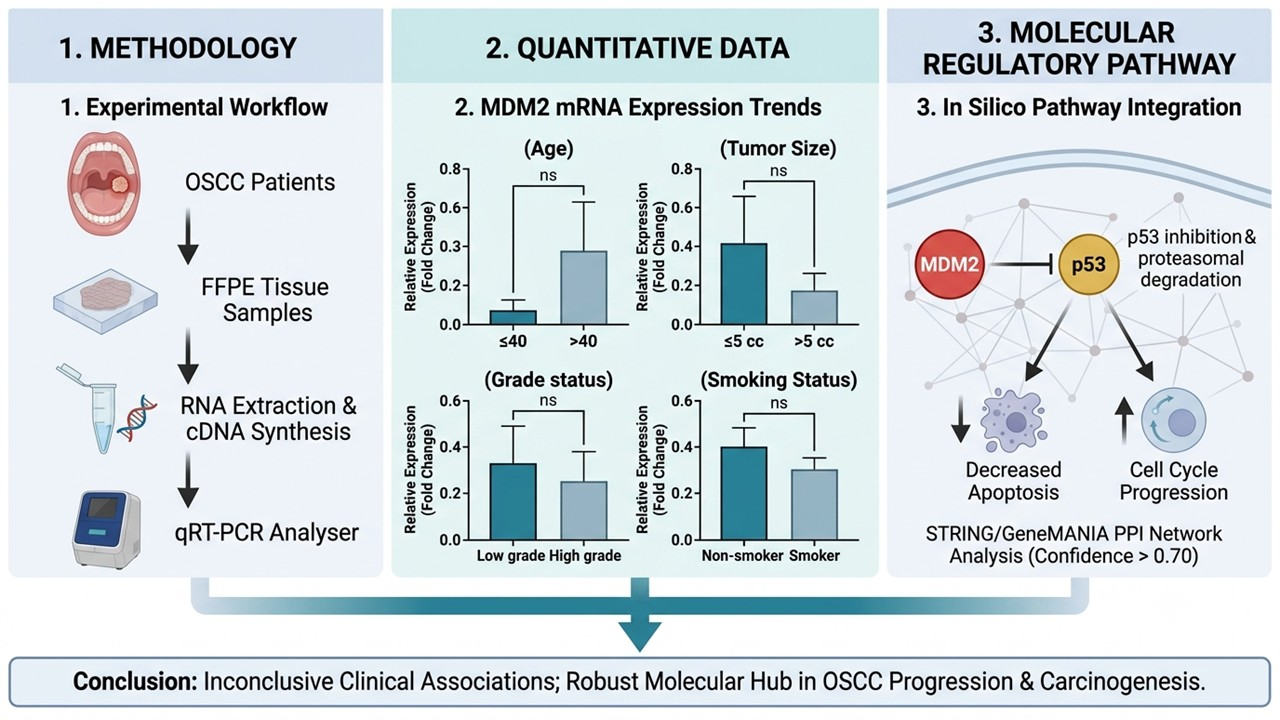
Methods: We performed an observational–analytical study using a cross-sectional design involving 39 patients with OSCC. RNA extraction, complementary DNA synthesis, and quantitative real-time polymerase chain reaction were performed. The relative MDM2 mRNA expression was quantified using the Livak method (2-ΔΔCT) with GenEX MultiD software version 6.0. Statistical significance was assessed using unpaired Student t-tests.
Results: MDM2 mRNA expression was 1.64-fold lower in patients with OSCC and tumor volumes >5 cc compared with those ≤ 5 cc (CT mean ± SE: 32.0 ± 2.6vs. 32.7 ± 1.8, respectively; P = 0.34). In high-grade cases, the expression was 0.92-fold lower than in low-grade cases (32.1 ± 2.3 vs. 32.2 ± 2.7, respectively; P = 0.90). The expression thereof was also 2.12-fold higher in smokers than in non-smokers (31.8 ± 2.4 vs. 32.9 ± 2.1, respectively; P = 0.3). None of these differences were significant. Network analysis identified MDM2, TP53, and CDKN1A as central hub genes, thus bridging p53 signaling, cell cycle regulation, and cellular senescence in OSCC. Gene Ontology enrichment revealed significant overrepresentation of p53-mediated DNA damage response and apoptotic pathways among the candidate genes.
Conclusion: Although MDM2 mRNA expression exhibited no significant clinical associations, in silico profiling identified MDM2 as a central molecular hub linking p53 signaling and cell cycle regulation in OSCC, thereby suggesting a mechanistic role that warrants further functional validation.
Downloads
References
Kahn MA, Hall JM. The ADA practical guide to soft tissue oral disease. Stomatol EDU J 2019;6:145.
https://doi.org/10.25241/stomaeduj.2019.6(2).bookreview.6
Balbinot J, Real CS, Melo CC, Dornelles S, Costa SSD. Quality of life in tongue cancer treated patients before and after speech therapy: a randomized clinical trial. Braz J Otorhinolaryngol 2022;88:491-6.
https://doi.org/10.1016/j.bjorl.2020.10.005
Shetty SS, Sharma M, Padam KSR, Kudva A, Patel P, Radhakrishnan R. The interplay of EMT and stemness driving malignant transformation of Oral Submucous Fibrosis. J Oral Biol Craniofacial Res 2024;14:63-71.
https://doi.org/10.1016/j.jobcr.2023.12.006
Ramadian KJ, Mahardika CI, Pangastuti AWS, Ramadhani ND, Sulistyo H, Widodo HB, et al. Enhancement of mRNA Vascular Endothelial Growth Factor-A ( VEGF-A ) induced anemia in Oral Squamous Cell Carcinoma ( OSCC ) data analysis. Indones J Cancer 2025;19:205-10.
https://doi.org/10.33371/ijoc.v19i2.1278
Jiang X, Wu J, Wang J, Huang R. Tobacco and oral squamous cell carcinoma: A review of carcinogenic pathways. Tob Induc Dis 2019;17:29.
https://doi.org/10.18332/tid/111652
Rumgay H, Nethan ST, Shah R, Vignat J, Ayo-Yusuf O, Chaturvedi P, et al. Global burden of oral cancer in 2022 attributable to smokeless tobacco and areca nut consumption: a population attributable fraction analysis. Lancet Oncol 2024;25:1413-23.
https://doi.org/10.1016/S1470-2045(24)00458-3
Chandimali N, Bak SG, Park EH, Lim HJ, Won YS, Kim EK, et al. Free radicals and their impact on health and antioxidant defenses: a review. Cell Death Discov 2025;11:19.
https://doi.org/10.1038/s41420-024-02278-8
Sun Z. The general information of the tumor suppressor gene p53 and the protein p53. J Cancer Prev Curr Res 2015;3:208-17.
https://doi.org/10.15406/jcpcr.2015.03.00068
Karni-Schmidt O, Lokshin M, Prives C. The roles of MDM2 and MDMX in cancer. Annu Rev Pathol 2016;11:617-44.
https://doi.org/10.1146/annurev-pathol-012414-040349
Saadatzadeh MR, Elmi AN, Pandya PH, Bijangi-Vishehsaraei K, Ding J, Stamatkin CW, et al. The role of MDM2 in promoting genome stability versus instability. Int J Mol Sci 2017;18:2216.
https://doi.org/10.3390/ijms18102216
Schmittgen TD, Livak KJ. Analyzing real-time PCR data by the comparative CT method. Nat Protoc 2008;3:1101-8.
https://doi.org/10.1038/nprot.2008.73
Qin Y. Identification of prognosis-associated biomarkers in thyroid carcinoma by a bioinformatics analysis. Int J Gen Med 2021;14:5737-47.
https://doi.org/10.2147/IJGM.S327497
Rahadiani N, Habiburrahman M, Stephanie M, Handjari DR, Krisnuhoni E. Estimated projection of oral squamous cell carcinoma annual incidence from twenty years registry data: a retrospective cross-sectional study in Indonesia. PeerJ 2023;11:e15911.
https://doi.org/10.7717/peerj.15911
Huang Y, Che X, Wang PW, Qu X. p53/MDM2 signaling pathway in aging, senescence and tumorigenesis. Semin Cancer Biol 2024;101:44-57.
https://doi.org/10.1016/j.semcancer.2024.05.001
Chen J, Wang G, Luo X, Zhang J, Zhang Y. Cuproptosis patterns and tumor microenvironment in endometrial cancer. Front Genet 2022;13:1001374.
https://doi.org/10.3389/fgene.2022.1001374
Sciot R. MDM2 amplified sarcomas: a literature review. Diagnostics (Basel) 2021;11:496.
https://doi.org/10.3390/diagnostics11030496
Arena G, Riscal R, Linares LK, Le Cam L. MDM2 controls gene expression independently of p53 in both normal and cancer cells. Cell Death Differ 2018;25:1533-5.
https://doi.org/10.1038/s41418-018-0156-x
Chibaya L, Karim B, Zhang H, Jones SN. Mdm2 phosphorylation by Akt regulates the p53 response to oxidative stress to promote cell proliferation and tumorigenesis. Proc Natl Acad Sci U S A 2021;118:e2003193118.
https://doi.org/10.1073/pnas.2003193118
Yanamoto S, Kawasaki G, Yoshitomi I, Mizuno A. p53, mdm2, and p21 expression in oral squamous cell carcinomas: Relationship with clinicopathologic factors. Oral Surg Oral Med Oral Pathol Oral Radiol Endod 2002;94:593-600.
https://doi.org/10.1067/moe.2002.127404
Ye J, Zhang L, Li Z, Lin R, Song Y, Ni H, et al. High expression of MDM2 and the p53 protein is predictive biomarkers for poor prognosis of oesophageal squamous cell carcinoma. Cancer Manag Res 2021;13:2733-44.
https://doi.org/10.2147/CMAR.S280326
Gołąbek K, Rączka G, Gaździcka J, Miśkiewicz-Orczyk K, Zięba N, Krakowczyk Ł, et al. Expression profiles of CDKN2A, MDM2, E2F2 and LTF genes in oral squamous cell carcinoma. Biomedicines 2022;10:3011.
https://doi.org/10.3390/biomedicines10123011
Cromie MM, Liu Z, Gao W. Epigallocatechin-3-gallate augments the therapeutic effects of benzo[a]pyrene-mediated lung carcinogenesis. BioFactors 2017;43:529-39.
https://doi.org/10.1002/biof.1355
Chen KM, Sun YW, Krebs NM, Sun D, Krzeminski J, Reinhart L, et al. Detection of DNA adducts derived from the tobacco carcinogens, benzo[a]pyrene and dibenzo[def,p]chrysene in human oral buccal cells. Carcinogenesis 2022;43:746-53.
https://doi.org/10.1093/carcin/bgac058
Wallace SJ, de Solla SR, Thomas PJ, Harner T, Eng A, Langlois VS. Airborne polycyclic aromatic compounds contribute to the induction of the tumour-suppressing P53 pathway in wild double-crested cormorants. Ecotoxicol Environ Saf 2018;150:176-89.
https://doi.org/10.1016/j.ecoenv.2017.12.028
Lao JY, Xie SY, Wu CC, Bao LJ, Tao S, Zeng EY. Importance of Dermal Absorption of Polycyclic Aromatic Hydrocarbons Derived from Barbecue Fumes. Environ Sci Technol 2018;52:8330-8.
https://doi.org/10.1021/acs.est.8b01689
Zhu RX, Seto WK, Lai CL, Yuen MF. Epidemiology of Hepatocellular carcinoma in the Asia-Pacific Region. Gut Liver 2016;10:332-9.
https://doi.org/10.5009/gnl15257
Zhu Y, Duan X, Qin N, Lv J, Wu G, Wei F. Health risk from dietary exposure to polycyclic aromatic hydrocarbons (PAHs) in a typical high cancer incidence area in southwest China. Sci Total Environ 2019;649:731-8.
https://doi.org/10.1016/j.scitotenv.2018.08.157
Chen BH, Chen YC. Formation of polycyclic aromatic hydrocarbons in the smoke from heated model lipids and food lipids. J Agric Food Chem 2001;49:5238-43.
https://doi.org/10.1021/jf0106906
Saputro E, Rosidi D, Radiati LE, Warsito W. Kajian pustaka: pemicu kanker dalam sate, ayam/bebek/ikan bakar/goreng dan abon. J Litbang Sukowati: Media Penelit dan Pengemb 2021;4:60-78.
https://doi.org/10.32630/sukowati.v4i2.187
Bensaad K, Tsuruta A, Selak MA, Vidal MN, Nakano K, Bartrons R, et al. TIGAR, a p53-inducible regulator of glycolysis and apoptosis. Cell 2006;126:107-20.
https://doi.org/10.1016/j.cell.2006.05.036
Vishnyakova P, Artemova D, Elchaninov A, Efendieva Z, Apolikhina I, Sukhikh G, et al. Effects of platelet-rich plasma on mesenchymal stem cells isolated from rat uterus. PeerJ 2020;8:e10415.
https://doi.org/10.7717/peerj.10415
Dong JT. Prevalent mutations in prostate cancer. J Cell Biochem 2006;97:433-47.
Downloads
Published
How to Cite
Issue
Section
License
Copyright (c) 2026 Chulalongkorn Medical Journal

This work is licensed under a Creative Commons Attribution-NonCommercial-NoDerivatives 4.0 International License.