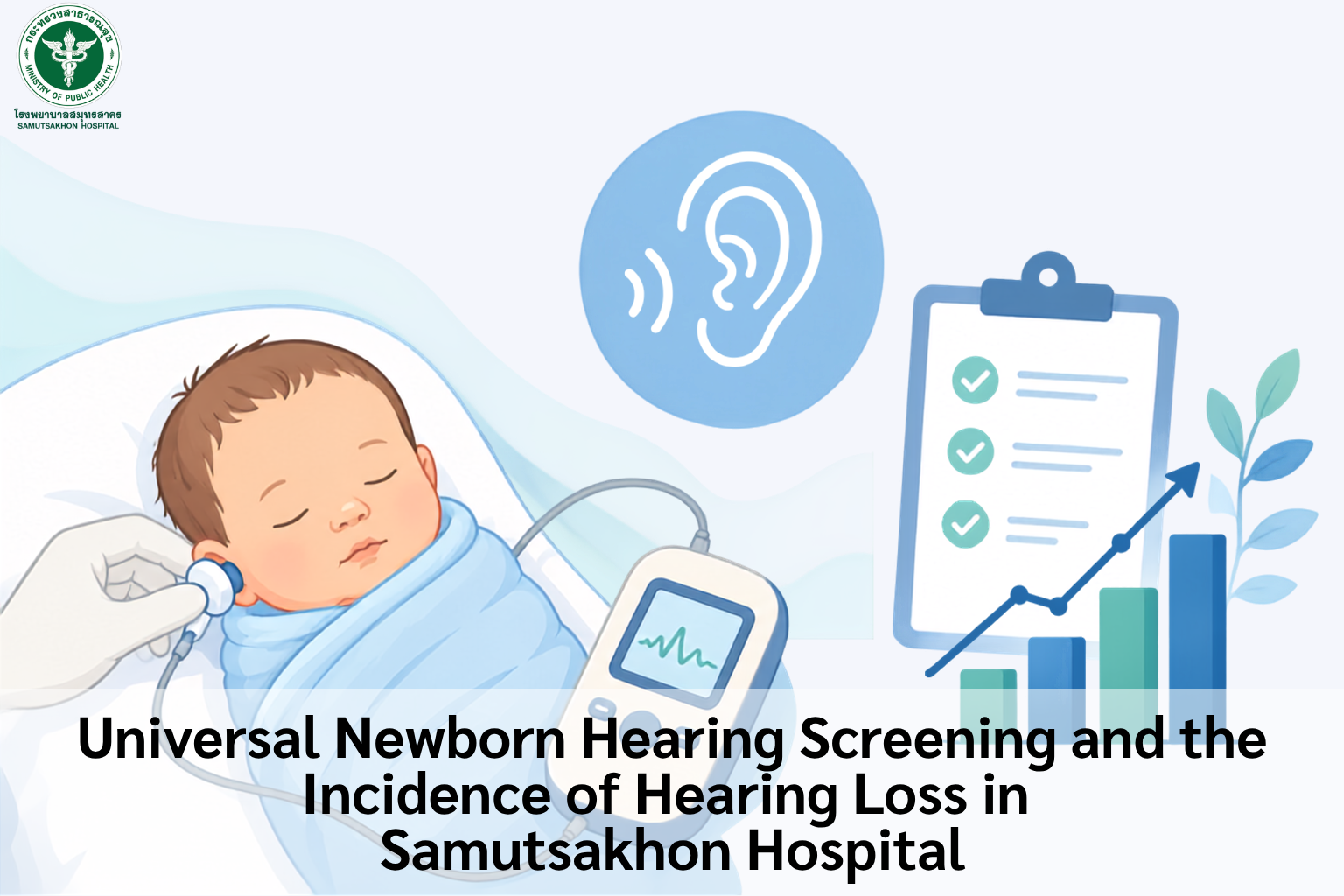
Universal Newborn Hearing Screening and the Incidence of Hearing Loss in Samutsakhon Hospital: A Retrospective Descriptive Study, 2021-2023
Keywords:
Newborn hearing screening, Newborn, Hearing lossAbstract
Background: Samutsakhon Hospital began implementing newborn hearing screening in July 2006, initially screening only high-risk infants according to the Joint Committee on Infant Hearing (JCIH) criteria and later expanded to universal screening of all newborns from January 2009 onward. However, a previous study reported that the outcomes of the newborn hearing screening program at Samutsakhon Hospital had not yet met the standard benchmarks recommended by the JCIH.
Objective: To evaluate the outcomes of the newborn hearing screening program at Samutsakhon Hospital between 2021 and 2023 and to determine the incidence of hearing loss among newborns.
Methods: A retrospective study was conducted using medical records of all live-born infants delivered at Samutsakhon Hospital from January 1, 2021 to December 31, 2023. Hearing screening was performed using transient evoked otoacoustic emissions (TEOAE). Infants who failed the initial screening were scheduled for rescreening at one month of age, followed by diagnostic evaluation using auditory brainstem response (ABR), auditory steady-state response (ASSR), and tympanometry. Descriptive statistics including percentages, means, and standard deviations were used for analysis and compared to JCIH benchmark.
Results: During the study period, 16,023 live births were recorded. Of these, 11,449 newborns (71.62%) underwent hearing screening prior to hospital discharge. The initial referral rate was 10.88%. A total of 36.56% of infants returned for rescreening. Among infants who underwent diagnostic evaluation, 10 cases of hearing loss were identified, the average age was 10.14 months. All hearing loss infants were fitted hearing aids at the mean age of 12 months. The incidence of hearing loss was 0.56 per 1,000 live births.
Conclusion: The newborn hearing screening program at Samutsakhon Hospital has not yet achieved the performance benchmarks recommended by JCIH, particularly in screening coverage and follow-up rates. Strengthening program infrastructure, improving follow-up systems, and reducing diagnostic delay may enhance the effectiveness of the screening program.
Downloads
References
Chumjam A. Newborn Hearing Screening in Samutsakhon Hospital. Reg 4-5 Med J. 2012;31(2):135–142. https://he02.tcithaijo.org/index.php/reg45/article/view/128034
Yoshinaga-Itano C. Benefits of early intervention for children with hearing loss. Otolaryngol Clin Morth Am. 1999;32(6):1089-102. doi: 10.1016/s0030-6665(05)70196-1.
Chouyboonchum T, Chamchoi P, Chaikhamrongkul T, Isarangura S, & Tiravanitchakul, R. Universal newborn hearing screening and incidence of hearing loss in Ramathibodi Hospital: A 5 years experience (2014 to 2018). Rama Med J. 2022;45(4):25–34. https://doi.org/10.33165/rmj.2022.45.4.258412
Joint Committee on Infant Hearing (JCIH). (2019). Year 2019 position statement: Principles and guidelines for early hearing detection and intervention programs. The Journal of Early Hearing Detection and Intervention. 2019;4(2): 1–44. https://doi.org/10.15142/fptk-b748
Grosse SD. Ross DS. Cost savings from universal newborn hearing screening. Pediatrics. 2006;118(2):844-5. doi:10.1542/peds.2006-1146
Kiatchoosakun P, Suphadun W, Jirapradittha J, Yimtae, K, Thanawirattananit P. Incidence and risk factors associated with hearing loss in high-risk neonates in Srinagarind Hospital. J Med Assoc Thai. 2012;95(1):52–7.
Lertbussarakam P, Pitathawatchai P. The effectiveness and cost analysis of a pilot newborn hearing screening program at a hospital in a low- to middle-income country. J Int Adv Otol. 2024;20(6):477–83. https://doi.org/10.5152/iao.2024.231109
Morton CC, Nance WE. Newborn hearing screening—a silent revolution. N Engl J Med. 2006;354(20):2151–64. https://doi.org/10.1056/NEJMra050700
Olusanya BO. Neumann KJ. Saunders JE. The global burden of disabling hearing impairment: A call to action. Bull World Health Organ. 2014;92(5):367-73. doi: 10.2471/BLT.13.128728
World Health Organization. World report on hearing. [Internet]. 2021 [cited 2026 Mar 20]. Available form: https://www.who.int/publications/i/item/world-report-on-hearing
Cui Y, Tang M, Mu Q, Wu Q, Kang L, Chen Q, et al. Four-year review of safe and effective procedural sedation in neonates and young infants. Front Pharmacol. 2024;26:15:181413. doi: 10.3389/fphar.2024.1381413
Downloads
Published
How to Cite
Issue
Section
License
Copyright (c) 2026 Health Science and Nursing Samutsakhon Hospital Journal

This work is licensed under a Creative Commons Attribution-NonCommercial-NoDerivatives 4.0 International License.
Articles in this journal are copyrighted by the x may be read and used for academic purposes, such as teaching, research, or citation, with proper credit given to the author and the journal.use or modification of the articles is prohibited without permission.
statements expressed in the articles are solely the opinions of the authors.
authors are fully responsible for the content and accuracy of their articles.
other reuse or republication requires permission from the journal."