Predictive Factors of Medication Adherence in Patients with Schizophrenia at Psychiatric Clinic, Samutsakhon Hospital
Keywords:
Schizophrenia, The perceived need for medication adherence, Perceived social supportAbstract
Objective: To identify predictive factors of medication adherence in patients with schizophrenia at the psychiatric clinic, Samut Sakhon Hospital.
Methods: A cross-sectional study of 297 outpatients with schizophrenia was conducted. Data were collected using a general information questionnaire and the Multidimensional Scale of Perceived Social Support (MSPSS; 12 items). Medication adherence was assessed by direct patient self-report, asking whether the patient had missed medication for more than two consecutive weeks during the past year. Chi-square test, point-biserial correlation, and stepwise logistic regression were used for data analysis.
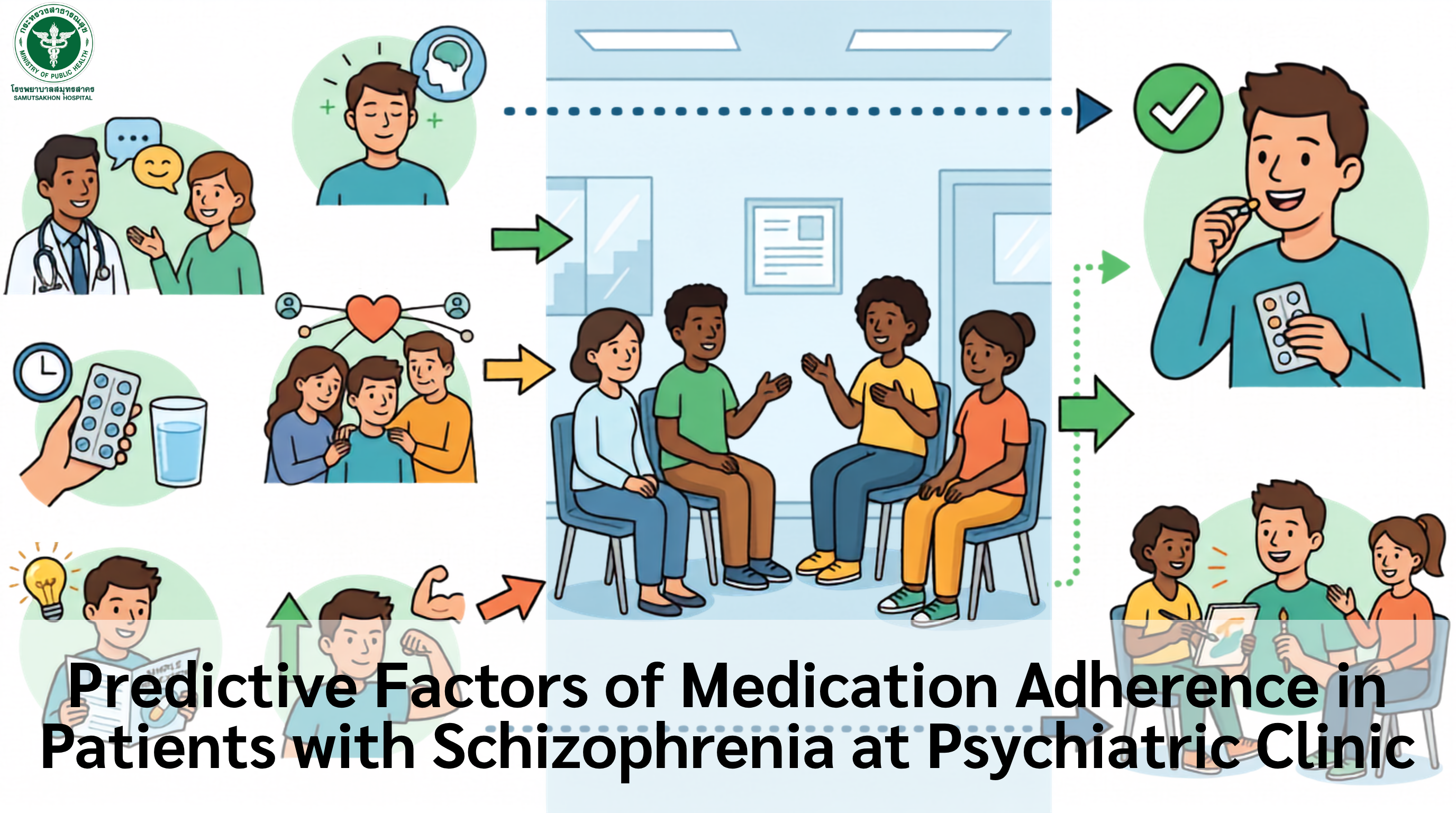
Results: The majority of participants were male (61.62%), single (70.71%), and unemployed (57.91%). Overall medication adherence was 96.30%. Variables significantly associated the perceived need for medication adherence included clinic appointment adherence, family accompaniment to clinic visits, and cigarette smoking. Stepwise logistic regression identified four predictive factors: clinic appointment adherence, family accompaniment, perceived social support from friends, and perceived social support from significant others, collectively explaining 29.20% of the variance in the perceived need for medication adherence.
Conclusion: Encouraging regular clinic attendance, promoting family involvement in treatment, and strengthening perceived social support are key strategies for improving the perceived need for medication adherence in patients with schizophrenia
Downloads
References
จีรศักดิ์ ห้วยทราย, สมชาย สุริยะไกร. ปัจจัยที่เกี่ยวข้องกับความร่วมมือในการใช้ยาของผู้ป่วยจิตเภท โรงพยาบาลดงหลวง. ศรีนครินทร์เวชสาร. 2562;34(2):150-4. เข้าถึงได้จาก: https://www.tci-thaijo.org/articles/life01-181345
ธงชัย อักษรพิมพ์, สกาวเดือน เกษทองมา. ปัจจัยที่มีความสัมพันธ์ต่อการรับประทานยาของผู้ป่วยจิตเภทที่เข้ารับการรักษาที่คลินิกจิตเวช แผนกผู้ป่วยนอก โรงพยาบาลหนองคาย. [อินเทอร์เน็ต]. 2567 [เข้าถึงเมื่อ 8 กุมภาพันธ์ 2569]
เข้าถึงได้จาก: https://nkhospital.moph.go.th/doc/journal/20241126015503.pdf
ภัทรพร ภูคลัง. ปัจจัยที่มีความสัมพันธ์กับความร่วมมือในการใช้ยาของผู้ป่วยจิตเภท โรงพยาบาลหนองนาคำ อำเภอหนองนาคำ จังหวัดขอนแก่น. วารสารสำนักงานสาธารณสุขจังหวัดขอนแก่น. 2567;6(1):56-67. เข้าถึงได้จาก: https://he02.tci-thaijo.org/index.php/jkkpho/article/ view/267173
Lacro JP, Dunn LB, Dolder CR, Leckband SG, Jeste DV. Prevalence of and risk factors for medication nonadherence in patients with schizophrenia: A comprehensive review of recent literature. J Clin Psychiatry. 2002;63(10):892-909. doi: 10.4088/jcp.v63n1007
Velligan DI, Weiden PJ, Sajatovic M, Scott J, Carpenter D, Ross R, Docherty JP. The expert consensus guideline series: Adherence problems in patients with serious and persistent mental illness. J Clin Psychiatry. 2009;70(Suppl. 4):1-46. Available from: https://pubmed.ncbi.nlm.nih.gov/19686636/
Leucht S, Tardy M, Komossa K, Heres S, Kissling W, Salanti G, et al. Antipsychotic drugs versus placebo for relapse prevention in schizophrenia: a systematic review and meta-analysis. Lancet. 2012;2;379(9831):2063-71. doi: 10.1016/S0140-6736(12)60239-6.
Emsley R, Chiliza B, Asmal L, Harvey BH. The nature of relapse in schizophrenia. BMC Psychiatry. 2013;8:13:50. 10.1186/1471-244X-13-50.
Andreasen NC, Liu D, Ziebell S, Varta A, Ho BC. Relapse duration, treatment intensity, and brain tissue loss in schizophrenia: a prospective longitudinal MRI study. Am J Psychiatry. 2013;170(6):609-15. doi: 10.1176/appi.ajp.2013.12050674.
Fazel S, Zetterqvist J, Larsson H, Långström N, Lichtenstein P. Antipsychotics, mood stabilisers, and risk of violent crime. Lancet. 2014;384(9949):1206-1214. doi:10.1016/S0140-6736(14)60379-2
Kane JM, Kishimoto T, Correll CU. Non-adherence to medication in patients with psychotic disorders: epidemiology, contributing factors and management strategies. World Psychiatry. 2013 Oct;12(3):216-26. doi: 10.1002/wps.20060.
Caqueo-Urízar A, Gutiérrez-Maldonado J, Miranda-Castillo C. Quality of life in caregivers of patients with schizophrenia: a literature review. Health Qual Life Outcomes. 2009;11:7:84. doi: 10.1186/1477-7525-7-84.
Daniel WW. Biostatistics: Basic Concepts and Methodology for the Health. New York: John Wiley & Sons; 2010.
Zimet GD, Dahlem NW, Zimet SG, Farley GK. The multidimensional scale of perceived social support. J Pers Assess. 1988;52(1):30-41. doi: 10.1207/s15327752 jpa5201_2
Wongpakaran T, Wongpakaran N. Multi-dimensional Scale of Perceived Social Support (MSPSS) [Internet]. Chiang Mai: Faculty of Medicine, Chiang Mai University; 2011 [cited 2026 Jul 12]. Available from: https://www.wongpakaran.com/ images/column_1331223504/MSPSS-R_12Dec2011.pdf
Wongpakaran T, Wongpakaran N. A revised Thai Multi-Dimensional Scale of Perceived Social Support. Spanish J Psychol. 2012;15(3):1503-9. doi: 10.5209/rev_sjop.2012.v15.n3.39434.
Razali MS. Compliance with Treatment in Schizophrenia. In: Ritsner MS, editor. Handbook of Schizophrenia Spectrum Disorders, volume III: Therapeutic Approaches, Comorbidity, and Outcomes. New York: Springer; 2011. p. 119-38.
Liman YSP, Junadi P, Rusadi RA. The effectiveness of family support on medication adherence in preventing recurrence in people with schizophrenia: Scoping review. Media Publikasi Promosi Kesehatan Indonesia (MPPKI). 2024;7(10): 2414-2421. https://doi.org/10.56338/mppki.v7i10.5999
Febriana B, Susanto W, Rochmawati DH, Setiawati WE. Family support is the key to compliance with the treatment of relapsing schizophrenia patients. Jurnal Ners. 2020;15(2):457–461. https://doi.org/10.20473/jn.v15i1Sp.20361
Rabinovitch M, Cassidy C, Schmitz N, Joober R, Malla A. The influence of perceived social support on medication adherence in first-episode psychosis. Can J Psychiatry. 2013;58(1):59-65. doi: 10.1177/070674371305800111. PMID: 23327758.
World Health Organization. Adherence to long-term therapies: evidence for action. Geneva: World Health Organization; 2003.
Downloads
Published
How to Cite
Issue
Section
License
Copyright (c) 2026 Health Science and Nursing Samutsakhon Hospital Journal

This work is licensed under a Creative Commons Attribution-NonCommercial-NoDerivatives 4.0 International License.
Articles in this journal are copyrighted by the x may be read and used for academic purposes, such as teaching, research, or citation, with proper credit given to the author and the journal.use or modification of the articles is prohibited without permission.
statements expressed in the articles are solely the opinions of the authors.
authors are fully responsible for the content and accuracy of their articles.
other reuse or republication requires permission from the journal."