
Efficacy of a Rapid External Ventricular Drain (EVD) Weaning Protocol in Preventing EVD Associated Complications
Keywords:
External ventricular drainage, Hydrocephalus, Neurosurgical patients, InfectionAbstract
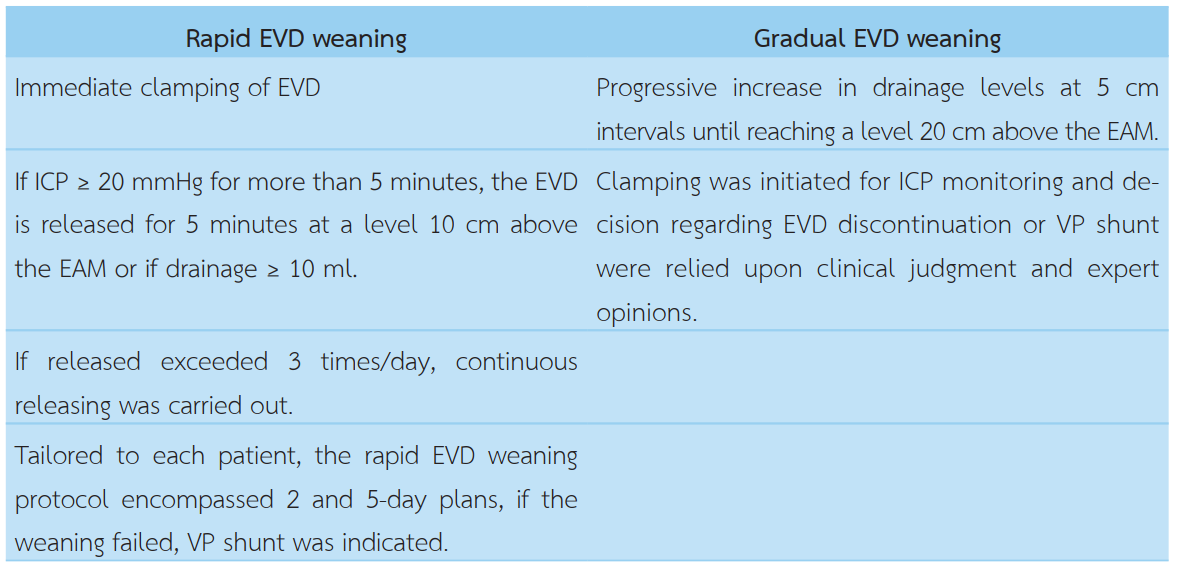
Background: External ventricular drainage (EVD) is a temporary management in patients with acute obstructive hydrocephalus from various causes. However, prolonged EVD placement is associated with significant risk of EVD-associated complications. To mitigate these risks and expedite the weaning process, a rapid external ventricular drainage weaning protocol has been proposed as a potential solution. This research aims to evaluate the efficacy of such a weaning protocol in preventing EVD-associated complications and improving patient outcomes. Methods: Between January 2020 and December 2023, a prospective cohort study was conducted in patients who underwent EVD placement. The rapid EVD weaning protocol was assigned in the cohort group. The rate of EVD-associated complications was compared to the historical control group. Results: Sixty patients were divided into rapid or gradual EVD-weaning groups (n = 30 each). EVD-related infection and complications occurred in 3.3% vs 10%; p = 0.612 and 23.3% and 40.0%: p = 0.258 in the rapid and gradual groups, respectively. Secondary outcomes—VP shunt rate, hospital length of stay, ICU stay, and EVD duration—did not differ significantly between groups. Only EVD-weaning duration was shorter with rapid weaning (4.4 vs 7.61 days; p=0.002). Conclusion: The results indicate that rapid EVD weaning may shorten the weaning process without adversely affecting clinical outcomes or increasing complication rates. Confirmation in larger, adequately powered studies with extended follow-up is needed to define its role in neurocritical care.
Downloads
References
Gu C, Lind ANR, Haldrup M, Eschen JT, Eskildsen MH, Kjær A, et al. Outcomes and complications of external ventricular drainage in primary and secondary intraventricular hemorrhage: a descriptive observational study. J Neurosurg. 2025 June 1;142(6):1599-605. https://doi.org/10.3171/2024.8.JNS24915
Huang TF, Su YK, Su IC, Yeh YK, Liu HW, Kan IH, et al. Risk, Predictive, and Preventive Factors for Noninfectious Ventriculitis and External Ventricular Drain Infection. Neurocrit Care. 2024 Aug;41(1):109-18. https://doi.org/10.1007/s12028-023-01925-9
Khalaveh F, Fazel N, Mischkulnig M, Vossen MG, Reinprecht A, Dorfer C, et al. Risk Factors Promoting External Ventricular Drain Infections in Adult Neurosurgical Patients at the Intensive Care Unit-A Retrospective Study. Front Neurol. 2021 Nov 8;12:734156.
https://doi.org/10.3389/fneur.2021.734156
Fried HI, Nathan BR, Rowe AS, Zabramski JM, Andaluz N, Bhimraj A, et al. The Insertion and Management of External Ventricular Drains: An Evidence-Based Consensus Statement : A Statement for Healthcare Professionals from the Neurocritical Care Society. Neurocrit Care. 2016 Feb;24(1):61-81. https://doi.org/10.1007/s12028-015-0224-8
Tavakoli S, Peitz G, Ares W, Hafeez S, Grandhi R. Complications of invasive intracranial pressure monitoring devices in neurocritical care. Neurosurg Focus. 2017 Nov;43(5):E6. https://doi.org/10.3171/2017.8.FOCUS17450
Poblete R, Zheng L, Raghavan R, Cen S, Amar A, Sanossian N, et al. Trends in VentriculostomyAssociated Infections and Mortality in Aneurysmal Subarachnoid Hemorrhage: Data From the Nationwide Inpatient Sample. World Neurosurg. 2017 Mar;99:599-604. https://doi.org/10.1016/j.wneu.2016.12.073
Holloway KL, Barnes T, Choi S, Bullock R, Marshall LF, Eisenberg HM, et al. Ventriculostomy infections: the effect of monitoring duration and catheter exchange in 584 patients. J Neurosurg. 1996 Sept;85(3):419-24. https://doi.org/10.3171/jns.1996.85.3.0419
Klopfenstein JD, Kim LJ, Feiz-Erfan I, Hott JS, Goslar P, Zabramski JM, et al. Comparison of rapid and gradual weaning from external ventricular drainage in patients with aneurysmal subarachnoid hemorrhage: a prospective randomized trial. J Neurosurg. 2004 Feb;100(2):225-9. https://doi.org/10.3171/jns.2004.100.2.0225
Jabbarli R, Pierscianek D, RÖlz R, Reinhard M, Darkwah Oppong M, Scheiwe C, et al. Gradual External Ventricular Drainage Weaning Reduces The Risk of Shunt Dependency After Aneurysmal Subarachnoid Hemorrhage: A Pooled Analysis. Oper Neurosurg. 2018 Nov 1;15(5):498-504. https://doi.org/10.1093/ons/opy009
Chung DY, Leslie-Mazwi TM, Patel AB, Rordorf GA. Management of External Ventricular Drains After Subarachnoid Hemorrhage: A MultiInstitutional Survey. Neurocrit Care. 2017 June; 26(3):356-61. https://doi.org/10.1007/s12028-016-0352-9
Rao SS, Chung DY, Wolcott Z, Sheriff F, Khawaja AM, Lee H, et al. Intermittent CSF drainage and rapid EVD weaning approach after subarachnoid hemorrhage: association with fewer VP shunts and shorter length of stay. J Neurosurg. 2020 May 1;132(5):1583-8. https://doi.org/10.3171/2019.1.JNS182702
Chung DY, Thompson BB, Kumar MA, Mahta A, Rao SS, Lai JH, et al. Association of External Ventricular Drain Wean Strategy with Shunt Placement and Length of Stay in Subarachnoid Hemorrhage: A Prospective Multicenter Study. Neurocrit Care. 2022 Apr;36(2):536-45. https://doi.org/10.1007/s12028-021-01343-9
Downloads
Published
How to Cite
Issue
Section
License
Copyright (c) 2025 Thai Journal of Neurological Surgery

This work is licensed under a Creative Commons Attribution-NonCommercial-NoDerivatives 4.0 International License.
Articles in this journal are copyrighted by the x may be read and used for academic purposes, such as teaching, research, or citation, with proper credit given to the author and the journal.use or modification of the articles is prohibited without permission.
statements expressed in the articles are solely the opinions of the authors.
authors are fully responsible for the content and accuracy of their articles.
other reuse or republication requires permission from the journal."


