
Infantile High-Grade Glioma : A Case Report from Southern Thailand
Keywords:
Infantile high-grade glioma, neuro-oncology, seizure, glioma, infant-type hemispheric gliomasAbstract
Background: High-grade gliomas (HGG) in infants under 1 year of age are rare, biologically distinct tumors that often present with subtle, nonspecific symptoms. Early diagnosis remains challenging in resource-limited settings.
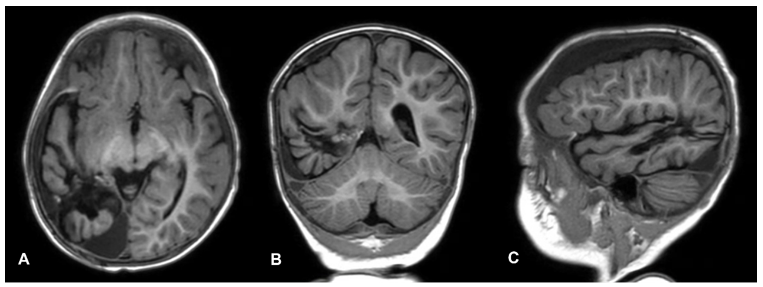
Case: We present the case of an 11-month-old Thai girl with one month of progressive early-morning vomiting, irritability, head-grabbing behavior, and recurrent falls. She developed an acute generalized tonic-clonic seizure before hospital arrival. Magnetic resonance imaging revealed a large supratentorial mass with mass effect. Gross total resection was performed. Histopathology demonstrated high-grade glioma with anaplastic features, brisk mitoses, microvascular proliferation, and a Ki-67 index of 35%. Immunohistochemistry showed GFAP positivity, positive H3K27me3, and negative IDH1-R132H. Molecular fusion testing was not available. Postoperative recovery was uneventful, and adjuvant chemotherapy following the Thai POG-BT-131FB protocol was planned.
Discussion: Infantile HGG is a rare and biologically distinct tumor that often presents with nonspecific symptoms, leading to diagnostic delay, particularly in resource-limited settings. In this case, persistent early-morning vomiting and acute seizure activity were key clinical warning signs prompting neuroimaging and timely intervention. Although many infantile hemispheric gliomas are driven by oncogenic kinase fusions, molecular testing was unavailable; therefore, diagnosis relied on characteristic histopathological and immunohistochemical features. Maximal safe resection remains the cornerstone of management and a critical determinant of outcome. Given the substantial neurodevelopmental risks of radiotherapy in infants, chemotherapy-based regimens are favored as first-line adjuvant therapy to achieve disease control while minimizing long-term toxicity.
Conclusion: This case highlights key diagnostic clues for infantile HGG and emphasizes the need for early neuroimaging in infants presenting with persistent vomiting and acute neurological changes. Multimodal treatment -including maximal safe resection and chemotherapy -is essential in this age group.
Downloads
References
Ostrom QT, de Blank PM, Kruchko C, et al. Alex’s Lemonade Stand Foundation infant and childhood primary brain and central nervous system tumors diagnosed in the United States in 2007–2011. Neuro Oncol. 2014;16(Suppl 10):x1–36. doi:10.1093/neuonc/nou327.
Fangusaro J. Pediatric high grade glioma: a review and update on tumor clinical characteristics and biology. Front Oncol. 2012;2:105. doi:10.3389/fonc.2012.00105.
Louis DN, Perry A, Wesseling P, Brat DJ, Cree IA, Figarella-Branger D, et al. The 2021 WHO classification of tumors of the central nervous system: a summary. Neuro Oncol. 2021;23(8):1231–51. doi:10.1093/neuonc/noab106.
Chavaz L, Bagchi A, Dhanda SK, et al. A systematic study of molecular diagnosis, treatment and prognosis in infant-type hemispheric glioma: an individual patient data meta-analysis of 164 patients. Neuro Oncol. 2025 Nov 8;noaf264. Epub ahead of print. doi:10.1093/neuonc/noaf264. PMID:41206756.
Bagchi A, Chiang J, Pinto S, Dhanda S, Gajjar A. Infant-type hemispheric gliomas: a review of clinical, radiologic, histopathologic, and molecular features. J Natl Compr Canc Netw. 2025;23(11):e257064. doi:10.6004/jnccn.2025.7064.
Guerreiro Stucklin AS, Ryall S, Fukuoka K, Zapotocky M, Lassaletta A, Li C, Bridge T, Kim B, et al. Alterations in ALK/ROS1/NTRK/MET drive a group of infantile hemispheric gliomas. Nat Commun. 2019;10(1):4343. doi:10.1038/s41467-019-12187-5.
Buccoliero AM, Giunti L, Moscardi S, Castiglione F, Provenzano A, Sardi I, et al. Pediatric high-grade glioma classification criteria and molecular features of a case series. Genes (Basel). 2022;13(4):624. doi:10.3390/genes13040624.
Jones C, Karajannis MA, Jones DTW, Kieran MW, Monje M, Baker SJ, et al. Pediatric high-grade glioma: biologically and clinically in need of new thinking. Neuro Oncol. 2017;19(2):153–61. doi:10.1093/neuonc/now101.
Baugh JN, Gielen GH, van Vuurden DG, Veldhuijzen van Zanten SEM, Hargrave D, Massimino M, et al. Transitioning to molecular diagnostics in pediatric high-grade glioma: experiences with the 2016 WHO classification of CNS tumors. Neurooncol Adv. 2021;3(1):vdab113. doi:10.1093/noajnl/vdab113.
Papusha L, Zaytseva M, Senchenko M, Panferova A, Sanakoeva A, Artemov A, et al. Challenges in diagnostics and treatment of infant-type hemispheric gliomas. Neurooncol Adv. 2025;7(1):vdaf124. doi:10.1093/noajnl/vdaf124.
Lu VM, O’Connor KP, Himes BT, Brown DA, Nesvick CL, Siada RG, et al. Effect of surgery and chemotherapy on long-term survival in infants with congenital glioblastoma: an integrated survival analysis. J Neurosurg Pediatr. 2020;26(5):563–71. doi:10.3171/2020.5.PEDS20226.
Tunthanathip T, Madteng S. Factors associated with the extent of resection of glioblastoma. Precis Cancer Med. 2020;3:12. doi:10.21037/pcm.2020.01.01.
Major N, Patel NA, Bennett J, Novakovic E, Poloni D, Abraham M, et al. The current state of radiotherapy for pediatric brain tumors: an overview of post-radiotherapy neurocognitive decline and outcomes. J Pers Med. 2022;12(7):1050. doi:10.3390/jpm12071050.
Chiang J, Bagchi A, Li X, Dhanda SK, Huang J, Pinto SN, et al. High-grade glioma in infants and young children is histologically, molecularly, and clinically diverse: results from the SJYC07 trial and institutional experience. Neuro Oncol. 2024;26(1):178–90. doi:10.1093/neuonc/noad130.
Tunthanathip T, Sae-Heng S, Oearsakul T, Kaewborisutsakul A, Taweesomboonyat C. Economic impact of a machine learning-based strategy for preparation of blood products in brain tumor surgery. PLoS One. 2022;17(7):e0270916. doi:10.1371/journal.pone.0270916.
Clarke M, Mackay A, Ismer B, Pickles JC, Tatevossian RG, Newman S, et al. Infant high-grade gliomas comprise multiple subgroups characterized by novel targetable gene fusions and favorable outcomes. Cancer Discov. 2020;10(7):942–63. doi:10.1158/2159-8290.CD-19-1030.
Jitchanvichai J, Tunthanathip T. Cost-effectiveness of intracranial pressure monitoring in severe traumatic brain injury in Southern Thailand. Acute Crit Care. 2025;40(1):69–78. doi:10.4266/acc.004080.
Downloads
Published
How to Cite
Issue
Section
License
Copyright (c) 2026 Thai Journal of Neurological Surgery

This work is licensed under a Creative Commons Attribution-NonCommercial-NoDerivatives 4.0 International License.
Articles in this journal are copyrighted by the x may be read and used for academic purposes, such as teaching, research, or citation, with proper credit given to the author and the journal.use or modification of the articles is prohibited without permission.
statements expressed in the articles are solely the opinions of the authors.
authors are fully responsible for the content and accuracy of their articles.
other reuse or republication requires permission from the journal."


