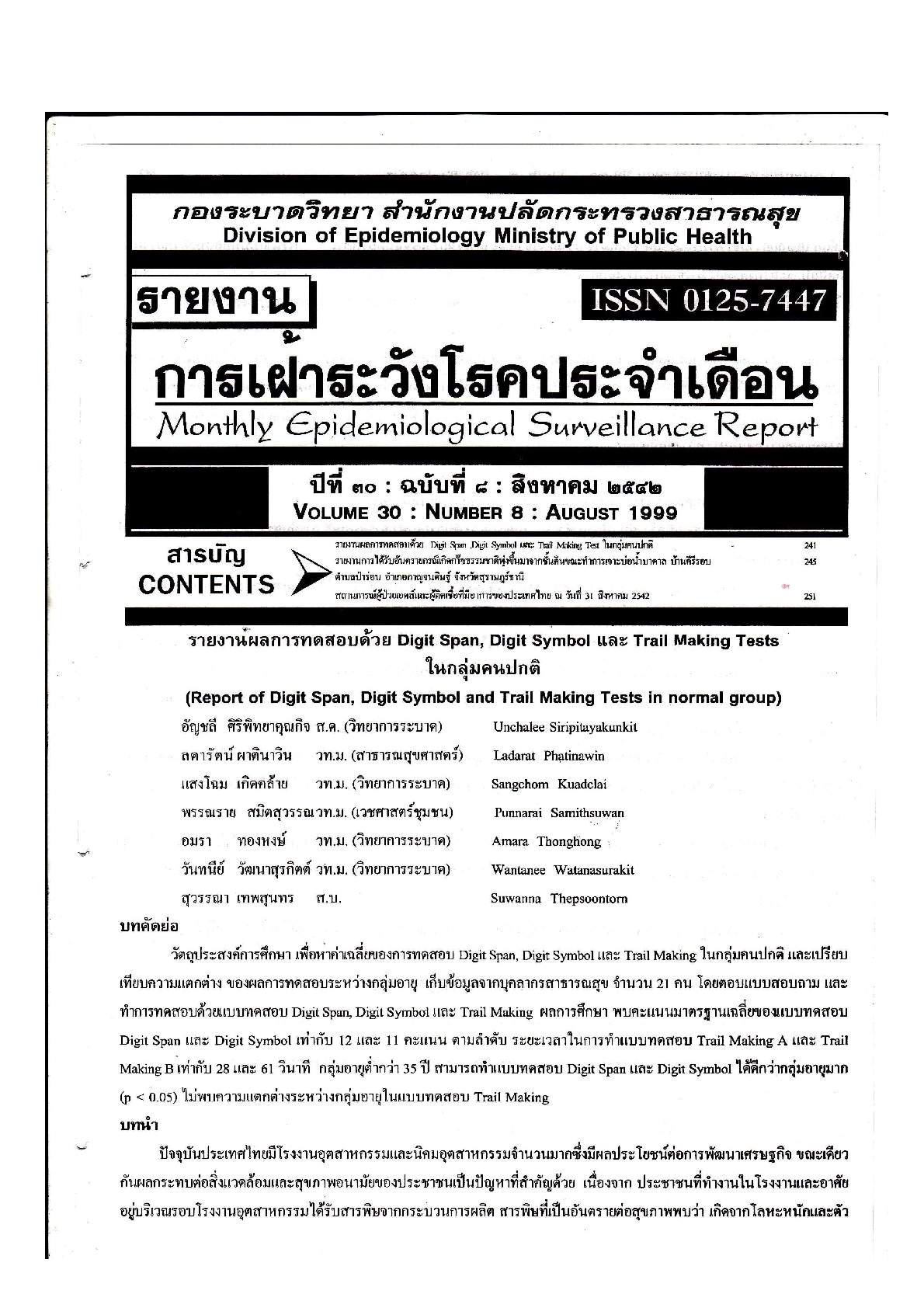
Report of Digit Span, Digit Symbol and Trail Making Tests in normal group
Abstract
วัตถุประสงค์การศึกษา เพื่อหาค่าเฉลี่ยของการทดสอบ Digit Span, Digit Symbol และ Trail Making ในกลุ่มคนปกติ และเปรียบเทียบความแตกต่างของผลการทดสอบระหว่างกลุ่มอายุ เก็บข้อมูลจากบุคลากรสาธารณสุข จำนวน 21 คน โดยตอบแบบสอบถาม และทำการทดสอบด้วยแบบทดสอบ Digit Span, Digit Symbol และ Trail Making ผลการศึกษา พบคะแนนมาตรฐานเฉลี่ยของแบบทดสอบ Digit Span และ Digit Symbol เท่ากับ 12 และ 11 คะแนน ตามลำดับ ระยะเวลาในการทำแบบทดสอบ Trail Making A และ Trail Making B เท่ากับ 28 และ 61 วินาที กลุ่มอายุต่ำกว่า 35 ปี สามารถทำแบบทดสอบ Digit Span และ Digit Symbol ได้ดีกว่ากลุ่มอายุมาก (p < 0.05) ไม่พบความแตกต่างระหว่างกลุ่มอายุในแบบทดสอบ Trail Making
References
Amler RW, Lybarger JA. "Research program for neurotoxic disorders and other adverse health outcomes at hazardous chemical sites in the United States of America".Environ Research 1993; 61: 279-284.
Simonsen L, Lund SP, Hass U. "An approach to risk assessment."Neurotoxicology1996; 17: 815-824.
Mikkelsen S "Epidemiological update on solvent neurotoxicity." Environ Research 1997; 73: 101-112.
Valciukas JA, Lilis R. "Psychometric techniques in environmental research." Environ Research 1980; 21: 275-297.
Golden CJ. Diagnosis and rehabilitation in clinical neuropsychology.2nd edition. Illinois: Charles C Thomas Publisher, 1981.
Wechsler D. The measurement and appraisal of adult intelligence. Baltimore: Waverly Press, Inc., 1961.
Lindemann JE, Matarazzo JD. "Intellectual assessment of adults." In Goldstein G, Hersen M, eds. Handbook of psychological assessment. New York : Pergamon Press Inc., 1984.
วิไลพร ชัยสงคราม. "การเปรียบเทียบผลการทดสอบระหว่างผู้ป่วยที่มีพยาธิสภาพทางสมองกับคนปกติ โดยใช้แบบทดสอบเทร์ลเมดคิงและแบบทดสอบอะเฟเซียสกรีนนิง". วิทยานิพนธ์หลักสูตรวิทยาศ่าสตร์มหาบัณฑิต สาขาจิตวิทยาคลินิค, คณะบัณฑิตวิทยาลัย มหาวิทยาลัยมหิดล, 2532.
Downloads
Published
How to Cite
Issue
Section
License
Copyright (c) 1999 Weekly Epidemiological Surveillance Report

This work is licensed under a Creative Commons Attribution-NonCommercial-NoDerivatives 4.0 International License.
Responsibility and Copyright
1. Author Responsibility and Editorial Disagreement
The content and data in all articles published in WESR are the direct opinions and responsibility of the article authors, and the Journal's Editorial Board is not necessarily in agreement with, or jointly responsible for, them.
2. Copyright and Referencing
All articles, data, content, figures, etc., published in WESR are considered the copyright of the academic journal. If any individual or entity wishes to disseminate all or any part of the published material, appropriate citation of the article is required.