
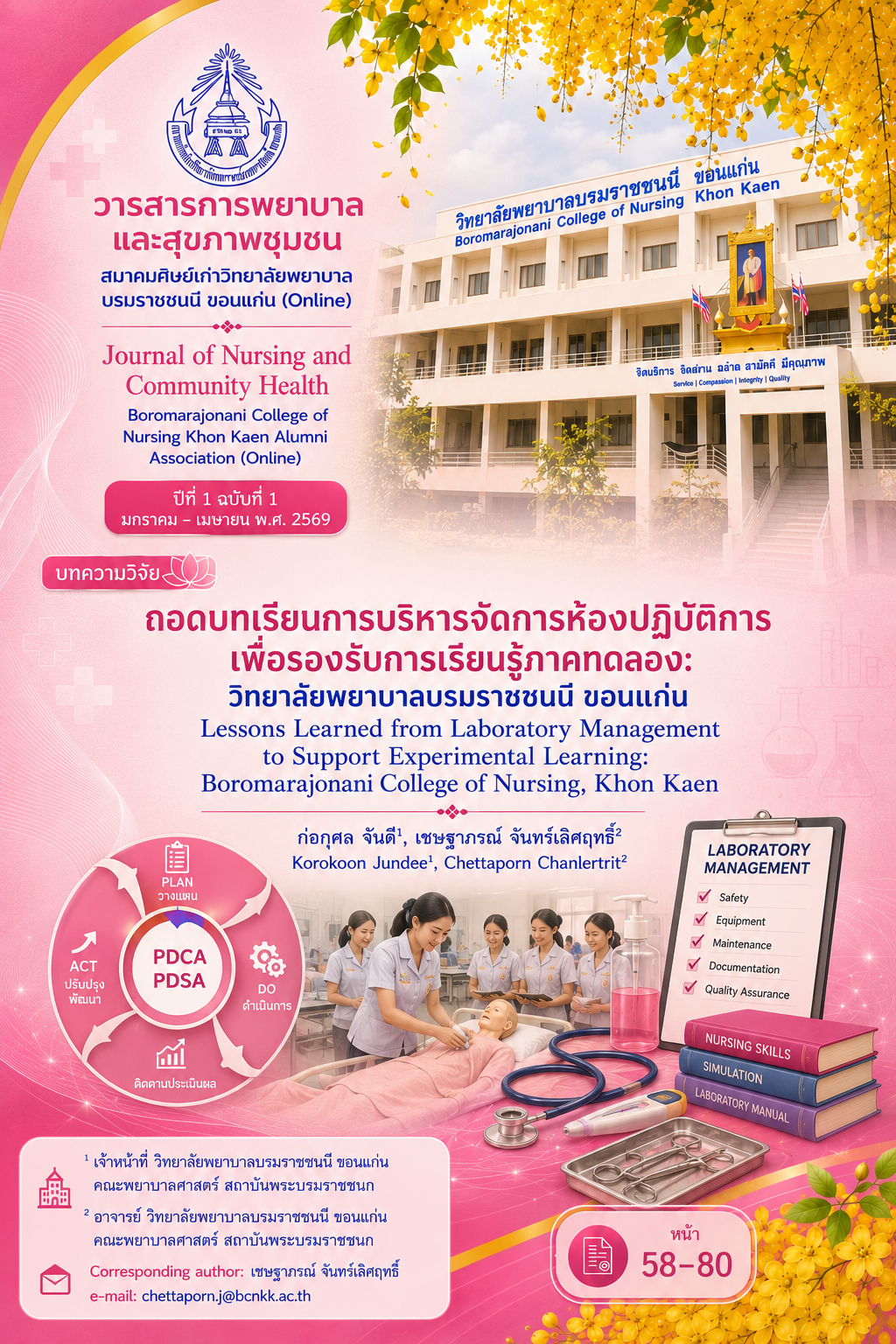
Lessons Learned from Skills Laboratory Management to Support Experiential Learning: Boromarajonani College of Nursing, Khon Kaen
Keywords:
skills laboratory; experiential learning; management system; PDCA/PDSA; quality assuranceAbstract
Experiential learning is a crucial mechanism in producing nursing graduates with competencies in clinical skills, critical thinking, and patient safety. The skills laboratory serves as essential infrastructure that must be adequately prepared, standardized, and supported by an auditable management system. This lesson-learned academic article aims to synthesize a laboratory management system that supports experiential learning for students across all programs at Boromarajonani College of Nursing, Khon Kaen. The synthesis emphasizes a systems-based approach encompassing structural governance, operational processes, and monitoring and evaluation, including equipment lending and return services that support both internal and external units in accordance with official administrative requests.
The lesson-learned framework integrates the Structure–Process–Outcome model with the quality improvement cycle (PDCA/PDSA) to explain the interrelationships among responsible roles, documentation and information systems, safety measures, management of equipment and consumables, scheduling and pre-instruction readiness, skills training support, and service performance evaluation. The findings identify the “minimum essential system components” required to ensure continuous readiness of skills laboratories for experiential learning. These include a clearly defined governance structure, comprehensive standard operating procedures (SOPs) covering room preparation, equipment lending and return, maintenance, and safety, an evidence-based documentation and indicator dashboard, and a post-semester review mechanism to drive continuous improvement. The article offers practical recommendations for nursing education institutions to develop laboratory management systems aligned with quality assurance and accreditation standards.
References
สภาการพยาบาล. (2568). คู่มือการรับรองสถาบันการศึกษาวิชาการพยาบาลและการผดุงครรภ์ ฉบับปรับปรุง
พ.ศ. 2568 [ออนไลน์]. สืบค้นเมื่อ 17 ธันวาคม 2568, จาก
https://www.tnmc.or.th/tnmc/public/images/userfiles/files/okk.pdf
สภาการพยาบาล. (ม.ป.ป.). การรับรองสถาบันการศึกษา (หน้ารวบรวมเอกสาร/ขั้นตอน) [ออนไลน์]. สืบค้นเมื่อ
ธันวาคม 2568, จาก https://www.tnmc.or.th/news/35
อมรโรจน์วรวุฒิ, ว., & นรสาร, ศ. (2568). บทบาทผู้นำพยาบาลยุคใหม่ในการขับเคลื่อนองค์กรวิชาชีพไม่แสวงหา
ผลกำไรผ่านเครือข่ายวิชาการและนวัตกรรม. วารสารศูนย์อนามัยที่ 7 ขอนแก่น, 17(2), 1–12.
https://he01.tci-thaijo.org/index.php/johpc7/article/view/278183
Ayanian, J. Z., & Markel, H. (2016). Donabedian’s lasting framework for health care quality. New
England Journal of Medicine, 375(3), 205–207.
Deming Institute. (n.d.). PDSA cycle [Online]. Retrieved December 17, 2025, from
https://deming.org/explore/pdsa/
Donabedian, A. (2005). Evaluating the quality of medical care. The Milbank Quarterly, 83(4), 691–
https://doi.org/10.1111/j.1468-0009.2005.00397.x
International Nursing Association for Clinical Simulation and Learning. (n.d.). Healthcare simulation
standards of best practice® [Online]. Retrieved December 17, 2025, from
https://www.inacsl.org/healthcare-simulation-standards-of-best-practice-
Taylor, M. J., McNicholas, C., Nicolay, C., Darzi, A., Bell, D., & Reed, J. E. (2014). Systematic review
of the application of the plan–do–study–act method to improve quality in healthcare.
BMJ Quality & Safety, 23, 290–298.
Downloads
Published
How to Cite
Issue
Section
License
Copyright (c) 2026 Journal of Nursing and Community Health, Boromarajonani College of Nursing Khon Kaen Alumni Association (Online)

This work is licensed under a Creative Commons Attribution-NonCommercial-NoDerivatives 4.0 International License.
Articles in this journal are copyrighted by the x may be read and used for academic purposes, such as teaching, research, or citation, with proper credit given to the author and the journal.use or modification of the articles is prohibited without permission.
statements expressed in the articles are solely the opinions of the authors.
authors are fully responsible for the content and accuracy of their articles.
other reuse or republication requires permission from the journal."


