
Development of a Sensor-Enabled Arm Simulator and Its Effects on Nursing Students’ Learning of Intravenous Infusion Skills
Abstract
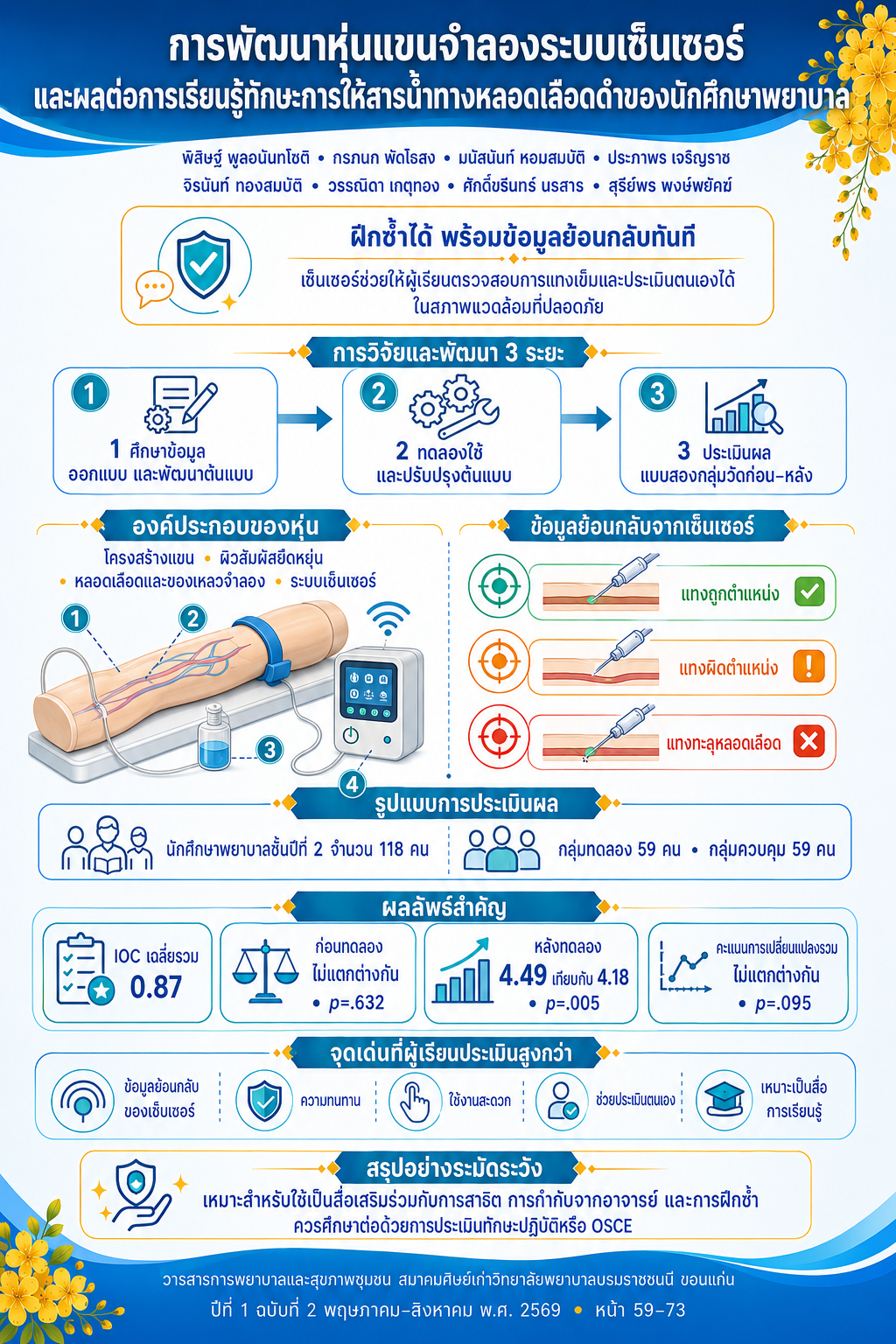
This research and development study aimed to: 1) develop a sensor-enabled arm simulator for intravenous infusion practice among nursing students, and 2) examine the effects of using the simulator on perceived learning of intravenous infusion skills and self-awareness. The study was conducted in three phases: Phase 1 involved a review of relevant information, prototype design and development, and evaluation by three experts; Phase 2 comprised pilot testing and prototype refinement; and Phase 3 employed a two-group pretest–posttest quasi-experimental design. The participants were 118 second-year nursing students, equally assigned to an experimental group and a control group, with 59 students in each group. The experimental group practiced using the sensor-enabled arm simulator, whereas the control group received the comparison training condition. Data were collected using a five-point rating-scale questionnaire covering simulator characteristics, perceived learning, and self-awareness. Data were analyzed using descriptive statistics and Welch’s independent-samples t-test.
The developed simulator consisted of an arm structure, flexible skin, a simulated vascular and fluid system, and a sensor system that provided immediate feedback for correct needle insertion, incorrect placement, and vessel penetration. The item-objective congruence indices ranged from 0.67 to 1.00, with an overall mean of 0.87. At pretest, the mean scores of the experimental and control groups were not significantly different (M=4.05, SD=0.64 and M=3.99, SD=0.64, respectively; p=.632). At posttest, the experimental group had a significantly higher mean score than the control group (M=4.49, SD=0.52 and M=4.18, SD=0.64, respectively; mean difference=0.32, 95% CI 0.10–0.53, p=.005). However, the between-group difference in change scores was not statistically significant (p=.095). Item-level analyses showed significant differences in sensor feedback, durability, ease of use, support for self-assessment, and overall suitability as a learning resource.
The sensor-enabled arm simulator was suitable for supporting nursing students’ learning and self-assessment. However, as the outcomes were based on students’ perceptions, future studies should incorporate objective assessments of clinical performance.
References
Alexander M, Corrigan A, Gorski L, Hankins J, Perucca R. Infusion therapy standards of practice. J Infus Nurs. 2019;42(1 Suppl):S1–S224.
World Health Organization. Guidelines for the prevention of bloodstream infections and other infections associated with the use of intravascular catheters: part 1, peripheral catheters. Geneva: World Health Organization; 2024.
Koukourikos K, Tsaloglidou A, Kourkouta L, Papathanasiou IV, Iliadis C, Fratzana A, et al. Simulation in clinical nursing education. Acta Inform Med. 2021;29(1):15–20.
Kim J, Park JH, Shin S. Effectiveness of simulation-based nursing education depending on fidelity: a meta-analysis. BMC Med Educ. 2016;16:152.
Cant RP, Cooper SJ. Use of simulation-based learning in undergraduate nurse education: an umbrella systematic review. Nurse Educ Today. 2017;49:63–71.
Choeichom S, Rujivatanakorn D. Innovation of arm manikin in practicing intravenous fluid administration of nursing students. Rama Nurs J. 2015;21(3):395–409.
Wongprad M, Phonmueang C, Norkaew P, Singwisut S, Donwicha A, Khongkam A, et al. Development of a simulated arm model for practicing intravenous fluid administration among nursing students. Journal of Education, Mahasarakham University. Forthcoming.
Kolb DA. Experiential learning: experience as the source of learning and development. Englewood Cliffs: Prentice Hall; 1984.
ก่อกุศล จันดี, เชษฐาภรณ์ จันทร์เลิศฤทธิ์. ถอดบทเรียนการบริหารจัดการห้องปฏิบัติการเพื่อรองรับการเรียนรู้ภาคทดลอง: วิทยาลัยพยาบาลบรมราชชนนี ขอนแก่น. วารสารการพยาบาลและสุขภาพชุมชน สมาคมศิษย์เก่าวิทยาลัยพยาบาลบรมราชชนนี ขอนแก่น. 2569;1(1):58–81.
Downloads
Published
How to Cite
Issue
Section
License
Copyright (c) 2026 Journal of Nursing and Community Health, Boromarajonani College of Nursing Khon Kaen Alumni Association (Online)

This work is licensed under a Creative Commons Attribution-NonCommercial-NoDerivatives 4.0 International License.
Articles in this journal are copyrighted by the x may be read and used for academic purposes, such as teaching, research, or citation, with proper credit given to the author and the journal.use or modification of the articles is prohibited without permission.
statements expressed in the articles are solely the opinions of the authors.
authors are fully responsible for the content and accuracy of their articles.
other reuse or republication requires permission from the journal."


