Factors associated with colorectal cancer screening decision-making among older adults at the Comprehensive Geriatric Clinic, King Chulalongkorn Memorial Hospital, Thai Red Cross Society
Keywords:
Associated factors, colonoscopy, colorectal cancer screening, fecal occult blood, older adultAbstract
Background: The incidence of colorectal cancer (CRC) in Thailand is constantly increasing and is highest in individuals aged 60-75 years. However, the number of older individuals undergoing CRC screening remains suboptimal.
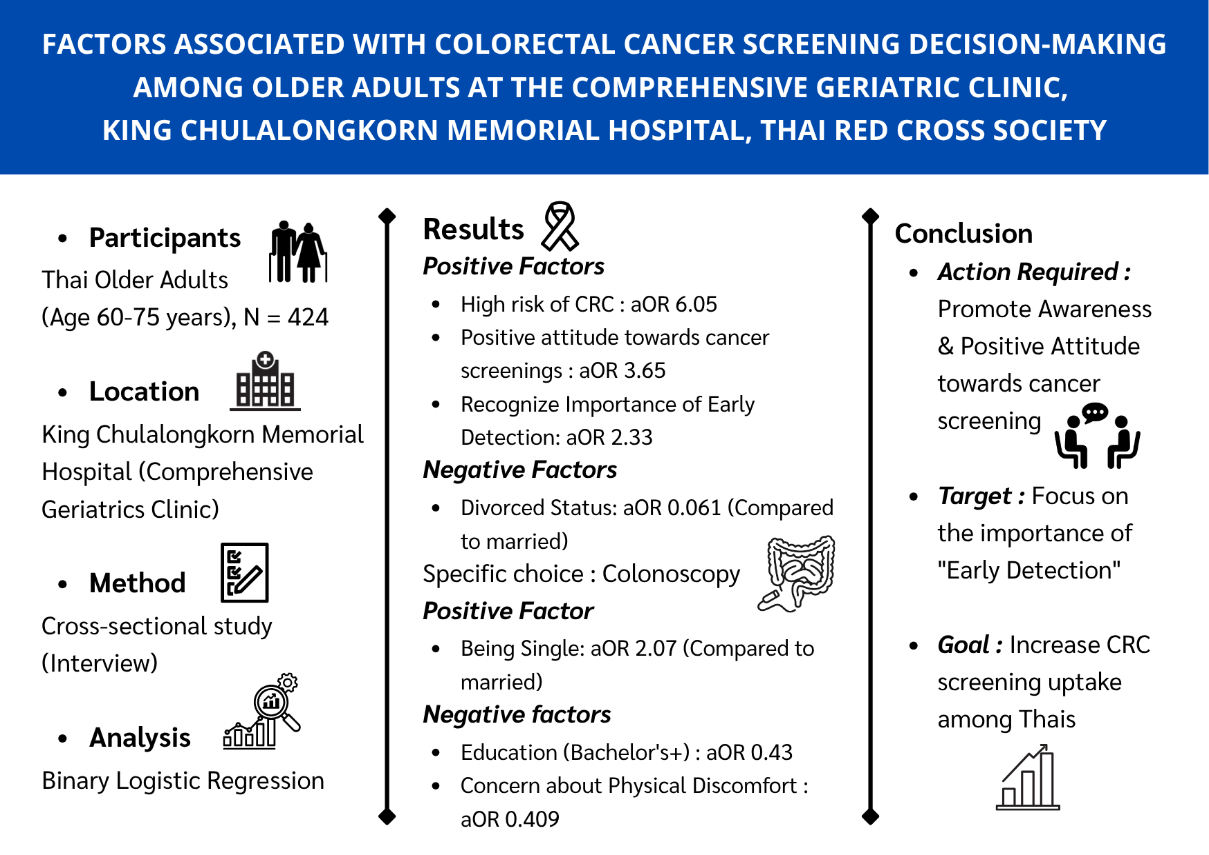
Objectives: This study aimed to identify factors associated with CRC screening decision-making among Thai older adults attending the Comprehensive Geriatric Clinic at King Chulalongkorn Memorial Hospital. The secondary objective was to identify factors associated with the choice of screening method—colonoscopy versus fecal occult blood testing (FOBT).
Methods: A cross-sectional study was conducted using a data record form at the Comprehensive Geriatrics Clinic, King Chulalongkorn Memorial Hospital in Bangkok, Thailand, from September to October 2023. Participants aged 60-75 were interviewed to collect information about factors associated with CRC screening decision-making, which were categorized into five groups: demographic, health, psychological, physician, and social factors. Participants were classified into two groups based on their intention to undergo CRC screening. The factors preliminarily associations using the Chi-square test and the Mann-Whitney U test. The factors with a P < 0.2 were then analysed by a binary logistic regression for identifying factors that were significantly associated with the decision to undergo CRC screening as primary outcome and the choice of method as secondary outcome.
Results: A total of 424 valid responses were obtained, with 320 respondents intending to undergo CRC screening. The binary logistic regression analysis revealed significant associations between CRC screening decision and the following factors: high risk for CRC (aOR 6.05, 95%CI 2.42 15.13), positive attitude towards cancer screening (aOR 3.65, 95%CI 2.19 6.10), recognition of the importance of early detection (aOR 2.33, 95%CI 1.32 4.11), and being divorced, as compared to being married (aOR 0.06, 95%CI 0.01 0.49). The decision to undergo colonoscopy for the CRC screening was associated with an education level of having at least a bachelor’s degree (aOR 0.43, 95%CI 0.24 0.75), being single, as compared to being married (aOR 2.08, 95%CI 1.20 3.58), and concerns about physical discomfort from CRC screening (aOR 0.41, 95%CI 0.19 0.90).
Conclusion: Factors associated with CRC screening decision-making uptake amongst older adults, attending a geriatric clinic in a tertiary care hospital in Bangkok, that can be promoted include having a positive attitude towards cancer screening and the recognition of the importance of early detection. Therefore, raising awareness and highlighting the importance of cancer screening may help increase the rates of CRC screening in Thailand in the future.
Downloads
References
Lohsiriwat V, Chaisomboon N, Pattana-Arun J. Current Colorectal Cancer in Thailand. Ann Coloproctol 2020;36:78-82.
https://doi.org/10.3393/ac.2020.01.07
Charoenkajornchai S, Sangrajrang S, Dhamaraks S. Colorectal cancer screening in the thai public health system. Thai Cancer J 2002:42:86-103
Atkinson TM, Salz T, Touza KK, Li Y, Hay JL. Does colorectal cancer risk perception predict screening behavior? A systematic review and meta-analysis. J Behav Med 2015;38:837-50.
https://doi.org/10.1007/s10865-015-9668-8
Choi E, Lee YY, Suh M, Park B, Jun JK, Kim Y, et al. Associations of perceived risk and cancer worry for colorectal cancer with screening behaviour. J Health Psychol 2018;23:840-52.
https://doi.org/10.1177/1359105316679721
Gimeno Garcia AZ, Hernandez Alvarez Buylla N, Nicolas-Perez D, Quintero E. Public awareness of colorectal cancer screening: knowledge, attitudes, and interventions for increasing screening uptake. ISRN Oncol 2014;2014:425787.
https://doi.org/10.1155/2014/425787
Sifri R, Rosenthal M, Hyslop T, Andrel J, Wender R, Vernon SW, et al. Factors associated with colorectal cancer screening decision stage. Prev Med 2010;51:329-31.
https://doi.org/10.1016/j.ypmed.2010.06.015
El-Haddad B, Dong F, Kallail KJ, Hines RB, Ablah E. Association of marital status and colorectal cancer screening participation in the USA. Colorectal Dis 2015;17:O108-14.
https://doi.org/10.1111/codi.12926
Gram MA, Therkildsen C, Clarke RB, Andersen KK, Mørch LS, Tybjerg AJ. The influence of marital status and partner concordance on participation in colorectal cancer screening. Eur J Public Health 2021;31:340-6.
https://doi.org/10.1093/eurpub/ckaa206
Chen CC, Basch CE, Yamada T. An evaluation of colonoscopy use: implications for health education. J Cancer Educ 2010;25:160-5.
https://doi.org/10.1007/s13187-009-0024-y
Frederiksen BL, Jørgensen T, Brasso K, Holten I, Osler M. Socioeconomic position and participation in colorectal cancer screening. Br J Cancer 2010;103:1496-501.
https://doi.org/10.1038/sj.bjc.6605962
Hermann S, Friedrich S, Haug U, Rohrmann S, Becker N, Kaaks R. Association between socioeconomic and demographic characteristics and utilization of colonoscopy in the EPIC-Heidelberg cohort. Eur J Cancer Prev 2015;24:81-8.
https://doi.org/10.1097/CEJ.0000000000000080
Stimpson JP, Wilson FA, Watanabe-Galloway S, Peek MK. The effect of marriage on utilization of colorectal endoscopy exam in the United States. Cancer Epidemiol 2012;36:e325-32.
https://doi.org/10.1016/j.canep.2012.05.005
Anderson JC, Fortinsky RH, Kleppinger A, Merz-Beyus AB, Huntington CG 3rd, Lagarde S. Predictors of compliance with free endoscopic colorectal cancer screening in uninsured adults. J Gen Intern Med 2011;26:875-80.
Downloads
Published
How to Cite
Issue
Section
License
Copyright (c) 2026 Chulalongkorn Medical Journal

This work is licensed under a Creative Commons Attribution-NonCommercial-NoDerivatives 4.0 International License.