Epidemiological analysis of scorpion-sting cases in Qeshm County, Hormozgan Province, Iran: A four-year retrospective study (2021–2024)
Keywords:
Antivenom, epidemiology, Hormozgan, Iran, Qeshm, retrospective study, scorpion stingAbstract
Background: Scorpion stings are a major public health issue in tropical and subtropical regions of Iran, particularly in Hormozgan Province, where the incidence thereof is high.
Objective: This study aimed to analyze the epidemiological, clinical, and therapeutic aspects of scorpionsting cases in Qeshm County over four years (2021–2024).
Methods: A retrospective cross-sectional study analyzed hospital records from 408 scorpion-sting cases. Information on demographic, temporal, geographical, clinical, and treatment factors was collected. Descriptive statistics (frequency, percentage, mean ± standard deviation) and analytical tests (chi-square for categorical variables) were employed for analysis.
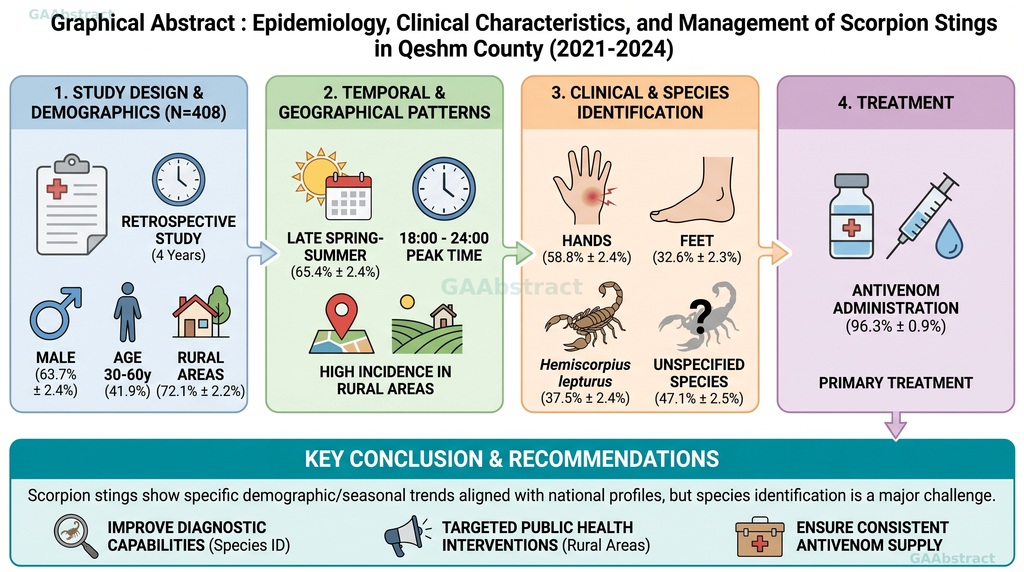
Results: The majority of victims were male (63.7% ± 2.4%), aged 30–60 years (41.9%), and residents of rural areas (72.1% ± 2.2%). The highest frequency of stings occurred from late spring to summer (65.4% ± 2.4%) and between 18:00 and 24:00. The extremities, particularly hands (58.8% ± 2.4%) and feet (32.6% ± 2.3%), were the most common sting sites. Hemiscorpius lepturus was the most frequently identified species (37.5% ± 2.4%), whereas the species remained unspecified in 47.1% ± 2.5% of cases. The primary treatment involved the administration of antivenom (96.3% ± 0.9%).
Conclusion: Scorpion stings in Qeshm County demonstrate specific demographic and seasonal trends that align with the broader epidemiological profile in Iran. However, there is a notable challenge in identifying the species involved in these incidents. This highlights the importance of improving diagnostic capabilities for species identification, implementing targeted public health interventions in rural areas, and ensuring a consistent supply of antivenom to address this ongoing health issue.
Downloads
References
Chippaux J-P, Goyffon M. Epidemiology of scorpionism: a global appraisal. Acta tropica 2008;107:71-9.
https://doi.org/10.1016/j.actatropica.2008.05.021
Jalali A, Rahim F. Epidemiological review of scorpion envenomation in Iran. Iran J Pharm Res 2014;13:743-56.
Nasirian H. Factors affecting the distribution of scorpions (Arachnida: Scorpions) in Iran. Chulal Med J 2025;69:145-51.
https://doi.org/10.56808/2673-060X.5512
Radmanesh M. Cutaneous manifestations of the Hemiscorpius lepturus sting: a clinical study. Int J Dermatol 1998;37:500-7.
https://doi.org/10.1046/j.1365-4362.1998.00386.x
Kassiri H, Kasiri N, Dianat A. Species composition, sex ratio, geographical distribution, seasonal and monthly activity of scorpions and epidemiological features of scorpionism in Zarrin-dasht County, Fars Province, Southern Iran. Asian Pac J Trop Dis 2015;5:S99-S103.
https://doi.org/10.1016/S2222-1808(15)60867-2
Nejati J, Mozafari E, Saghafipour A, Kiyani M. Scorpion fauna and epidemiological aspects of scorpionism in southeastern Iran. Asian Pac J Trop Biomed 2014;4 Suppl 1:S217-S21.
https://doi.org/10.12980/APJTB.4.2014C1323
Moosavy SH, Shahi M, Rafinejad J, Zare S, Madani A, Navidpour S. Epidemiological aspect of scorpion sting in Bandar Abbas, Iran, during 2009-2011. Electronic Physician 2016;8:2286-90.
Shahi M, Moosavy SH, Hanafi-Bojd AA, Navidpour S, Zare S, Madani A, et al. Spatial distribution of scorpion sting in a high-risk area of southern Iran. J Med Entomol 2016;53:1198-204.
https://doi.org/10.1093/jme/tjw043
World Health Organization. Rabies and envenomings: a neglected public health issue: report of a consultative meeting World Health Organization, Geneva 10 January 2007. Geneva: World Health Organization; 2007.
Nasirian H, Mohebi Nodez SM, Poudat A, Alizadeh I, Ebrahimi S, Ebrahimifar J. A novel approach to monitoring scorpion sting trends in Qeshm County over a five-year period (2019-2024). J Mazandaran Univ Med Sci 2025;35:94-103.
Shanavaz M, Zahirnia AH, Nasirian H. Monitor the rate of scorpion bites using scorpion biodiversity indices in the Shush County, Khuzestan Province. J Biodivers Anim Taxo. 2025;2 2:275-89.
Sanaei-Zadeh H, Marashi SM, Dehghani R. Epidemiological and clinical characteristics of scorpionism in Shiraz (2012-2016); development of a clinical severity grading for Iranian scorpion envenomation. Med J Islam Repub Iran 2017;31:27.
https://doi.org/10.18869/mjiri.31.27
Kassiri H, Khodkar I, Safari-Asl A, Lotfi M. Study of The frequency and incidence of scorpion envenomation in Aghajri County, Khuzestan Province, Southwestern Iran. Entomol Appl Sci Lett 2018;5:64-71.
Vazirianzadeh B, Farhadpour F, Hosseinzadeh M, Zarean M, Moravvej S. An epidemiological and clinical study on scorpionism in hospitalized children in Khuzestan, Iran. J Arthropod Borne Dis 2012;6:62-9.
Dehghani R, Charkhloo E, Seyyedi-Bidgoli N, Chimehi E, Ghavami-Ghameshlo M. A review on scorpionism in Iran. J Arthropod Borne Dis 2018;12:325-33.
https://doi.org/10.18502/jad.v12i4.350
Shahrabadi E, Moradi M, Rezaeian M, Salimabadi Y, Esmaeili Ranjbar A, Moinaddini S, et al. The epidemiological study of clinical signs and outcomes of patients with scorpion stings referred to emergency department of Rafsanjan Ali-Ibn-Abitaleb Hospital in 2017-2018: a descriptive study. J Rafsanjan Univ Med Sci 2020;19:713-26.
https://doi.org/10.29252/jrums.19.7.713
Pipelzadeh MH, Jalali A, Taraz M, Pourabbas R, Zaremirakabadi A. An epidemiological and a clinical study on scorpionism by the Iranian scorpion Hemiscorpius lepturus. Toxicon 2007;50:984-92.
https://doi.org/10.1016/j.toxicon.2007.07.018
Bagheri M, Alipour H, Keshawarz A. Epidemiological study of scorpion-sting in patients referred to medical centers of Shiraz, south-west of Iran. J Health Sci Surveill Syst 2021;9:105-10.
Zahirnia AH, Shanavaz M, Nasirian H, Davari B, Salehzadeh A. Species composition, temporal distribution, and degree of dependence of scorpion species on the environment in terms of soil texture and moisture level in Shush County, Khuzestan Province. J Maz Univ Med Sci 2023;33:126-33.
Shanavaz M, Zahirnia AH, Nasirian H. Monitoring scorpionism in Shush County of Khuzestan Province in the first six months of 2019. J Isfahan Med Sch 2023;41:319-25.
Downloads
Published
How to Cite
Issue
Section
License
Copyright (c) 2026 Chulalongkorn Medical Journal

This work is licensed under a Creative Commons Attribution-NonCommercial-NoDerivatives 4.0 International License.