Breakthrough allergic-like reactions to contrast media despite preventive measures in patients with prior reactions: A retrospective study
Keywords:
Allergic-like reaction, breakthrough reaction, contrast switching, iodinated contrast media, sidechain classificationAbstract
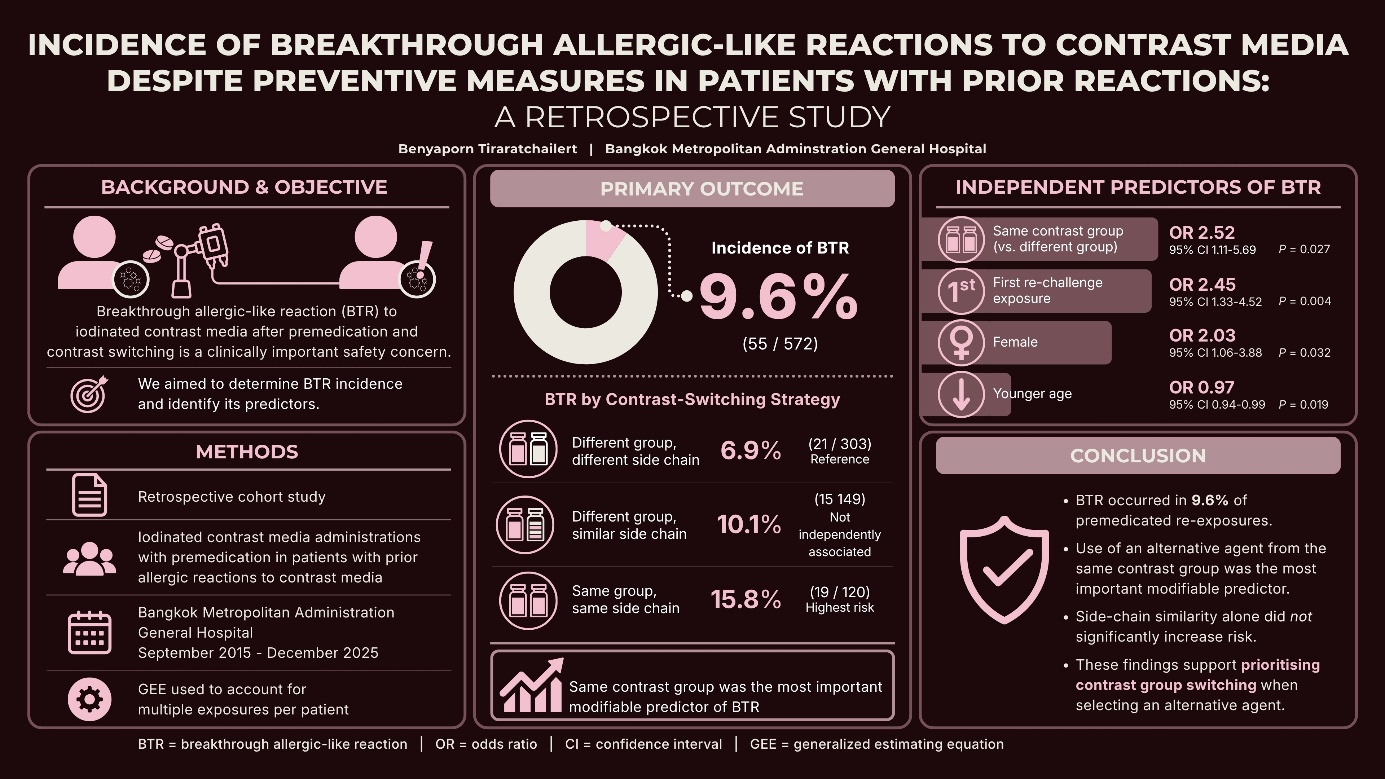
Background: Breakthrough allergic-like reaction (BTR) to iodinated contrast media, an allergic-like reaction despite premedication and contrast switching, remains an important safety concern.
Objective: To determine BTR incidence and identify its predictors, particularly whether contrast group membership and side-chain similarity are associated with reaction risk.
Methods: A retrospective cohort study of iodinated contrast media administration with premedication in patients with prior allergic-like reactions at Bangkok Metropolitan Administration General Hospital (September 2015–December 2025). The primary outcome was BTR incidence. Contrast administration was classified into three categories: 1) different group, different side chain; 2) different group, similar side chain; and 3) same group, same side chain. Generalized estimating equations (GEE) was used to account for multiple exposures per patient.
Results: A total of 572 contrast administrations from 210 patients were included; BTR occurred in 55 (9.6%, 95% CI 7.20%–12.03%). Independent predictors in the GEE model included same contrast group (OR 2.52, 95% CI 1.11–5.69, P = 0.027), female sex (OR 2.03, 95% CI 1.06–3.88, P = 0.032), younger age (OR 0.97 per year, 95% CI 0.94–0.99, P = 0.019), and first rechallenge exposure (OR 2.45, 95% CI 1.33–4.52, P = 0.004). Differentgroup switching with similar side chains was not independently associated with BTR.
Conclusion: BTR occurred in 9.6% of premedicated re-exposures. An alternative agent from the same contrast group was the most important modifiable predictor, while side-chain similarity alone did not significantly increase risk. This supports prioritizing contrast group switching when choosing an alternative agent.
Downloads
References
Cochran ST, Bomyea K, Sayre JW. Trends in adverse events after IV administration of contrast media. AJR Am J Roentgenol 2001;176:1385-8.
https://doi.org/10.2214/ajr.176.6.1761385
Mortelé KJ, Oliva MR, Ondategui S, Ros PR, Silverman SG. Universal use of nonionic iodinated contrast medium for CT: evaluation of safety in a large urban teaching hospital. AJR Am J Roentgenol 2005;184:31-4.
https://doi.org/10.2214/ajr.184.1.01840031
Wang CL, Cohan RH, Ellis JH, Caoili EM, Wang G, Francis IR. Frequency, outcome, and appropriateness of treatment of nonionic iodinated contrast media reactions. AJR Am J Roentgenol 2008;191:409-15.
https://doi.org/10.2214/AJR.07.3421
Katayama H, Yamaguchi K, Kozuka T, Takashima T, Seez P, Matsuura K. Adverse reactions to ionic and nonionic contrast media: a report from the Japanese Committee on the Safety of Contrast Media. Radiology 1990;175:621-8.
https://doi.org/10.1148/radiology.175.3.2343107
Freed KS, Leder RA, Alexander C, DeLong DM, Kliewer MA. Breakthrough adverse reactions to low-osmolar contrast media after steroid premedication. AJR Am J Roentgenol 2001;176:1389-92.
https://doi.org/10.2214/ajr.176.6.1761389
Mervak BM, Davenport MS, Ellis JH, Cohan RH. Rates of breakthrough reactions in inpatients at high risk receiving premedication before contrast-enhanced CT. AJR Am J Roentgenol 2015;205:77-84.
https://doi.org/10.2214/AJR.14.13810
Kim S, Jeon KN, Jung JW, Park HK, Lee W, Lee J, et al. Substitution with low-osmolar iodinated contrast agent to minimize recurrent immediate hypersensitivity reaction. Radiology 2023;309:e222467.
https://doi.org/10.1148/radiol.222467
Beiner L, Jeong J, Kang DY, Lombardo P, Kang HR, Boehm I. Immediate hypersensitivity reactions to iodinated contrast media despite drug prophylaxis: a comparative retrospective cohort study of breakthrough reactions in Bern (Switzerland) and Seoul (South Korea). Quant Imaging Med Surg 2024;14:3326-38.
https://doi.org/10.21037/qims-23-912
Lim SJ, Suh PS, Suh CH, Kim PH, Park KJ, Park HJ, et al. Substituting with alternative iodinated contrast medium to prevent recurrent adverse drug reactions associated with its use: a meta-analysis. Eur Radiol 2025;35:2569-79.
https://doi.org/10.1007/s00330-024-11114-7
Kim PH, Suh CH, Jang EB, Kim S, Park KJ, Park HJ, et al. N-(2,3-dihydroxypropyl) carbamoyl side chain: a potentially significant factor for recurrent iodinated contrast medium-related adverse drug reactions. Eur Radiol 2024;34:6444-53.
https://doi.org/10.1007/s00330-024-10730-7
Vega F, van de Ven AAJM, van der Molen AJ. Cross-reactivity in hypersensitivity reactions to contrast agents: new classification and guide for clinical practice. Eur Radiol 2024;34:7583-8.
https://doi.org/10.1007/s00330-024-10872-8
Wang C, Ramsey A, Lang D, Copaescu AM, Krishnan P, Kuruvilla M, et al. Management and prevention of hypersensitivity reactions to radiocontrast media: a consensus statement from the American College of Radiology and the American Academy of Allergy, Asthma & Immunology. Radiology 2025;315:e240100.
https://doi.org/10.1148/radiol.240100
Wang C, Ramsey A, Lang D, Copaescu AM, Krishnan P, Kuruvilla M, et al. Management and prevention of hypersensitivity reactions to radiocontrast media: a consensus statement from the American College of Radiology and the American Academy of Allergy, Asthma & Immunology. J Allergy Clin Immunol Pract 2025;13:1029-47.
https://doi.org/10.1016/j.jaip.2025.01.042
Pinyopornpanish K, Phithakham C, Prakaikietikul P, Aramrat C, Pinyopornpanish K. Characterization of hypersensitivity to iodinated contrast media: insights from a six-year cohort of 26,465 procedures. Healthcare (Basel) 2025;13:1407.
https://doi.org/10.3390/healthcare13121407
Umakoshi H, Nihashi T, Takada A, Hirasawa N, Ishihara S, Takehara Y, et al. Iodinated contrast media substitution to prevent recurrent hypersensitivity reactions: a systematic review and meta-analysis. Radiology 2022;305:341-9.
https://doi.org/10.1148/radiol.220370
McDonald JS, Larson NB, Kolbe AB, Hunt CH, Schmitz JJ, Maddox DE, et al. Prevention of allergic-like reactions at repeat CT: steroid pretreatment versus contrast material substitution. Radiology 2021;301:133-40.
https://doi.org/10.1148/radiol.2021210490
Brockow K, Romano A, Aberer W, Bircher AJ, Barbaud A, Bonadonna P, et al. Skin testing in patients with hypersensitivity reactions to iodinated contrast media - a European multicenter study. Allergy 2009;64:234-41.
https://doi.org/10.1111/j.1398-9995.2008.01832.x
van der Molen AJ, van de Ven AAJM, Vega F, Dekkers IA, Geenen RWF, Bellin MF, et al. Hypersensitivity reactions to contrast media: Part 2. Prevention of recurrent hypersensitivity reactions in adults. Updated guidelines by the ESUR Contrast Media Safety Committee. Eur Radiol 2025;35:6811-25.
https://doi.org/10.1007/s00330-025-11676-0
Byrne A, Macdonald DB, Kirkpatrick IDC, Pham M, Green CR, Copaescu AM, et al. CAR/CSACI practice guidance for contrast media hypersensitivity. Can Assoc Radiol J 2025;76:400-16.
Downloads
Published
How to Cite
Issue
Section
License
Copyright (c) 2026 Chulalongkorn Medical Journal

This work is licensed under a Creative Commons Attribution-NonCommercial-NoDerivatives 4.0 International License.