Effectiveness of a Traditional Thai Hemorrhoid and Skin Disease Formula in a Patient with Severe Psoriasis at the Thai Traditional and Alternative Medicine Center: A Case Report
Keywords:
Psoriasis, Herbal Formulation, ็Hemorrhoid and Skin Disease Topical FormulaAbstract
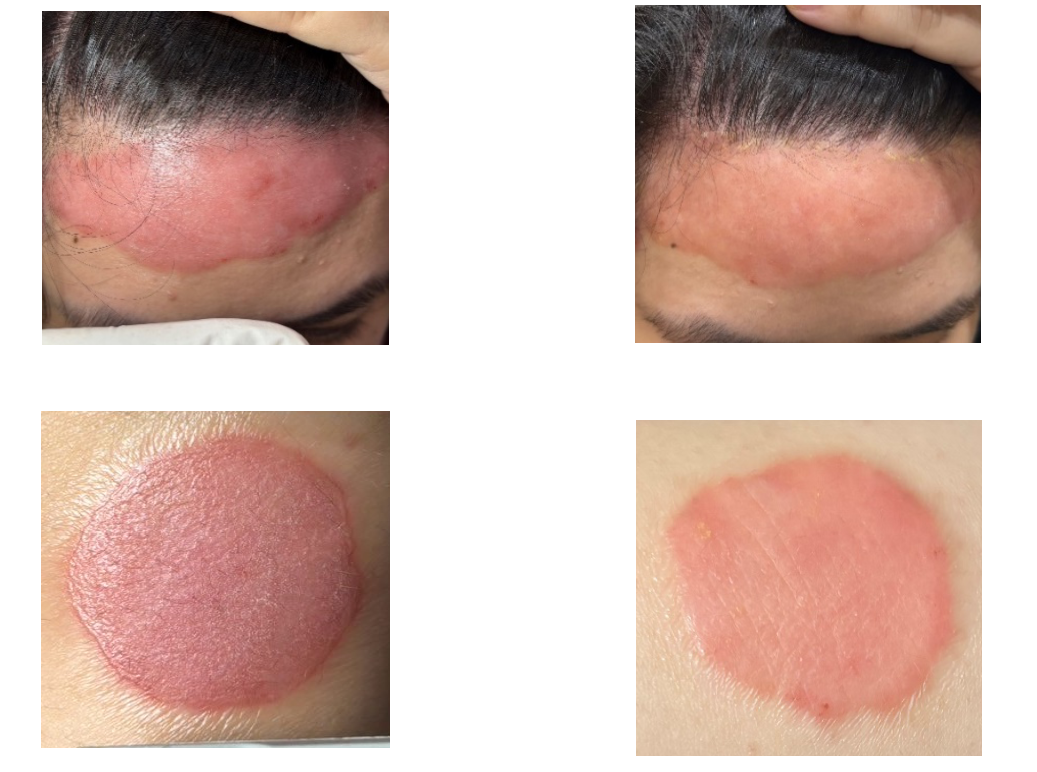
A 29-year-old Thai female patient presented with a history of thick, erythematous plaques with scaling and silvery scales accompanied by pruritus on both arms and legs, the abdomen, the back, and the forehead. The patient received treatment from a Thai traditional medicine practitioner using a traditional hemorrhoid and skin disease topical formulation in cream form (50 g per tube). The formulation contained three herbal ingredients: cottonseed oil (Gossypium spp.), turmeric (Curcuma longa L.), and cannabis leaves (Cannabis sativa L.). The cream was applied to the affected areas at a dosage of three fingertip units for a lesion approximately equivalent to two palm areas, twice daily after morning and evening bathing. The patient was followed up every 30 days for three consecutive months at the Thai Traditional and Alternative Medicine Center, Nonthaburi Province. Treatment outcomes were evaluated using the Psoriasis Area and Severity Index (PASI), and safety was assessed through laboratory investigations. Before treatment, the patient’s PASI score was 22.4, indicating very severe psoriasis (PASI > 12). Laboratory results showed elevated levels of albumin/globulin ratio, aspartate aminotransferase (AST), and alanine aminotransferase (ALT) above the normal range. After 30, 60, and 90 days of treatment, the PASI scores decreased to 22.0, 19.2, and 13.6, respectively. However, the albumin/globulin ratio and erythrocyte sedimentation rate (ESR) remained higher than the normal range. Quality of life was assessed using the Dermatology Life Quality Index (DLQI). The results showed improvement after treatment, with the DLQI score decreasing from 24 points at baseline (Day 0), indicating a very large impact on the patient’s life, to 8 points at Day 90, indicating a moderate impact on quality of life. These findings suggest that the traditional hemorrhoid and skin disease herbal formulation may have potential in reducing the severity of psoriasis and improving quality of life among patients with severe psoriasis.
References
Ade-Ademilua, O.E., & Okpoma, M.O. (2018). Gossypium hirsutum L. and Gossypium barbadense L.: differences in phytochemical contents, antioxidant and antimicrobial properties. Ife Journal of Science. 20(1): 77-88. https://www.academia.edu/71853495/Gossypium_hirsutum_L_and_ Gossypium_barbadense_L_differences_in_phytochemical_contents_antioxidant_and_antimicro bial_properties
Boonchoet, S. (2024). Nursing care for psoriasis patients with complications from Methotrexate treatment using Orem’s nursing theory. Department of Disease Control, Ministry of Public Health. https://www.ddc.moph.go.th/uploads/files/5294320250527 093528.pdf
Charoenying, T., Lomwong, K., Boonkrong, P., & Kruanamkam, W. (2024). Therapeutic potential of topical cannabis for the treatment of psoriasis: a preliminary clinical evaluation of two different formulations. J Curr Sci Technol. 14(1): Article 6. https://ph04.tci-thaijo.org/ index.php/JCST/article/download/1225/470
Gamret, A. C., Price, A., Fertig, R.M., Lev-Tov, H., & Nichols, A.J., (2018). Complementary and alternative medicine therapies for psoriasis: a systematic review. JAMA Dermatol, 154(11): 1330-7.
Gutierrez, J., & Komarnytsky, S. (2025). Cottonseed oil composition and its application to skin health a n d p e r s o n a l c a r e . F r o n t i e r s i n P h a rma c o l o g y , 1 6 , 1 5 5 9 1 3 9 . https://doi.org/10.3389/fphar.2025.1559139
Imperial College Healthcare NHS Trust. (2025). Dermatology Life Quality Index (DLQI). https://www.imperial.nhs.uk/-/media/website/services/dermatology/patientforms/ dermatology-life-quality-iindex-dlqi.pdf
Institute of Dermatology. (2025). Manual: Guidelines for Developing a Service Model for Psoriasis Patients in Health Service Facilities, by Health Region. https://www.iod.go.th/wpcontent/ uploads/2025/07/สะเก็ดเงินเวป-1.pdf
Jensen, P., & Skov, L. (2016). Psoriasis and obesity. Dermatology, 232(6), 633–639. Li HL. (1973). An archaeological and historical account of cannabis in China. Economic Botany. 28(4): 437–448.
Meekai, N., Lasongmuang, K., & Junto, E. (2024). Effectiveness of the hemorrhoids and skin disease formula from the Ayurvedic Textbook of Khun Nitthes Sukkhakit: A case study of a patient with psoriasis. Journal of Thai Traditional and Alternative Medicine, 22(3), 601–613.
Menter, A., Strober, B. E., Kaplan, D. H., Kivelevitch, D., Prater, E. F., Stoff, B., & Armstrong, A. W. (2020). Joint AAD-NPF guidelines of care for the management of psoriasis with systemic non-biologic therapies. J Am Acad Dermatol, 82(6): 1445-86. https://doi.org/10.1 016/j.jaad.2018.11.057
Nantasen, R, & Bamphenrat, Y. (2024). Investigation of the efficacy of cannabis oil in patients with psoriasis in Chaturaphakphiman Hospital, Roi-Et province, northeast Thailand. J Health Innov Res Dev. 5(3):179–86.
Panahi Y, Sahebkar A, Parvin S, Saadat A. A randomized controlled trial on the anti-inflammatory effects of curcumin in patients with chronic sulphur mustard-induced cutaneous complications. Ann Clin Biochem. 2012. 49(6): 580-8.
Pothisat, P., Nadoo, W., Nettippawan, I., Najaikong, T., Yanpaisan, W., Pongpirul, K., & Teerachaisakul, M. (2021). Psoriasis: Knowledge from Thai traditional medicine. Journal of Thai Traditional and Alternative Medicine, 19(3), 646–658
Radhakrishnan R, Wilkinson ST, & D’Souza DC. Gone to pot-a review of the association between cannabis and psychosis. Frontiers in Psychiatry. 2014;54(5): 1-24.
Rajasekharan, A., Munisamy, M., Menon, V., Raj, P. S. M., Priyadarshini, G., & Rajappa, M. (2023). Stress and psoriasis: Exploring the link through the prism of hypothalamo-pituitary-adrenal axis and inflammation. Journal of Psychosomatic Research, 170, 111350.
Royal Gazette. (2019). Announcement of the Ministry of Public Health regarding the designation of a category 5 narcotic formula that contains marijuana that can be consumed for disease treatment or research. special section94D. 136: 27.
Schräder, N. H. B., Duipmans, J. C., Molenbuur, B., Wolff, A. P., & Jonkman, M. F. (2019). Combined tetrahydrocannabinol and cannabidiol to treat pain in epidermolysis bullosa: a report of three cases. British Journal of Dermatology, 180(4): 922-924.
Wachirameetharat, C, Simmerman, P, & Chulawanna, S. (2022). Effectiveness of Medical Cannabis Extract in the Treatment of Psoriasis Patients. Service Plan Sharing Best Practice. Medical Cannabis Program. http://phdbservice.moph.go.th/APP/ SERVICEPLAN/uploads/ event2022/service19/index.html#p=6 Wat Po
Thai Traditional School. (2015). Thai medicinal recipes on Wat Phra Chettuphon Wimon Mangkhalaram’s stone inscriptions. Bangkok
Downloads
Published
How to Cite
Issue
Section
License
Copyright (c) 2026 Journal of Primary Health Research

This work is licensed under a Creative Commons Attribution-NonCommercial-NoDerivatives 4.0 International License.