
Factors Associated with the Performance of Village Health Volunteers in Nong Hong Subdistrict, Thung Song District, Nakhon Si Thammarat Province
Keywords:
Knowledge, Motivational Factors, Supporting Factors, Performance, Village Health Volunteers (VHVs)Abstract
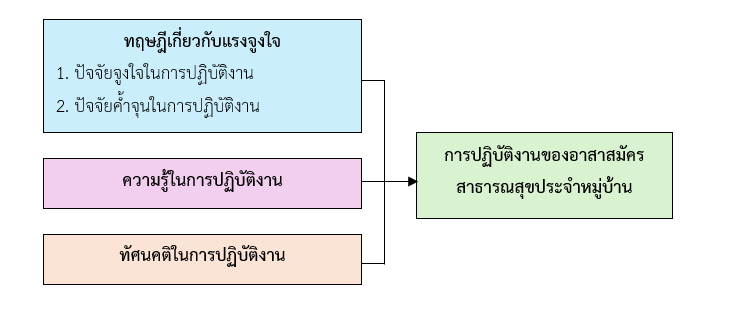
This predictive correlational study aimed to: (1) examine the knowledge, attitudes, motivational factors, and supporting factors related to the performance of Village Health Volunteers (VHVs); (2) assess the level of VHV performance; and (3) identify factors influencing the performance of VHVs in Nong Hong Subdistrict, Thung Song District, Nakhon Si Thammarat Province, Thailand. The study population consisted of VHVs working in Nong Hong Subdistrict. A sample of 155 participants was determined and selected using systematic random sampling. Data were collected using a structured questionnaire. Content validity of the instrument was evaluated by three experts, with item–objective congruence (IOC) values ranging from 0.67 to 1.00. The knowledge questionnaire demonstrated a Kuder–Richardson 20 (KR-20) reliability coefficient of 0.72. The reliability coefficients for the questionnaires measuring motivational factors, supporting factors, attitudes, and VHV performance were 0.86, 0.72, 0.70, and 0.88, respectively. Data were analyzed using descriptive statistics and stepwise multiple regression analysis.
The results showed that knowledge regarding work performance was at a high level (57.42%). Motivational factors (M = 3.76, SD = 0.47), supporting factors (M = 3.91, SD = 0.91), attitudes toward performance (M = 3.70, SD = 0.32), and VHV performance (M = 4.01, SD = 0.57) were also at high levels. Attitudes toward performance and motivational factors were significant predictors of VHV performance, jointly explaining 28.3% of the variance (adj. R² = 0.283, p < .01).
These findings suggest that relevant organizations should promote positive attitudes toward work in order to enhance VHVs’ confidence and effectiveness in performing their duties.
References
กรมสนับสนุนบริการสุขภาพ กระทรวงสาธารณสุข. (2554). คู่มือ อสม. ยุคใหม่. โรงพิมพ์ชุมนุมสหกรณ์การเกษตรแห่งประเทศไทย.
กิตติพงศ์ บุญเจริญ และณัฏฐ์นรี คำดี. (2567). ปัจจัยที่มีผลต่อการปฏิบัติงานของอาสาสมัครสาธารณสุขประจำหมู่บ้านในอำเภอราษีไศล จังหวัดศรีสะเกษ. วารสารวิจัยและพัฒนาสุขภาพศรีสะเกษ, 3(4), 187-199.
ณรงค์ศักดิ์ โพธิ์พิทยา. (2558). การรับรู้ เจตคติ และประสิทธิภาพในการปฏิบัติงานป้องกันและควบคุมวัณโรคของอาสาสมัครสาธารณสุขประจำหมู่บ้าน (อสม.) โรงพยาบาลส่งเสริมสุขภาพตำบลบ้านหนองตะเคียนบอน อำเภอวัฒนานคร จังหวัดสระแก้ว. วารสารการจัดการยุคใหม่ มหาวิทยาลัยชินวัตร, 3(2), 50-67.
ทัตพล นิยมพลอย. (2562). ปัจจัยที่มีผลต่อการปฏิบัติงานตามบทบาทของอาสาสมัครสาธารณสุขประจำหมู่บ้านนักจัดการสุขภาพชุมชนตามกลุ่มวัยในตำบลจัดการสุขภาพแบบบูรณาการ อำเภอท่ามะกา จังหวัดกาญจนบุรี [การค้นคว้าอิสระปริญญามหาบัณฑิต, มหาวิทยาลัยสุโขทัยธรรมาธิราช].
ธนเสฏฐ์ สายยาโน. (2566). ประสิทธิผลการปฏิบัติงานของอาสาสมัครสาธารณสุขประจำหมู่บ้าน (อสม.) ในอำเภอบ้านหลวง จังหวัดน่าน [สารนิพนธ์ปริญญามหาบัณฑิต, จุฬาลงกรณ์มหาวิทยาลัย].
นิลาวรรณ งามขำ, ดวงพรรณ ดวงศรี, น้ำฝน สายสุด และชนรดี ลิ้มเจริญ. (2567). สมรรถนะ อสม. 4.0 ที่ส่งผลต่อการปฏิบัติงานของอาสาสมัครสาธารณสุขประจำหมู่บ้าน ตำบลราชาเทวะ อำเภอบางพลี จังหวัดสมุทรปราการ. วารสารวิทยาศาสตร์สุขภาพและสุขภาวะ, 28(2), 121-132.
ปรางค์ จักรไชย, อภิชัย คุณีพงษ์ และวรเดช ช้างแก้ว. (2560). ปัจจัยที่มีผลต่อการปฏิบัติงานของอาสาสมัครสาธารณสุขประจำหมู่บ้าน (อสม.) ในทีมหมอครอบครัว จังหวัดปทุมธานี. วารสารพยาบาลสาธารณสุข, 31(1), 16-27.
พรพิรุณ พิมพ์พันธุ์ และสุรเดช สำราญจิตต์. (2568). สมรรถนะในการปฏิบัติงานของอาสาสมัครสาธารณสุขประจำหมู่บ้าน (อสม.) ในพื้นที่จังหวัดสมุทรปราการ. วารสารสาธารณสุขมูลฐาน (ภาคกลาง), 39(1), 15-16.
พฤหัสกัญยา บุญลบ, นวพรรธน์ ดีประเสริฐวรกร, อนุรักษ์ มีอิ่ม, เจริญ ทุนชัย และพระครูโอภาสกาจนธรรม. (2562). การปฏิบัติงานตามบทบาทหน้าที่ของอาสาสมัครสาธารณสุขประจำหมู่บ้าน (อสม.) ในเขตเทศบาลเมืองชะอำ อำเภอชะอำ จังหวัดเพชรบุรี. วารสารสิรินธรปริทรรศน์, 21(2), 197-205.
ยุทธนา แยบคาย. (2564). รูปแบบการพัฒนาผลการปฏิบัติงานของอาสาสมัครสาธารณสุขประจำหมู่บ้าน [วิทยานิพนธ์ปริญญาดุษฎีบัณฑิต, มหาวิทยาลัยนเรศวร].
วิภาพร สิทธิสาตร์, ภูดิท เตชาติวัฒน์, นิทรา กิจธีระวุฒิวงษ์ และศันสนีย์ เมฆรุ่งเรืองวงศ์. (2558). ปัจจัยส่วนบุคคลที่มีความสัมพันธ์กับผลการปฏิบัติงานของอาสาสมัครสาธารณสุขชุมชนในการควบคุมโรคไม่ติดต่อเรื้อรัง. วารสารวิจัยทางวิทยาศาสตร์สุขภาพ, 9(1), 25-31.
วิรินทร์ญา ทวีอนันต์ธนกุล. (2557). ประสิทธิภาพการปฏิบัติงานด้านการเงินการคลังท้องถิ่นของเทศบาลในจังหวัดนครสวรรค์ [วิทยานิพนธ์ปริญญามหาบัณฑิต, มหาวิทยาลัยมหาจุฬาลงกรณราชวิทยาลัย].
สำเริง จันทรสุวรรณ และสุวรรณ บัวทวน. (2547). ระเบียบวิธีวิจัยทางสังคมศาสตร์. ภาควิชาสังคมวิทยาและมานุษยวิทยา คณะมนุษยศาสตร์และสังคมศาสตร์ มหาวิทยาลัยขอนแก่น.
Best, J. W. (1977). Research in education (3rd ed.). Prentice-Hall.
Bloom, B. S. (1986). What we are learning about teaching and learning: A summary of recent research. Principal, 66, 6-10.
Cohen, J. (1988). Statistical power analysis for the behavioral sciences (2nd ed.). Lawrence Erlbaum Associates.
Faul, F., Erdfelder, E., Lang, A. G., & Buchner, A. (2007). G*Power 3: A flexible statistical power analysis program for the social, behavioral, and biomedical sciences. Behavior Research Methods, 39(2), 175-191.
Herzberg, F. (1959). The motivation to work. John Wiley & Sons.
Herzberg, F., Mausner, B., & Snyderman, B. B. (1993). The motivation to work (2nd ed.). Transaction Publishers. (Original work published 1959).
World Health Organization. (2008). Primary healthcare. WHO Press.
Downloads
Published
How to Cite
Issue
Section
License
Copyright (c) 2026 Journal of Primary Health Research

This work is licensed under a Creative Commons Attribution-NonCommercial-NoDerivatives 4.0 International License.