Factors Influencing Health Promotion Behaviors of Village Health Volunteers in Hua Sai District, Nakhon Si Thammarat Province
Keywords:
Health Promotion Behaviors, Village Health Volunteers, Cognitive and Affective Perceptions Related to BehaviorAbstract
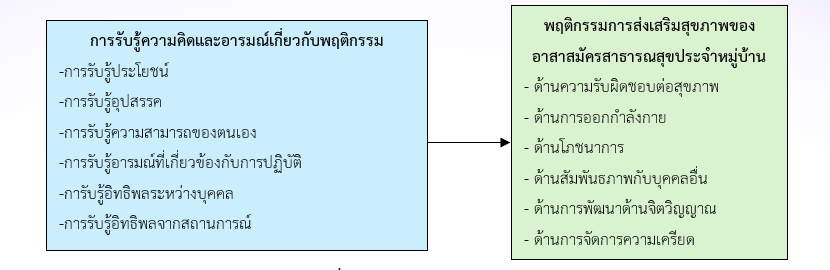
This cross-sectional research aimed to study 1) behavior-specific cognitions and affect, 2) health-promoting behaviors, and 3) factors influencing health-promoting behaviors among Village Health Volunteers (VHVs) in Hua Sai District, Nakhon Si Thammarat Province. The sample consisted of 176 VHVs, selected by simple random sampling using a lottery method. Data were collected in November 2025 using a questionnaire with a validity ranging from 0.67 to 1.00 and a reliability of 0.84. Data were analyzed using descriptive statistics and stepwise multiple regression analysis.
The results revealed that the overall behavior-specific cognitions and affect were at a high level (M = 4.04, SD = 0.30). Specifically, perceived benefits of action had the highest mean score (M = 4.46), while perceived barriers to action were at a moderate level (M = 3.49). Overall health-promoting behaviors and all of their sub-dimensions were at a high level (M = 4.14, SD = 0.39). Four variables significantly influenced the health-promoting behaviors of the VHVs, ranked by their predictive power: activity-related affect (b = 0.200), situational influences (b = 0.172), perceived benefits of action (b = 0.156), and perceived barriers to action (b = 0.084). Together, these variables accounted for 31.0% of the variance in health-promoting behaviors (adj. R² = 0.310, p < 0.05).
Recommendations Relevant organizations should develop proactive health care policies and guidelines, as well as support the creation of media and innovations to tangibly promote the health behaviors of VHVs.
References
กระทรวงสาธารณสุข. (2560). แผนยุทธศาสตร์ชาติระยะ 20 ปี (ด้านสาธารณสุข). นนทบุรี.
กรมสนับสนุนบริการสุขภาพ กระทรวงสาธารณสุข. (2556). คู่มืออาสาสมัครสาธารณสุขประจำหมู่บ้าน (อสม).นักจัดการสุขภาพชุมชน. นนทบุรี.
ขวัญเมือง แก้วดำเกิง, อลงกรณ์ เปลกาลี, จำเนียร ชุณหโสภาค และชาติชาย สุวรรณนิตย์. (2559). บทบาทของอาสาสมัครสาธารณสุขประจำหมู่บ้านในทีมหมอครอบครัว. วารสารวิจัยสาธารณสุขศาสตร์ มหาวิทยาลัยขอนแก่น, 9(2), 6-16.
จักรี ปัถพี และนวลฉวี ประเสริฐสุข. (2559). พฤติกรรมการส่งเสริมสุขภาพประชาชนของอาสาสมัครสาธารณสุขประจำหมู่บ้าน อำเภอบ่อพลอย จังหวัดกาญจนบุรี. Veridian E-Journal, Silpakorn University, 9(3), 1190-1205.
จิราภรณ์ เรืองสงคราม, รพพีร เทียมจันทร์ และวราภรณ์ ศิริสว่าง. (2558). ปัจจัยที่มีความสัมพันธ์กับพฤติกรรมส่งเสริมสุขภาพของอาสาสมัครสาธารณสุขประจำหมู่บ้าน ตำบลฟ้าฮ่าม อำเภอเมืองเชียงใหม่ จังหวัดเชียงใหม่. วารสารบัณฑิตวิจัย, 6(2), 172-183.
ณัฐปภัสร์ เจียรภักษ์ดี, นันชพัฒน์ แก้วทอง และพรพรรณ จิตบรรจง. (2567). ปัจจัยที่มีอิทธิพลกับพฤติกรรมส่งเสริมสุขภาพของอาสาสมัครสาธารณสุขประจำหมู่บ้านในเขตความรับผิดชอบของโรงพยาบาลส่งเสริมสุขภาพ ตำบลคลองข่อย อำเภอปากเกร็ด จังหวัดนนทบุรี. วารสารการพยาบาลสุขภาพ และการศึกษา, 7(3), 68-82.
ประเวศ วะสี. 2551. สุขภาวะที่สมบูรณ์. หมอชาวบ้าน. หน้า 352, 2551, สิงหาคม. กรุงเทพฯ.
พฤหัสกัญยา บุญลบ, นวพรรธน์ ดีประเสริฐวรกร, อนุรักษ์ มีอิ่ม, เจริญ ทุนชัย และพระครูโอภาสกาจนธรรม. (2562). การปฏิบัติงานตามบทบาทหน้าที่ของอาสาสมัครสาธารณสุขประจำหมู่บ้าน (อสม.) ในเขตเทศบาลเมืองชะอำ อำเภอชะอำ จังหวัดเพชรบุรี. วารสารสิรินธรปริทรรศน์, 21(2): 197–205
วิชุดา เตชะลือ, สมโภช รติโอฬาร และวรางคณา จันทร์คง. (2568). ปัจจัยที่มีอิทธิพลกับพฤติกรรมการสร้างเสริมสุขภาพของอาสาสมัครสาธารณสุข: กรณีศึกษา กลุ่มเขตกรุงเทพใต้. วารสารวิจัยและพัฒนาระบบสุขภาพ, 18(1), 1-15.
ศิริพร ขัมภลิขิต, ลดาวัลย์ ประทีปชัยกูร, นันทวัน สุวรรณรูป. (2545). แนวคิดสุขภาพและการสร้างเสริมสุขภาพ. กรุงเทพฯ : สาขาพยาบาลศาสตร์ของรัฐ ทบวงมหาวิทยาลัย.
สำนักงานสาธารณสุขอำเภอหัวไทร. (2568). ทะเบียนอาสาสมัครสาธารณสุขประจำหมู่บ้าน อำเภอหัวไทร .จังหวัดนครศรีธรรมราช. นครศรีธรรมราช.
สุทัศน์ ทองชัย. (2567). ปัจจัยที่มีความสัมพันธ์กับพฤติกรรมการสร้างเสริมสุขภาพของอาสาสมัครสาธารณสุขประจำหมู่บ้าน (อสม.) อำเภอเมืองสมุทรสาคร จังหวัดสมุทรสาคร. วารสารสาธารณสุขมูลฐาน (ภาคกลาง), 38(3), 13-26.
Best, J. W. (1977). Research in Education. (3nded). Englewod Cliffs: Prentice-Hall.
Cohen, J. (1988). Statistical power analysis for the behavioral sciences. (2nd). Hillsdale, NJ: Lawrence Erlbaum Associates, Publishers.
Faul, F., Erdfelder, E., Lang, A. G., & Buchner, A. (2007). G*Power 3: A flexible statistical power analysis program for the social, behavioral, and biomedical sciences. Behavior Research Methods, 39(2), 175-191.
Naing, L., Winn, T., & Rusli, B. N. (2006). Practical issues in calculating the sample size for prevalence studies, Archives of Orofacial Sciences, 1(1), 9-14.
Pender, N. J, Murdaugh, C. L., & Parsons, M. A. (2011). Health Promotion in Nurse Practice. (6th ed.). Pearson Education LTD: The United States of America.
Downloads
Published
How to Cite
Issue
Section
License
Copyright (c) 2026 Journal of Primary Health Research

This work is licensed under a Creative Commons Attribution-NonCommercial-NoDerivatives 4.0 International License.