The Relationship Between Health Literacy and Self-Care Behaviors Among Patients with Type 2 Diabetes in the Karen Community, Mae Na Chon Subdistrict, Mae Chaem District, Chiang Mai Province
Keywords:
Patients with Type 2 Diabetes, Karen Ethnic Group, Health Literacy, Self-care behaviorsAbstract
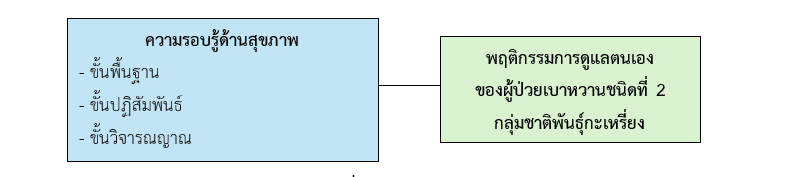
This analytical cross-sectional study aimed to examine health literacy, self-care behaviors, and the relationship between health literacy and self-care behaviors among patients with type 2 diabetes in a Karen ethnic community in Mae Chaem District, Chiang Mai Province. A total of 174 participants were recruited using stratified random sampling. The research instrument consisted of a structured interview questionnaire. Content validity was assessed by three experts, yielding an item-objective congruence (IOC) index of 1.00 for all items. Reliability coefficients were 0.91 and 0.85, respectively. Data were analyzed using frequency, percentage, mean, standard deviation, and Spearman’s rank correlation coefficient.
The results showed that 64.94% of the participants were female, with a mean age of 57.51 years. Both self-care behaviors and health literacy were at a moderate level. Overall health literacy and its domains—functional, interactive, and critical health literacy—were positively correlated at a low level with self-care behaviors (rs = 0.28, p < 0.01), (rs = 0.23, p = 0.01), (rs = 0.26, p < 0.01), and (rs = 0.28, p < 0.01), respectively.
The findings highlight the need to enhance health literacy across all dimensions among patients, with interventions tailored to the Karen language and cultural context. Given the significant positive association with self-care behaviors, strengthening family and community roles is also essential to support sustained self-care practices.
References
กรมสนับสนุนบริการสุขภาพ กองสุขศึกษา, และมหาวิทยาลัยมหิดล. (2559). การสำรวจความรู้แจ้งแตกฉานด้านสุขภาพ (Health Literacy) สำหรับผู้ป่วยโรคเบาหวานและโรคความดันโลหิตสูง. กระทรวงสาธารณสุข.
กระทรวงสาธารณสุข, กรมควบคุมโรค กองควบคุมโรคไม่ติดต่อ. (2566). ความดันโลหิตสูงที่ขึ้นทะเบียนได้รับการประเมินโอกาสเสี่ยงต่อโรคหัวใจและหลอดเลือด 2561–2565. https://shorturl.asia/u4lP3
กระทรวงสาธารณสุข, สำนักงานนโยบายและยุทธศาสตร์. (2554). รายงานการสาธารณสุขไทย พ.ศ. 2554. กระทรวงสาธารณสุข.
กฤษฎา เจริญรื่น. (2562). ความสัมพันธ์ระหว่างความรอบรู้ด้านสุขภาพกับพฤติกรรมการดูแลตนเองของผู้ป่วยเบาหวาน ตำบลกุดชมภู อำเภอพิบูลมังสาหาร จังหวัดอุบลราชธานี. วารสารสาธารณสุขและวิทยาศาสตร์สุขภาพ, 3(2), 1–13.
ณัจฉรีญา จิตจักร. (2562). พฤติกรรมเสี่ยงต่อโรคความดันโลหิตสูงในชนเผ่าปกาเกอะญอ อำเภอแม่แจ่ม จังหวัดเชียงใหม่. ลำปางเวชสาร, 40(1), 10–16.
ทัศนีย์ จินะธรรม, กิรภัทร์ คุ้มเนตร, และ พิษณุรัตน์ กันทวี. (2561). การศึกษาความเชื่อและพฤติกรรมด้านสุขภาพที่มีผลต่อการป้องกันโรคเบาหวานในกลุ่มชนชาติพันธุ์กะเหรี่ยง อำเภอดอยหลวง จังหวัดเชียงราย. เชียงรายเวชสาร, 10(1), 179–192.
ธารารัตน์ สัญญะโม, และ นรินทร์ สังข์รักษา. (2567). การพัฒนารูปแบบความรอบรู้ด้านสุขภาพเพื่อพัฒนาคุณภาพชีวิตกลุ่มชาติพันธุ์กะเหรี่ยงในอำเภอสวนผึ้ง จังหวัดราชบุรี. วารสารสังคมและวัฒนธรรม, 8(5), 279–292.
ประสงค์ เอี่ยมอนันต์, กรรณิการ์ ต๊ะวิไชย, และ กนกวรรณ เอี่ยมอนันต์. (2561). พฤติกรรมการบริโภคอาหารและภาวะโภชนาการของกลุ่มชาติพันธุ์ในเขตพื้นที่สูง จังหวัดเชียงใหม่. วารสารวิจัยระบบสาธารณสุข.
ยุทธการ ประพากรณ์, โรจนี จินตนาวัฒน์, และ เดชา ทำดี. (2564). ความรอบรู้ด้านสุขภาพและพฤติกรรมส่งเสริมสุขภาพของผู้สูงอายุกะเหรี่ยง. พยาบาลสาร, 48(1), 67–79.
ราชวิทยาลัยอายุรแพทย์แห่งประเทศไทยในพระบรมราชูปถัมภ์, สมาคมเบาหวานแห่งประเทศไทยในพระบรมราชูปถัมภ์สมเด็จพระเทพรัตนราชสุดาฯ สยามบรมราชกุมารี, สมาคมต่อมไร้ท่อประเทศไทย, กรมการแพทย์ กระทรวงสาธารณสุข, และสำนักงานหลักประกันสุขภาพแห่งชาติ. (2557). แนวทางเวชปฏิบัติสำหรับเบาหวาน 2557. หจก. อรุณการพิมพ์.
วัชรินทร์ คำสา, วรรณรัตน์ ลาวัง, และ สมสมัย รัตนกรีฑากุล. (2564). ปัจจัยที่มีอิทธิพลต่อพฤติกรรมการป้องกันโรคหลอดเลือดหัวใจ ในกลุ่มชาติพันธุ์กะเหรี่ยงที่เป็นกลุ่มเสี่ยง ในจังหวัดตาก. วารสารคณะพยาบาลศาสตร์ มหาวิทยาลัยบูรพ, 29(3), 76–89.
วิชัย เอกพลากร. (2559). รายงานการสำรวจสุขภาพประชาชนไทยโดยการตรวจร่างกาย ครั้งที่ 5 พ.ศ. 2557. อักษรกราฟฟิคดีไซน์.
ศูนย์มานุษยวิทยาสิรินธร. (2559). ฐานข้อมูลงานวิจัยทางชาติพันธุ์ในประเทศไทย. http://www.sac.or.th/databases/ethnicredb/articles.php
สมาคมโรคเบาหวานแห่งประเทศไทย, สมาคมต่อมไร้ท่อแห่งประเทศไทย, กรมการแพทย์ กระทรวงสาธารณสุข, และสำนักงานหลักประกันสุขภาพแห่งชาติ. (2560). แนวทางเวชปฏิบัติสำหรับโรคเบาหวาน 2560 (พิมพ์ครั้งที่ 2). บริษัท ร่มเย็น มีเดีย จำกัด.
สมพร รุ่งเรืองกลกิจ, อิงคฏา โคตนารา, รัชฎาพร ธรรมน้อย, อรพิน ยอดกลาง, และ บุษบา อนุศักดิ์. (2556). ประสบการณ์การพยายามฆ่าตัวตาย: ความแตกต่างทางเพศภาวะ. วารสารสมาคมจิตแพทย์แห่งประเทศไทย, 58(3), 245–256.
สุวรรณี สร้อยสงค์, อังคณา เรือนก้อน, ภัณฑิรชา เฟื่องทอง, และ คุณญา แก้วทันคำ. (2563). คุณภาพชีวิตและระดับน้ำตาลสะสมในเลือดของผู้ป่วยเบาหวานชนิดที่ 2. วารสารวิชาการมหาวิทยาลัยอีสเทิร์นเอเชีย, 14(1), 72.
อนงค์ คำตั๋น, วันเฉลิม ฤทธิมนต์, และ สุรางค์รัตน์ พ้องพาน. (2566). ปัจจัยด้านพฤติกรรมการบริโภคอาหารที่ส่งผลต่อภาวะโภชนาการของประชากรวัยทำงานกลุ่มชาติพันธุ์กะเหรี่ยงในหมู่บ้านพัฒนาเพื่อความมั่นคงพื้นที่ชายแดนอันเนื่องมาจากพระราชดําริ (หมู่บ้าน พมพ.) ตำบลเวียงเหนือ อำเภอปาย จังหวัดแม่ฮ่องสอน. Phrae Medical Journal and Clinical Sciences, 31(1), 43–58.
อารยา เชียงของ. (2561). ผลการพัฒนาความรอบรู้ด้านสุขภาพด้วยการจัดการเรียนรู้เพื่อการเปลี่ยนแปลงที่มีต่อพฤติกรรมการควบคุมระดับน้ำตาลในเลือดผู้ป่วยเบาหวาน [ดุษฎีนิพนธ์]. มหาวิทยาลัยศรีนครินทรวิโรฒ.
American Diabetes Association. (2023). Diagnosis and classification of diabetes mellitus. Diabetes Care, 46(Suppl. 1), S19–S40.
Daniel, W. W. (1999). Biostatistics: A foundation for analysis in the health sciences (7th ed.). John Wiley & Sons.
International Diabetes Federation. (2021). IDF Diabetes Atlas (10th ed.). https://diabetesatlas.org/
Ishikawa, H., Takeuchi, T., & Yano, E. (2008). Measuring functional, communicative, and critical health literacy among diabetic patients. Diabetes Care, 31(5), 874–879.
Leininger, M. M., & McFarland, M. R. (2002). Transcultural nursing: Concepts, theories, research and practice (3rd ed.). McGraw-Hill.
Lorga, T., Srithong, K., Manokulanan, P., Aung, T. N., & Aung, M. N. (2012). Public knowledge of diabetes in Karen ethnic rural residents. International Journal of General Medicine, 799–804.
Nutbeam, D. (2000). Health literacy as a public health goal. Health Promotion International, 15(3), 259–267.
Orem, D. E., Taylor, S. G., & Renpenning, K. M. (2001). Nursing: Concepts of practice (6th ed.). Mosby. Report of the Expert Committee on the Diagnosis and Classification of Diabetes Mellitus. (2002). Diabetes Care, 25(Suppl. 1), S5–S20. https://doi.org/10.2337/diacare.25.2007.s5
Stratton, I. M., Adler, A. I., Neil, H. A., Matthews, D. R., Manley, S. E., Cull, C. A., Hadden, D., Turner, R. C., & Holman, R. R. (2000). Association of glycaemia with macrovascular and microvascular complications of type 2 diabetes (UKPDS 35). BMJ, 321(7258), 405–412. https://doi.org/10.1136/bmj.321.7258.405
Downloads
Published
How to Cite
Issue
Section
License
Copyright (c) 2026 Journal of Primary Health Research

This work is licensed under a Creative Commons Attribution-NonCommercial-NoDerivatives 4.0 International License.