Development of a Participatory Solid Waste Management System to Enhance Health and Reduce Environmental Impacts: A Case Study in Wanon Niwat District, Sakon Nakhon Province
Keywords:
Solid Waste Management, Community Participation, Community Environment, Well-BeingAbstract
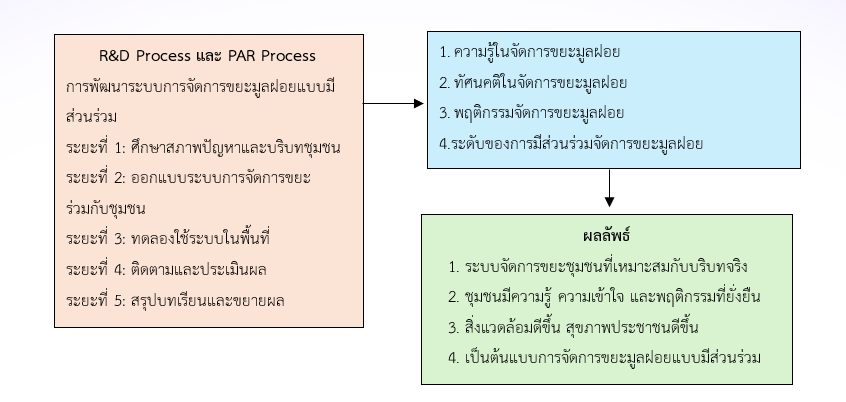
This study employed a research and development approach integrated with participatory action research. It was conducted in Ban Don Sawan, Village No. 8, Wanorn Niwat Subdistrict, Sakon Nakhon Province, with the aim of developing and evaluating a participatory solid waste management system in the community. The research process consisted of five phases: (1) assessing community problems and context, (2) collaboratively designing the system with the community, (3) implementing the system, (4) monitoring and evaluating the outcomes, and (5) summarizing lessons learned and scaling up the system. The study participants were 179 household representatives, and a census method was used. The research instruments included a general information questionnaire and assessment tools measuring knowledge, attitudes, and waste management behaviors. The overall reliability of the instruments, assessed using Cronbach’s alpha coefficient, was 0.89. Data were analyzed using percentages, means, standard deviations, and paired-samples t-tests.
The findings showed that the participatory solid waste management system developed in this study was appropriate to the community context. Before implementation, participants had moderate levels of knowledge, attitudes, and waste management behaviors (M = 5.83, SD = 1.74; M = 3.21, SD = 0.54; and M = 2.98, SD = 0.62, respectively). After implementation, knowledge increased to a high level (M = 8.74, SD = 1.08), while attitudes and behaviors also increased to high levels (M = 4.31, SD = 0.48 and M = 4.05, SD = 0.52, respectively). The mean scores for all three domains were significantly higher than those before implementation (p < 0.001). In addition, the proportion of households practicing waste segregation increased from 38.55% to 81.56%, while open waste burning decreased from 52.51% to 18.44%. The developed participatory solid waste management system enhanced community members’ knowledge, attitudes, and waste management behaviors, reduced environmental impacts, and could be sustainably applied as a model for solid waste management at the community and local administrative organization levels.
References
กรมควบคุมมลพิษ. (2566). รายงานสถานการณ์มลพิษของประเทศไทย ปี พ.ศ. 2566. รายการนี้ตรวจสอบชื่อรายงานได้ตรงกับเอกสารของกรมควบคุมมลพิษ
กรมควบคุมมลพิษ. (2567). รายงานสถานการณ์ขยะมูลฝอยของประเทศไทย ปี พ.ศ. 2567. กองประเมินผลกระทบต่อสุขภาพ. (2553). คู่มือการประเมินผลกระทบกรณีการจัดการขยะมูลฝอยสำหรับองค์กรปกครองส่วนท้องถิ่น. เอกสารคู่มือการประเมินผลกระทบ
ชัชวาล ปริวัฒน์. (2563). ศักยภาพการจัดการขยะขององค์กรปกครองส่วนท้องถิ่นในจังหวัดระนอง. วารสารการปกครองท้องถิ่น, 13(3), 286–300.
ตะวัน ปริญญา. (2562). การมีส่วนร่วมในการจัดการปัญหาขยะมูลฝอยของชุมชนตำบลริ้วราย อำเภอนครชัยศรี จังหวัดนครปฐม. วารสารแสงอีสาน มหาวิทยาลัยมหามกุฏราชวิทยาลัย วิทยาเขตอีสาน, 16(2), 499–512.
พัชรี ตรียากานต์. (2563). การศึกษาสภาพปัญหาการจัดการขยะมูลฝอยในเขตเทศบาลเมืองเพชรบูรณ์ จังหวัดเพชรบูรณ์. วารสารชุมชนวิจัย, 14(4), 53–61.
โรงพยาบาลวานรนิวาส. (2568). ข้อมูลพื้นฐานด้านประชากรและอนามัยสิ่งแวดล้อมในพื้นที่รับผิดชอบโรงพยาบาลวานรนิวาส.
สมชาย จารุโส และคณะ. (2561). รายงานวิจัยการจัดการขยะชุมชนอย่างยั่งยืนของชุมชนสระแก้วและชุมชนบ้านล่าง เทศบาลเมืองปากพนัง จังหวัดนครศรีธรรมราช. รายงานวิจัยฉบับเต็ม
สุมาลี พรหมศรี และเสาวลักษณ์ กิตติคุณ. (2560). พฤติกรรมในการจัดการขยะของครัวเรือนตามแนวคิด 3Rs: กรณีศึกษาเทศบาลพระนครศรีอยุธยา. วารสารการจัดการสิ่งแวดล้อม, 13(1), 80–91.
วันวิสาข์ คำดี, สรัญญา ถนอมศักดิ์, และวิโรจน์ จันทร์ศรี. (2560). ปัจจัยที่มีผลต่อพฤติกรรมการจัดการขยะในหมู่บ้านโป่งปะ ตำบลแก่งโสภา อำเภอวังทอง จังหวัดพิษณุโลก. วารสารวิชาการสาธารณสุข, 20(2), 310–319.
อิสระ กิตติคุณ, วรพจน์ พงษ์ศรี, และกฤษณ์ ขันธวิทย์. (2563). รูปแบบการจัดการขยะมูลฝอยหมู่บ้านจำปา ตำบลบงเหนือ อำเภอสว่างแดนดิน จังหวัดสกลนคร. วารสารวิชาการสาธารณสุขชุมชน, 6(12), 112–122.
เอกรัตน์ ลีลา และนิตยา ศรีสวัสดิ์. (2562). การจัดการขยะมูลฝอยขององค์การบริหารส่วนตำบลหนองกะปุ อำเภอบ้านลาด จังหวัดเพชรบุรี ตามหลักการของ 3R. วารสารบัณฑิตวิทยาลัย มหาวิทยาลัยราชภัฏจันทรเกษม, 14(1), 89–97.
Kaza, S., Yao, L. C., Bhada-Tata, P., & Van Woerden, F. (2018). What a waste 2.0: A global snapshot of solid waste management to 2050. World Bank. https://doi.org/10.1596/978-1-4648-1329-0
United Nations Environment Programme. (2023). Turning off the tap: How the world can end plastic pollution and create a circular economy. UNEP report
Downloads
Published
How to Cite
Issue
Section
License
Copyright (c) 2026 Journal of Primary Health Research

This work is licensed under a Creative Commons Attribution-NonCommercial-NoDerivatives 4.0 International License.