Relationship between Dental Health Literacy and Oral Health Behavior with Dental Caries Condition in grade 6 students in Huasai district, Nakhon Si Thammarat province
Keywords:
Dental Health Literacy, Oral Health Behavior, Dental Caries ConditionAbstract
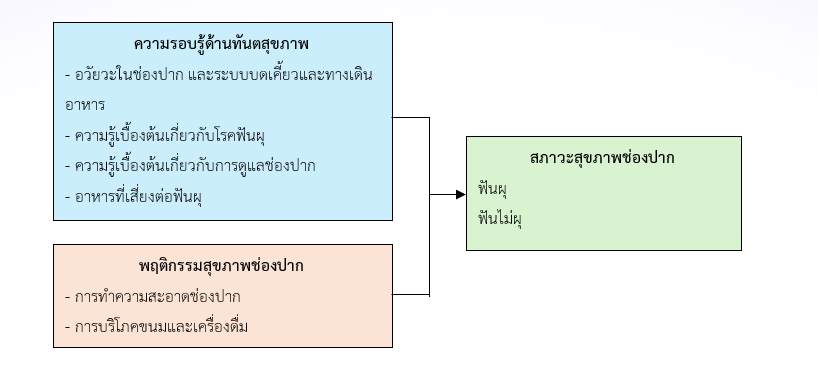
This analytical cross-sectional study aimed to study (1) the level of oral health literacy, (2) oral health behaviors, and (3) the relationship between oral health literacy and oral health behaviors with dental caries condition in Grade 6 students in Huasai District, Nakhon Si Thammarat Province. The samples were divided into two equal groups using oral health data from the Ministry of Public Health’s 43-file database: Group 1 had no active caries and Group 2 had active caries. A total of 292 participants were included (n = 146 per group). The research instrument was a standardized questionnaire from the Bureau of Dental Health, Department of Health, which had been tested for validity and reliability. Oral health condition data were obtained from the 43-file database. Examiner calibration was conducted to control data quality. Descriptive statistics and binary logistic regression were used for data analysis.
The results revealed that both groups demonstrated high levels of oral health literacy regarding oral organs, the masticatory and digestive systems, basic knowledge of dental caries, and basic oral care. Regarding food risks for dental caries, 51.37% of the group without active caries and 48.64% of the group with active caries had literacy levels at the low to moderate range. In terms of oral health behaviors, 51.37% of the group without active caries were at the "needs improvement" or "moderate" level, while only 18.49% of the group with active caries reached the "good" level. Correlation analysis found that oral health literacy was not significantly associated with dental caries condition. However, students with moderate and good oral health behaviors had a 70% and 90% lower risk of dental caries, respectively, compared to those with poor behaviors (Adj. OR = 0.30, 95% CI = 0.12–0.73; Adj. OR = 0.10, 95% CI = 0.04–0.25). Based on these findings, dental personnel should organize oral care education and workshops focusing on cariogenic foods, including periodic monitoring to ensure school-aged children maintain appropriate oral health behaviors.
References
กรมอนามัย. (2567). รายงานผลการสำรวจสภาวะสุขภาพช่องปากแห่งชาติ ครั้งที่ 9 ประเทศไทย พ.ศ. 2566. กรมอนามัย.
กรมอนามัย กระทรวงสาธารณสุข. (2566). แผนยุทธศาสตร์ด้านสุขภาพช่องปากประเทศไทย พ.ศ. 2566–2580 (พิมพ์ครั้งที่ 1). สำนักพิมพ์อักษรกราฟฟิคแอนด์ดีไซน์.
กระทรวงสาธารณสุข. (2568). ระบบคลังข้อมูลด้านการแพทย์และสุขภาพ (Health Data Center: HDC). สืบค้นเมื่อ 15 เมษายน 2569, จาก Health Data Center: HDC
ณัฐนันท์ วัฒนอเนก, และ ณัฐกฤตา ผลอ้อ. (2568). ปัจจัยที่มีความสัมพันธ์กับสภาวะทันตสุขภาพในนักเรียนชั้นมัธยมศึกษาตอนต้น ในอำเภอน้ำพอง จังหวัดขอนแก่น. วารสารศูนย์อนามัยที่ 7 ขอนแก่น, 17(2), 83–97.
ณัฐวุฒิ พูลทอง. (2561). ความรู้ ทัศนคติ พฤติกรรม และเครือข่ายการมีส่วนร่วมดูแลสุขภาพช่องปากที่มีผลต่อดัชนีค่าเฉลี่ยโรคฟันผุ ถอน อุด ในนักเรียนประถมศึกษา อำเภอเซกา จังหวัดบึงกาฬ. วารสารโรงพยาบาลนครพนม, 5(3), 17–25.
ทศพล แอนโก. (2566). การศึกษาปัจจัยที่มีความสัมพันธ์กับสภาวะช่องปากของนักเรียนประถมศึกษาตอนต้นในโรงเรียนประถมศึกษาที่อยู่ในเขตตำบลนาเวียง อำเภอทรายมูล จังหวัดยโสธร. วารสารทันตาภิบาล, 34(2), 75–83.
รัฐติภรณ์ ลีทองดี, จอนสัน พิมพิสาร, วัชรพล วิวรรศน์ เถาว์พันธุ์, จิรัชญา บุตรละคร, และ กนกวรรณ พิสัยพันธ์. (2568). ปัจจัยที่มีความสัมพันธ์กับพฤติกรรมป้องกันโรคฟันผุของนักเรียนชั้นประถมศึกษาปีที่ 6 อำเภอโชคชัย จังหวัดนครราชสีมา. วารสารทันตาภิบาล, 36(2), 60–74.
วัชรพล วิวรรศน์ เถาว์พันธุ์, รัฐติภรณ์ ลีทองดี, นฤพร ชูเสน, ปุณยรัตน์ ลวดทอง, วิลาสินี ยุวชาติ, และ อภิญญา พูนสวัสดิ์. (2566). ความรอบรู้ด้านสุขภาพช่องปากกับพฤติกรรมการดูแลสุขภาพช่องปากของนักเรียนชั้นประถมศึกษาปีที่ 6 เขตอำเภอพนมไพร จังหวัดร้อยเอ็ด. วารสารทันตาภิบาล, 34(1), 35–44.
สำนักทันตสาธารณสุข กรมอนามัย. (2564). แบบสอบถามพฤติกรรมสุขภาพช่องปากเด็กวัยเรียนและวัยรุ่น. กรมอนามัย กระทรวงสาธารณสุข.
สำนักทันตสาธารณสุข กรมอนามัย. (2566). คู่มือกิจกรรมผู้พิทักษ์ฟันดีและแบบประเมินความรอบรู้ด้านทันตสุขภาพสำหรับเด็กวัยเรียน. กรมอนามัย กระทรวงสาธารณสุข.
หทัยรัตน์ เพิงรัตน์. (2568). ปัจจัยที่มีความสัมพันธ์กับสภาวะสุขภาพช่องปาก และการเกิดฟันผุของฟันกรามซี่ที่ 1 ที่ได้รับการเคลือบหลุมร่องฟัน อำเภอตะกั่วทุ่ง จังหวัดพังงา. วารสารป้องกันควบคุมโรคและศาสตร์สุขภาพบูรณาการ, 1(2), 54–70.
Baumgartner, C. S., Wang, N. J., & Wigen, T. I. (2022). Oral health behaviours in 12-year-olds: Association with caries and characteristics of the children? Acta Odontologica Scandinavica, 80(1), 15–20. https://doi.org/10.1080/00016357.2021.1933173
Bloom, B. S. (Ed.). (1956). Taxonomy of educational objectives: The classification of educational goals. Handbook I: Cognitive domain. Longmans, Green.
Brusius, C. D., Alves, L. S., & Maltz, M. (2023). Association between toothbrushing frequency and dental caries and tooth loss in adolescents: A cohort study. Brazilian Oral Research, 37, e127. https://doi.org/10.1590/1807-3107bor-2023.vol37.0127
Fejerskov, O., & Kidd, E. (Eds.). (2008). Dental caries: The disease and its clinical management (2nd ed.). Blackwell Munksgaard.
Fernando, S., Tadakamadla, S., Kroon, J., Lalloo, R., & Johnson, N. W. (2021). Predicting dental caries increment using salivary biomarkers in a remote Indigenous Australian child population. BMC Oral Health, 21, 372. https://doi.org/10.1186/s12903-021-01702-0
Hao, J., Kang, Y., Wei, S., Wang, J., & Wang, H. (2024). 3D intraoral scanning techniques support the effects of crown morphology on dental caries. BMC Oral Health, 24, 549. https://doi.org/10.1186/s12903-024-04292-9
Hosmer, D. W., Jr., Lemeshow, S., & Sturdivant, R. X. (2013). Applied logistic regression (3rd ed.). Wiley. https://doi.org/10.1002/9781118548387 Kamolchaiwanich, K., &
Wanichsaithong, P. (2025). Oral health literacy: Its impact on oral health outcomes and associated factors in sixth-grade primary school students–A cross-sectional study. BMC Oral Health, 25, 1300. https://doi.org/10.1186/s12903-025-06613-y
Mariati, N. W., Duarsa, D. P., & Pinatih, G. N. I. (2024). A combination intervention of conventional educational models and motivational interviews increased knowledge of dental and oral health and reduced dental hygiene index, dental care index, and gingiva index in primary school children in Tomohon City, North Sulawesi. Asian Journal of Engineering, Social and Health, 3(1), 117–133. https://doi.org/10.46799/ajesh.v3i1.226
Moin, M., Maqsood, A., Haider, M. M., Asghar, H., Rizvi, K. F., Shqaidef, A., Sharif, R. A., Suleman, G., Das, G., Alam, M. K., & Ahmed, N. (2023). The association of socioeconomic and lifestyle factors with the oral health status in school-age children from Pakistan: A cross-sectional study. Healthcare, 11(5), 756. https://doi.org/10.3390/healthcare11050756
Nutbeam, D. (2000). Health literacy as a public health goal: A challenge for contemporary health education and communication strategies into the 21st century. Health Promotion International, 15(3), 259–267. https://doi.org/10.1093/heapro/15.3.259
Pitts, N. B., Zero, D. T., Marsh, P. D., Ekstrand, K., Weintraub, J. A., Ramos-Gomez, F., Tagami, J., Twetman, S., Tsakos, G., & Ismail, A. (2017). Dental caries. Nature Reviews Disease Primers, 3, 17030. https://doi.org/10.1038/nrdp.2017.30
Rosenstock, I. M. (1974). Historical origins of the Health Belief Model. Health Education Monographs, 2(4), 328–335. Sheiham, A. (2005). Oral health, general health and quality of life. Bulletin of the World Health Organization, 83(9), 644. https://doi.org/10.1590/S0042-96862005000900004
Shirahmadi, S., Bashirian, S., Soltanian, A. R., Karimi-Shahanjarini, A., & Vahdatinia, F. (2024). Effectiveness of theory-based educational interventions of promoting oral health among elementary school students. BMC Public Health, 24, 130. https://doi.org/10.1186/s12889-023-17528-0
Su, S., Zhang, J., Deng, R., Wang, W., Cui, T., Su, Y., & Li, X. (2024). Oral health status and associated factors among 12 to 15-year-old Chinese adolescents in Southeast China: A cross-sectional study. Medicine, 103(4), e37080. https://doi.org/10.1097/MD.0000000000037080
Tian, Z., Wang, Y., Li, Y., Lu, J., Song, L., Ding, L., Guo, X., & Zheng, J. (2023). Defining the connotations of oral health literacy using the conceptual composition method. International Journal of Environmental Research and Public Health, 20(4), 3518. https://doi.org/10.3390/ijerph20043518
Vaca Altamirano, G., Yumiceba Cashug, J. M., Vásquez Barberán, S. de los Á., & Salinas Goodier, C. (2024). Determinants of cariogenic risk in school-aged children: Implications for dental health. Salud, Ciencia y Tecnología–Serie de Conferencias, 3, 107. https://doi.org/10.56294/sctconf2024.107
Yamane, T. (1973). Statistics: An introductory analysis (3rd ed.). Harper & Row.
Downloads
Published
How to Cite
Issue
Section
License
Copyright (c) 2026 Journal of Primary Health Research

This work is licensed under a Creative Commons Attribution-NonCommercial-NoDerivatives 4.0 International License.