Prescribing Patterns and Quality of Life Outcomes of a Cannabis-Containing Traditional Thai Medicine (Tamrap Ya Suk Saiyas) in Patients with Insomnia: A Prospective Observational Study
Keywords:
Cannabis-Containing Traditional Thai Medicine, Tamrap Ya Suk Sai-Yad, Quality of life, InsomniaAbstract
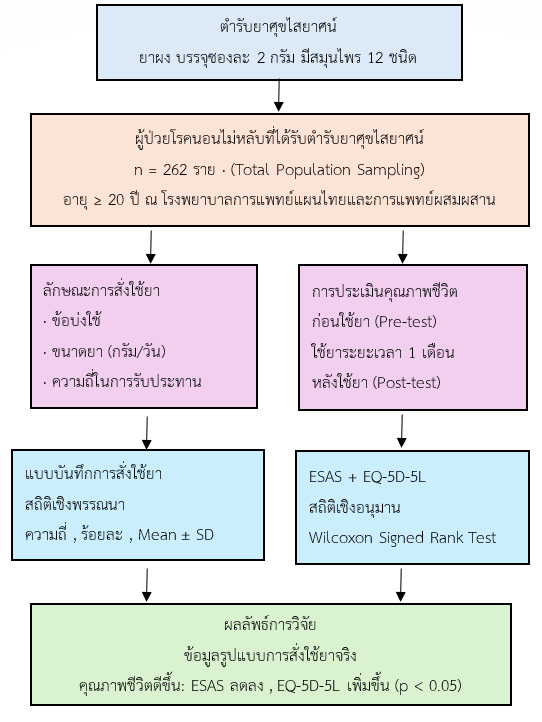
Tamrap Ya Suk Sai-Yad is a cannabis-containing traditional Thai medicinal formulation indicated for improving sleep and stimulating appetite. This study aimed to describe its prescribing patterns and compare the patient quality of life before and after treatment. This prospective observational study was conducted in a real-world clinical setting (Actual Use Research) at the Thai Traditional and Integrative Medicine Hospital, Bangkok. A total of 262 patients who were prescribed Tamrap Ya Suk Sai-Yad between October 2021 and September 2022 were enrolled and followed up for 1 month. Quality of life was assessed using the Edmonton Symptom Assessment System (ESAS) and EQ-5D-5L. Data were analyzed using descriptive statistics, including frequency, percentage, mean, and standard deviation, and inferential statistics using the Wilcoxon signed-rank test.
Most participants were male (56.87%) with a mean age of 53.75 ± 16.66 years. The primary indication was insomnia (81.68%) The most commonly prescribed dosage was 0.5 g per day, administered twice daily. ESAS scores significantly improved in most symptom domains (p < 0.05), except for drowsiness and loss of appetite. EQ-5D-5L utility scores increased from 0.64 ± 0.47 to 0.72 ± 0.37, and visual analog scale (VAS) scores increased from 68.80 ± 8.02 to 79.33 ± 7.68 (p < 0.05). Adverse events were reported in 12.97% of patients, The majority of adverse events were mild in severity, including drowsiness and somnolence. Tamrap Ya Suk Sai-Yad was associated with improved quality of life over a 1-month period, particularly among patients with insomnia. However, Further studies incorporating control groups and long-term follow-up are needed to confirm the efficacy and to assess potential long-term side effects and adverse events associated with prolonged use.
References
อมรรัตน์ ราชเดิม, ปรีชา หนูทิม, ธันวา บัวมหะกุล, & วรกานต์ มาดา. (2568). การศึกษาประสิทธิผลและความปลอดภัยระหว่างตำรับยาศุขไสยาศน์ที่มีกัญชาปรุงผสมกับตำรับยาศุขไสยาศน์ที่ไม่มีกัญชาปรุงผสม ในผู้ป่วยที่นอนไม่หลับ. วารสารการแพทย์แผนไทยและการแพทย์ทางเลือก, 23(1), 7–22.
อาภากร บุญธรรม, ปรีชา หนูทิม, และ ปัทมา ดิลกธรสกุล (2565). รูปแบบการสั่งใช้ ความปลอดภัย และผลต่อคุณภาพชีวิตของตำรับยาศุขไสยาศน์. วารสารการแพทย์แผนไทยและการแพทย์ทางเลือก, 20(2), 295–309.
Bhagavan, C., Kung, S., Doppen, M., John, M., Vakalalabure, I., Oldfield, K., et al. (2020). annabinoids in the treatment of insomnia disorder: A systematic review and meta-analysis. CNS Drugs, 34(12), 1217–1228. https://doi.org/10.1007/s40263-020-00773-x
Chinda, M., Jaturapatporn, D., Kirshen, A. J., & Udomsubpayakul, U. (2011). Reliability and validity of a Thai version of the Edmonton Symptom Assessment Scale (ESAS-Thai). Journal of Pain and Symptom Management, 42(6), 954–960.https://doi.org/10.1016/j.jpainsymman.2011.02.020
Department of Thai Traditional and Alternative Medicine. (2019). Guidance on the use of cannabis in Thai traditional medicine. Ministry of Public Health.
Duangdamrong, J., Jamparngernthaweesri, K., Sathiyos, Y., Poopong, S., Lumlerdkij, N., & Akarasereenont, P. (2022). Evidence of cannabis for medical uses and its indications: An evidence-based comparison between Thai traditional medicine and Western medicine. Siriraj Medical Bulletin, 15(3), 155–163.
Food and Drug Administration, Ministry of Public Health. (2019). Narcotics Act (No. 7) B.E. 2562 and related regulations for the medical use of cannabis. https://www.fda.moph.go.th /sites/Narcotics/SitePages/Home.aspx Health Product Vigilance Center. (n.d.). Download forms. Food and Drug Administration, Ministry of Public Health. https://hpvcthai.fda.moph.go.th/publication-documents/category/download-form
Jamparngernthaweesri, K., Lumlerdkij, N., Booranasubkajorn, S., & Akarasereenont, P. (2023). A retrospective study of Suk Sai Yad recipe uses in patients with insomnia. Siriraj Medical Bulletin, 16(2), 119–130. https://doi.org/10.33192/smb.v16i2.260891
McClure, N. S., Al Sayah, F., Xie, F., Luo, N., & Johnson, J. A. (2017). Instrument-defined estimates of the minimally important difference for EQ-5D-5L index scores. Value in Health, 20(4), 644–650. https://doi.org/10.1016/j.jval.2016.11.015
Naranjo, C. A., Busto, U., Sellers, E. M., Sandor, P., Ruiz, I., Roberts, E. A., Janecek, E., Domecq, C., & Greenblatt, D. J. (1981). A method for estimating the probability of adverse drug reactions. Clinical Pharmacology & Therapeutics, 30(2), 239–245. https://doi.org/10.1038/clpt.1981.154
Narcotics Act (No. 7) B.E. 2562 (2019). (2019, February 18). Royal Gazette, 136(19A). https://www.ratchakitcha.soc.go.th/DATA/PDF/2562/A/019/T_0001.PDF
Punpeng, T., Sathiyos, Y., Thakulbanmahing, P., Paraput, T., Duangdamrong, J., Jamparngernthaweesri, K., et al. (2022). The use of cannabis-containing herbal recipes in Thai traditional medicine manuscript and the analytical data of Thai herbal recipes. Siriraj Medical Bulletin, 15(3), 164–171.
Sakthong, P., Sonsa-Ardjit, N., Sukarnjanaset, P., & Munpan, W. (2015). Psychometric properties of the EQ-5D-5L in Thai patients with chronic diseases. Quality of Life Research, 24(12), 3015–3022. https://doi.org/10.1007/s11136-015-1038-z
Ware, M. A., Wang, T., Shapiro, S., Collet, J. P., & COMPASS study team. (2015). Cannabis for the management of pain: Assessment of safety study (COMPASS). Journal of Pain, 16(12), 1233–1242. https://doi.org/10.1016/j.jpain.2015.07.014
Whiting, P. F., Wolff, R. F., Deshpande, S., Di Nisio, M., Duffy, S., Hernandez, A. V., et al. (2015). Cannabinoids for medical use: A systematic review and meta-analysis. JAMA, 313(24), 2456–2473. https://doi.org/10.1001/jama.2015.6358
Zinboonyahgoon, N., Sansing, W., Sittipunt, C., Srikuea, R., Thienthong, S., Rushatamukayanunt, P., et al. (2021). Medicinal cannabis in Thailand: 1-year experience after legalization. Pain, 162 (Suppl 1), S105–S109. https://doi.org/10.1097/j.pain.0000000000001936
Downloads
Published
How to Cite
Issue
Section
License
Copyright (c) 2026 Journal of Primary Health Research

This work is licensed under a Creative Commons Attribution-NonCommercial-NoDerivatives 4.0 International License.