Developing a Model for Caring for Psychiatric and Substance Abuse Patients to Prevent Violence in the Community of Lamthamenchai District, Nakhon Ratchasima Province
Article Sidebar
Main Article Content
Abstract
Background: Violence perpetrated by psychiatric and substance abuse patients is a significant problem impacting families and communities, and its prevalence is increasing. Therefore, providing care for psychiatric and substance abuse patients is crucial in preventing community violence. This study aims to investigate the current situation and challenges in caring for psychiatric and substance abuse patients, develop a model for community-based care, and analyze the effectiveness of this model.
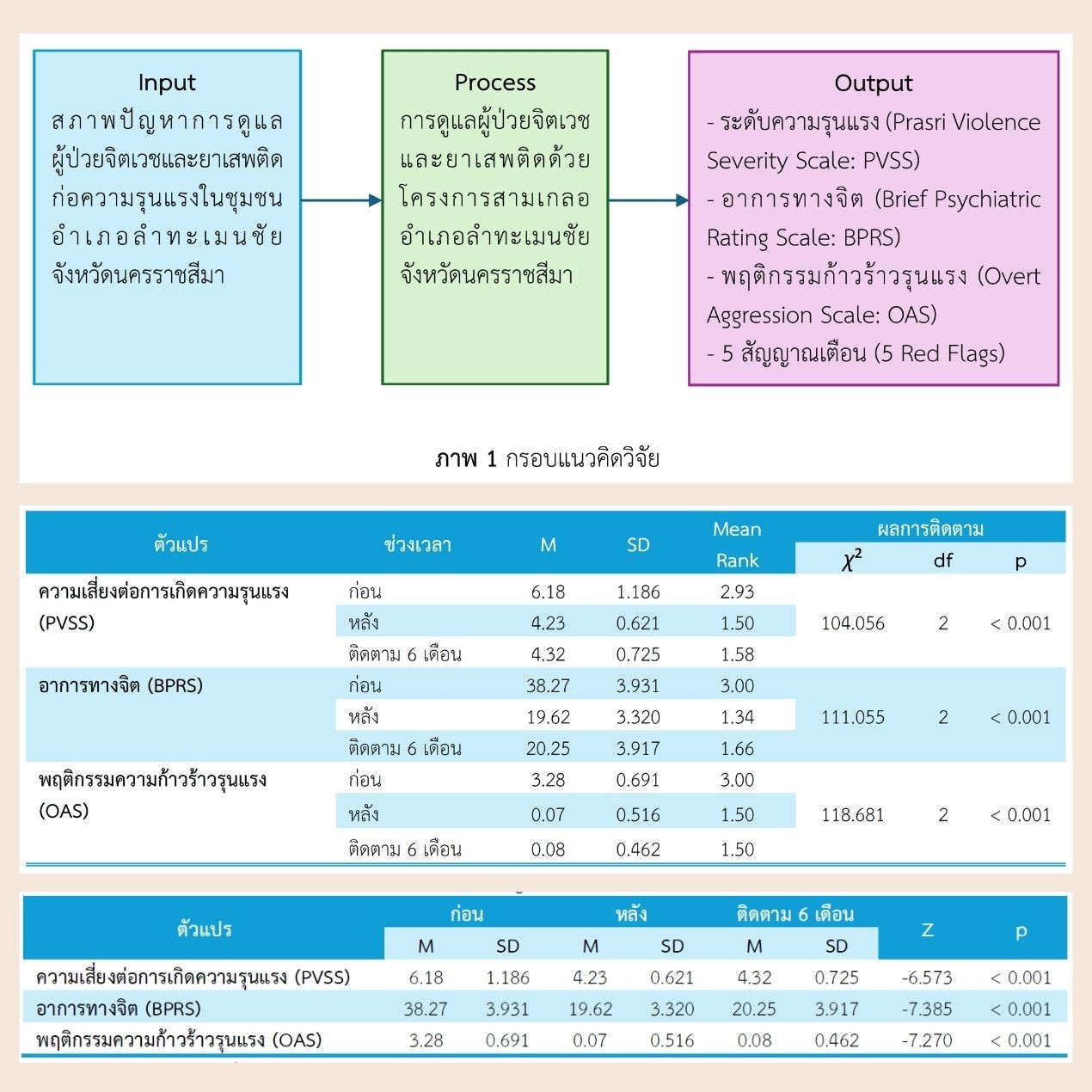
Methods: This research and development project was divided into six phases: 1) Studying the problem situation through in-depth interviews with stakeholders to obtain input for development; 2) Participatory planning for developing care for psychiatric and substance abuse patients; 3) Implementing the care model for psychiatric and substance abuse patients; 4) Improving the operation; 5) Expanding the care model for psychiatric and substance abuse patients; and 6) Evaluating the effectiveness of the care model by analyzing results before, after participation, and at the 6 months follow-up. This evaluation utilized assessment tools for the severity of risk of violence against oneself and others, a psychiatric symptom assessment, an assessment of aggressive behavior, and a risk assessment tool for relapse (5 warning signs). Descriptive statistics were used to compare average scores over different time periods using the Friedman Test and the Wilcoxon signed-ranks test.
Results: The study found an increasing trend of psychiatric and substance abuse patients in Lamthamenchai District. These patients often lack caregivers, continuous treatment, deny their illness, and use substances. The " Samkler Lamthamenchai " care model in Lamthamenchai District, where relatives, village health volunteers, and village headmen or assistant village headmen served as primary caregivers, was found to significantly reduce the risk of violence, psychiatric symptoms, and aggressive behavior at the 0.05 significance level.
Conclusion: The " Samkler Lamthamenchai " care model in Lamthamenchai can help reduce the risk of violence against oneself and others, psychiatric symptoms, and aggressive behavior.
Article Details

This work is licensed under a Creative Commons Attribution-NonCommercial-NoDerivatives 4.0 International License.
The opinions and content expressed in the articles are solely those of the individual authors and do not necessarily reflect the views of the journal or the authors’ affiliated institutions. Authors are fully responsible for the accuracy and correctness of their work.
Any reuse, reproduction, or redistribution of the articles, content, data, or images in other forms requires prior written permission from the Journal of Medicine, Nursing and Public Health Research, Thungsong Hospital.
References
กรมสุขภาพจิต กระทรวงสาธารณสุข. มาตรฐานการปฏิบัติงานการดูแลผู้ป่วยจิตเวชและยาเสพติดที่มีความเสี่ยงสูงต่อการก่อความรุนแรง Standard Operating Procedures: SOPs Severe Mental Illness High Risk to Violence (V-Care). พิมพ์ครั้งที่ 1. นนทบุรี: บริษัท บียอนด์ พับลิสซิ่ง จำกัด; 2566.
กรมสุขภาพจิต กระทรวงสาธารณสุข. คู่มือระบบการดูแลผู้ป่วยจิตเวชที่มีความเสี่ยงสูงต่อการก่อความรุนแรงสำหรับสถาบัน/โรงพยาบาลสังกัดกรมสุขภาพจิต. พิมพ์ครั้งที่ 1. นนทบุรี: บริษัท พรอสเพอรัสพลัส จำกัด; 2563.
Fazel S, Langstrom N, Hjern A, Grann M, Lichtenstein P. Schizophrenia, substance abuse, and violent crime. JAMA. 2009;301(19):2016–23. doi: 10.1001/jama.2009.675
สุพัตรา จันทร์สุวรรณ, วรางคณา จำปาเงิน, สุนทรี ขะชาตย์, ปวิดา โพธิ์ทอง, เสาวลักษณ์ ศรีโพธิ์. ปัญหาและสาเหตุการกลับเป็นซ้ำของผู้ป่วยจิตเวชที่ใช้สารเสพติดในชุมชน. วารสารวิทยาลัยพยาบาลบรมราชชนนี สุพรรณีบุรี. 2566;6(2):67–77. เข้าถึงได้จาก: https://he02.tci-thaijo.org/index.php/SNC/article/view/266510
บรมัตถ์ วิสุงเร, ดรุณี รุจกรกานต์. ปัจจัยทำนายการฟื้นคืนสู่สุขภาวะในผู้ป่วยจิตเภท. วารสารการพยาบาลจิตเวชและสุขภาพจิต. 2566;37(1):1–16. เข้าถึงได้จาก: https://he02.tci-thaijo.org/index.php/JPNMH/article/view/260909
สำนักงานจังหวัดนครราชสีมา. ผู้ป่วยยาเสพติดกลุ่มเสี่ยงที่มีอาการทางจิตและมีพฤติกรรมก่อความรุนแรง [อินเทอร์เน็ต]. นครราชสีมา: สำนักงานจังหวัดนครราชสีมา; 2566 [เข้าถึงเมื่อ 6 ธันวาคม 2566]. เข้าถึงได้จาก: https://data.go.th/dataset/dataset_5_19_
โรงพยาบาลลำทะเมนชัย. รายงานกลุ่มงานจิตเวชและยาเสพติด. ลำทะเมนชัย: โรงพยาบาลลำทะเมนชัย; 2566. [เอกสารที่ยังไม่เผยแพร่].
สุจิตรา ลักษณะ. ระบบการเฝ้าระวังป้องกันการป่วยซ้ำผู้ป่วยจิตเภทโดยการมีส่วนร่วมอำเภอโคกโพธิ์ จังหวัดปัตตานี: กรณีศึกษาตำบลนาเกตุ อำเภอโคกโพธิ์ จังหวัดปัตตานี. วารสารอนามัยสิ่งแวดล้อมและสุขภาพชุมชน. 2563;5(3):129–37. เข้าถึงได้จาก: https://he03.tci-thaijo.org/index.php/ech/article/view/853
พิณณรัฐ ศรีหารักษา. การดูแลผู้ป่วยจิตเภทที่เสี่ยงต่อการก่อความรุนแรงโดยการใช้การจัดการรายกรณีแบบมีส่วนร่วมในชุมชน อำเภอเมือง จังหวัดสกลนคร: กรณีศึกษาตำบลขมิ้น อำเภอเมือง จังหวัดสกลนคร. วารสารสุขภาพและสิ่งแวดล้อมศึกษา. 2566;8(1):437–47. เข้าถึงได้จาก: https://so06.tci-thaijo.org/index.php/hej/article/view/262848
สุกัญญา ละอองศรี, บัววรุณ ศรีชัยกุล, นพดล พิมพ์จันทร์. การพัฒนารูปแบบการดูแลผู้ป่วยจิตเวชในชุมชน ตำบลไผ่ อำเภอรัตนบุรี จังหวัดสุรินทร์. วารสารวิทยาลัยพยาบาลบรมราชชนนี นครราชสีมา. 2560;23(2):68–79. เข้าถึงได้จาก: https://he02.tci-thaijo.org/index.php/Jolbcnm/article/view/105943/83990
หทัยกาญจน์ เสียงเพราะ. การพัฒนารูปแบบการดูแลผู้ป่วยจิตเวชที่กลับมารักษาซ้ำโดยการมีส่วนร่วมของชุมชน. วารสารการแพทย์ศรีสะเกษ สุรินทร์ บุรีรัมย์. 2564;36(2):413–26. เข้าถึงได้จาก: https://he02.tci-thaijo.org/index.php/MJSSBH/article/view/252861
กรองจิต วลัยศรี. การพัฒนารูปแบบการดูแลผู้ป่วยจิตเวชและยาเสพติดที่มีความเสี่ยงสูงต่อการก่อความรุนแรงในชุมชน โดยการมีส่วนร่วมของภาคีเครือข่าย อำเภอเสลภูมิ จังหวัดร้อยเอ็ด. วารสารอนามัยสิ่งแวดล้อมและสุขภาพชุมชน. 2566;8(3):909–17. เข้าถึงได้จาก: https://he03.tci-thaijo.org/index.php/ech/article/view/1864
กรรณิกา ช่อรักษ์. การพัฒนารูปแบบการดูแลผู้ป่วยโรคจิตจากสารเสพติดโดยภาคีเครือข่ายมีส่วนร่วม อำเภอพยัคฆภูมิพิสัย จังหวัดมหาสารคาม. วารสารสุขภาพและสิ่งแวดล้อมศึกษา. 2566;8(4):503–13. เข้าถึงได้จาก: https://so06.tci-thaijo.org/index.php/hej/article/view/269261
House JS. Work stress and social support. Menlo Park: Addison-Wesley; 1981.
อรุณกมล ทราบรัมย์. ผลของการสนับสนุนของครอบครัวต่อพฤติกรรมการใช้ยาตามเกณฑ์การรักษาในผู้ป่วยจิตเภทที่มีพฤติกรรมรุนแรง. [วิทยานิพนธ์]. กรุงเทพมหานคร: จุฬาลงกรณ์มหาวิทยาลัย; 2564.
กฤตภาส ไทยวงษ์. การพัฒนาแนวทางการป้องกันกระทำผิดซ้ำในผู้ป่วยนิติจิตเวช. [วิทยานิพนธ์]. กรุงเทพมหานคร: จุฬาลงกรณ์มหาวิทยาลัย; 2564.
ไพรจิตร พุทธรอด. การพัฒนารูปแบบการดูแลต่อเนื่องในผู้ป่วยจิตเภท. วารสารวิชาการสาธารณสุข. 2561;27(3):478–86. เข้าถึงได้จาก: https://thaidj.org/index.php/JHS/article/view/3835
ผกามาศ สุฐิติวนิช, สันติภาพ คงนาวัง. การพัฒนาสมรรถนะทีมบุคลากรในการดูแลผู้ป่วยจิตเภทที่มีพฤติกรรมก้าวร้าวรุนแรง โรงพยาบาลชัยภูมิ. วารสารวิชาการทางการพยาบาลและวิทยาศาสตร์สุขภาพ. 2565;2(2):46–58. เข้าถึงได้จาก: https://he04.tci-thaijo.org/index.php/AJNHS/article/view/23
บำรุง วงษ์นิ่ม, แสงเดือน ดีผิว, สุรพล สุพวง. การพัฒนาระบบการดูแลผู้ป่วยจิตเวชสารเสพติดโดยการมีส่วนร่วมและไร้รอยต่อ ตัวแบบลพบุรี: กรณีศึกษาอำเภอโคกสำโรง. วารสารวิชาการสาธารณสุขชุมชน. 2567;10(1):223–33. เข้าถึงได้จาก: https://he02.tci-thaijo.org/index.php/ajcph/article/view/265916
Anderson KK, Jenson CE. Violence risk-assessment screening tools for acute care mental health settings: Literature review. Arch Psychiatr Nurs. 2019;33(1):112–9. doi: 10.1016/j.apnu.2018.08.012
Sarver WL, Radziewicz R, Coyne G, Colon K, Mantz L. Implementation of the Broset Violence Checklist on an Acute Psychiatric Unit. J Am Psychiatr Nurses Assoc. 2019;25(6):476–86. doi: 10.1177/1078390318820668
Hofmann AB, Schmid HM, Jabat M, Brackmann N, Noboa V, Bobes J, et al. Utility and validity of the Brief Psychiatric Rating Scale (BPRS) as a transdiagnostic scale. Psychiatry Res. 2022;314:114659. doi: 10.1016/j.psychres.2022.114659
Hiebert BJ, Care WD, Udod SA, Waddell CM. Psychiatric Nurses' Lived Experiences of Workplace Violence in Acute Care Psychiatric Units in Western Canada. Issues Ment Health Nurs. 2022;43(2):146–53. doi: 10.1080/01612840.2021.1956656
American Psychiatric Nurses Association. Position: Violence prevention [Internet]. APNA; 2022 [cited 2024 Jul 26]. Available from: https://www.apna.org/news/violence-prevention/
Hove E, Hazelton MJ, Santangelo P, Wilson RL. Integrated nursing care for people with combined mental health and substance use disorders. Int J Ment Health Nurs. 2023;32(2):378–401. doi: 10.1111/inm.13094
Jenkins E, Currie LM, Hirani S, Garrod E, Goodyear T, McGuinness L, et al. Enhancing nurses' capacity to provide concurrent mental health and substance use disorder care: A quasi-experimental intervention study. Nurse Educ Today. 2022;117:105483. doi: 10.1016/j.nedt.2022.105483
