
The Role of Registered Nurses in Nursing Skills Laboratories in Supporting Nursing Students’ Learning Outcomes
Keywords:
laboratory registered nurse, nursing skills laboratory, learning outcomes, simulation, nursing studentsAbstract
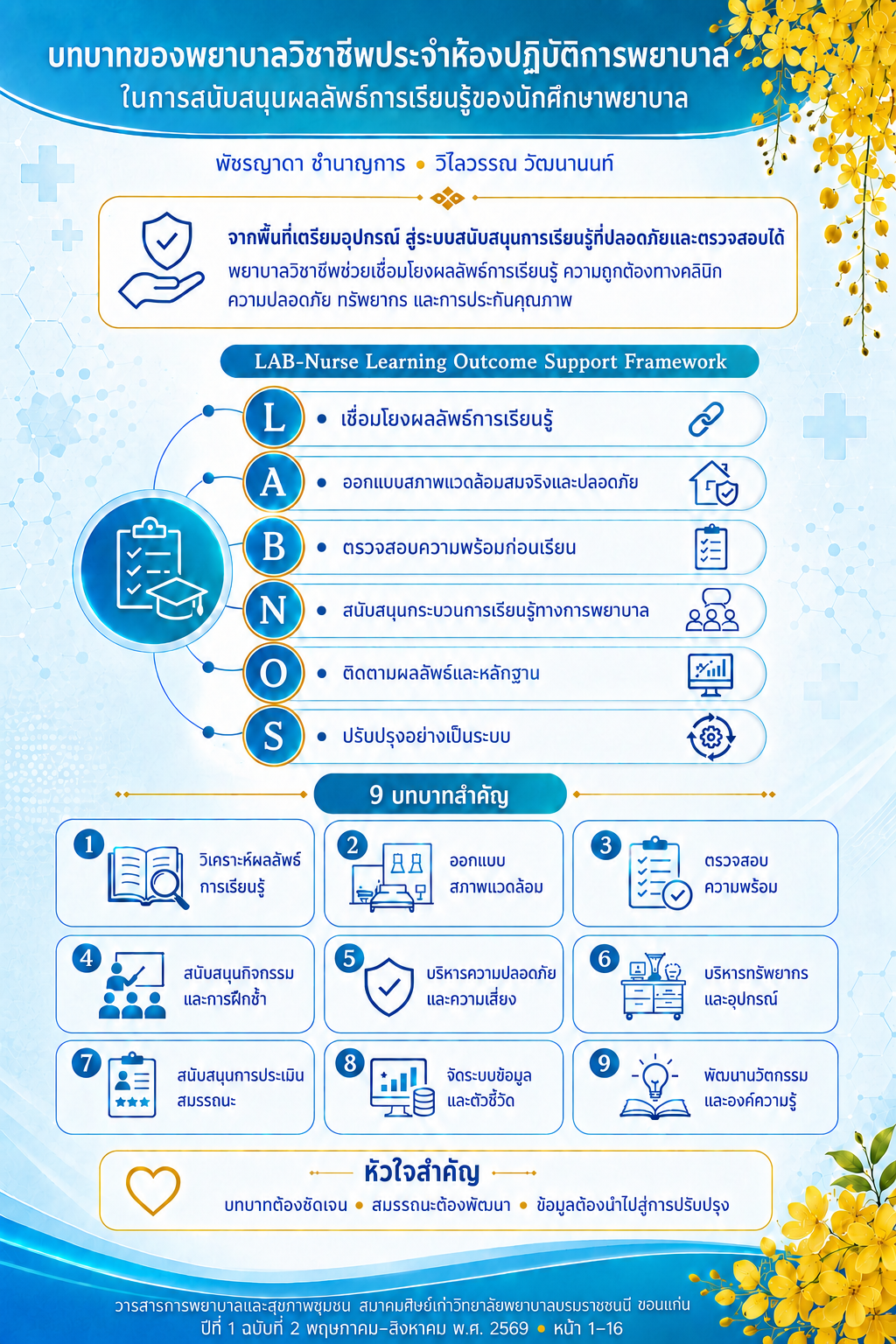
Nursing skills laboratories are essential learning environments that bridge theoretical knowledge and clinical practice. They provide nursing students with opportunities to develop practical skills, clinical reasoning, decision-making, communication, and safety competencies before delivering care to real patients. The effectiveness of a nursing skills laboratory depends not only on facilities, simulation manikins, and equipment but also on personnel who can systematically align learning outcomes with the preparation of learning environments and supporting processes. This academic article aims to explain the significance of registered nurses working in nursing skills laboratories, analyze their roles and required competencies, and propose practical guidance for nursing education institutions with or without registered nurses assigned to these positions.
The synthesis identified nine major roles: participating in learning-outcome analysis; designing and preparing learning environments; verifying readiness; supporting learning activities and repeated practice; managing safety and risks; managing resources and equipment life cycles; supporting competency assessment; establishing data, evidence, and indicator systems; and contributing to innovation and knowledge development. Required competencies encompass clinical and professional practice, learning support, simulation, technology and operations, management, quality and risk management, and data, research, and innovation. The authors propose the LAB-Nurse Learning Outcome Support Framework, which consists of learning-outcome alignment, authentic and safe environment design, before-learning readiness, nursing learning-process support, outcome and evidence monitoring, and systematic improvement. Employing registered nurses in nursing skills laboratories may represent a systematic approach to transforming laboratories from equipment-preparation areas into professional learning-support systems characterized by clinical accuracy, safety, standardization, and accountability. Further research is recommended to evaluate the proposed framework and its contribution to nursing students’ learning outcomes.
References
Mulyadi M, Tonapa SI, Rompas SSJ, Wang RH, Lee BO. Effects of simulation technology-based learning on nursing students’ learning outcomes: a systematic review and meta-analysis of experimental studies. Nurse Educ Today. 2021;107:105127. doi:10.1016/j.nedt.2021.105127.
Cant RP, Cooper SJ. Use of simulation-based learning in undergraduate nurse education: an umbrella systematic review. Nurse Educ Today. 2017;49:63-71. doi:10.1016/j.nedt.2016.11.015.
Theobald KA, Tutticci N, Ramsbotham J, Johnston S. Effectiveness of using simulation in the development of clinical reasoning in undergraduate nursing students: a systematic review. Nurse Educ Pract. 2021;57:103220. doi:10.1016/j.nepr.2021.103220.
Rothgeb MK. Creating a nursing simulation laboratory: a literature review. J Nurs Educ. 2008;47(11):489-94. doi:10.3928/01484834-20081101-06.
Silva GO, Fonseca LMM, Siqueira KM, Góes FDSN, Ribeiro LM, Aredes NDA. The simulation design in health and nursing: a scoping review. Nurs Open. 2023;10(4):1966-84. doi:10.1002/nop2.1466.
Sittner BJ, Aebersold ML, Paige JB, Graham LLM, Schram AP, Decker SI, et al. INACSL Standards of Best Practice for Simulation: past, present, and future. Nurs Educ Perspect. 2015;36(5):294-8. doi:10.5480/15-1670.
McMahon E, Jimenez FA, Lawrence K, Victor J. Healthcare Simulation Standards of Best Practice™: evaluation of learning and performance. Clin Simul Nurs. 2021;58:54-6. doi:10.1016/j.ecns.2021.08.016.
Roche AF, Condron CM, Eppich WJ, O’Connor PE. A mixed methods study identifying the competencies of health care simulation technicians. Simul Healthc. 2023;18(5):293-8. doi:10.1097/SIH.0000000000000682.
ก่อกุศล จันดี, เชษฐาภรณ์ จันทร์เลิศฤทธิ์. ถอดบทเรียนการบริหารจัดการห้องปฏิบัติการเพื่อรองรับการเรียนรู้ภาคทดลอง: วิทยาลัยพยาบาลบรมราชชนนี ขอนแก่น. วารสารการพยาบาลและสุขภาพชุมชน สมาคมศิษย์เก่าวิทยาลัยพยาบาลบรมราชชนนี ขอนแก่น. 2569;1(1):58-81.
สภาการพยาบาล. คู่มือการรับรองสถาบันการศึกษาวิชาการพยาบาลและการผดุงครรภ์ ฉบับปรับปรุง พ.ศ. 2568 [อินเทอร์เน็ต]. นนทบุรี: สภาการพยาบาล; 2568 [สืบค้นเมื่อ 31 ก.ค. 2569].
สภาการพยาบาล. ประกาศสภาการพยาบาล เรื่อง มาตรฐานการพยาบาล พ.ศ. 2562. ราชกิจจานุเบกษา. 2562;136(ตอนพิเศษ 97 ง):30-6.
คณะกรรมการมาตรฐานการอุดมศึกษา. ประกาศคณะกรรมการมาตรฐานการอุดมศึกษา เรื่อง รายละเอียดผลลัพธ์การเรียนรู้ตามมาตรฐานคุณวุฒิระดับอุดมศึกษา พ.ศ. 2565 [อินเทอร์เน็ต]. กรุงเทพฯ: กระทรวงการอุดมศึกษา วิทยาศาสตร์ วิจัยและนวัตกรรม; 2565 [สืบค้นเมื่อ 31 ก.ค. 2569].
Downloads
Published
How to Cite
Issue
Section
License
Copyright (c) 2026 Journal of Nursing and Community Health, Boromarajonani College of Nursing Khon Kaen Alumni Association (Online)

This work is licensed under a Creative Commons Attribution-NonCommercial-NoDerivatives 4.0 International License.
Articles in this journal are copyrighted by the x may be read and used for academic purposes, such as teaching, research, or citation, with proper credit given to the author and the journal.use or modification of the articles is prohibited without permission.
statements expressed in the articles are solely the opinions of the authors.
authors are fully responsible for the content and accuracy of their articles.
other reuse or republication requires permission from the journal."


