
From Ophthalmic Nurse to Nursing Instructor: Roles in Facilitating Learning for Nursing Students
Abstract
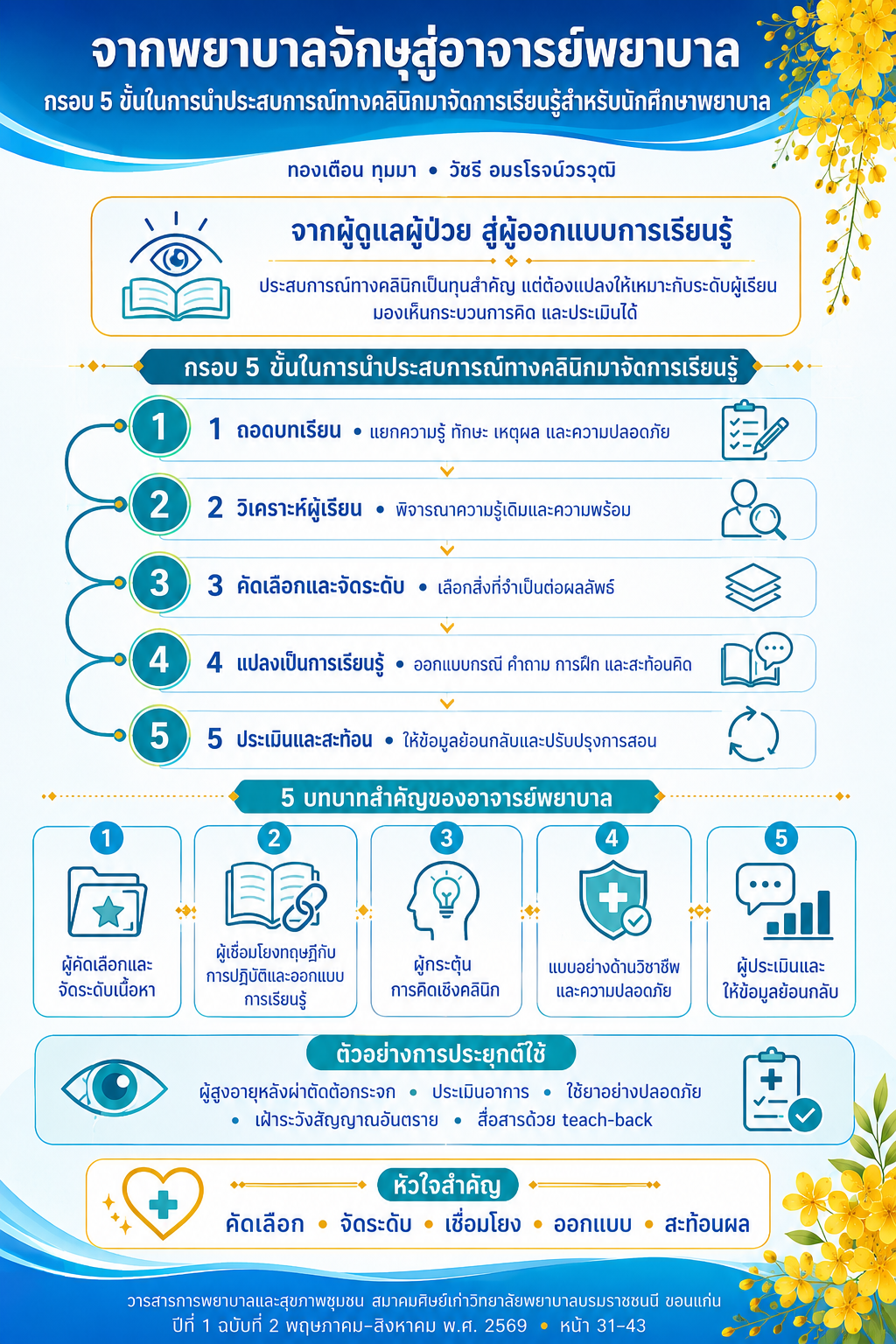
The transition from ophthalmic nurse to nursing instructor is more than a change of workplace; it is a transformation of professional identity and accountability. The focus shifts from providing direct nursing care and ensuring patient safety to designing learning experiences that support student development, graduate quality, and the safety of future care recipients. Ophthalmic expertise provides valuable professional capital, including specialized knowledge, precise assessment, recognition of urgent eye conditions, medication safety, and communication with people who have visual impairment. However, clinical expertise does not automatically become teaching expertise. This academic article explains transition challenges, synthesizes key educator roles, and proposes a framework for translating clinical expertise into learning for second-year nursing students. The framework comprises five steps: (1) unpacking clinical expertise, (2) analyzing learners, (3) selecting and leveling content, (4) transforming knowledge into learning experiences, and (5) assessing and reflecting on outcomes. Within this process, nursing instructors enact five interrelated roles: content selector and leveler; theory–practice connector and learning designer; facilitator of clinical reasoning; professional and safety role model; and assessor and feedback provider. An application example involving an older adult after cataract surgery illustrates how the framework can align learning outcomes, case information, guiding questions, practice, assessment, and reflection. The framework makes tacit clinical knowledge visible, learner-appropriate, and actionable. It can also be adapted for novice nursing instructors transitioning from other clinical specialties, although its appropriateness and educational outcomes require further evaluation.
References
World Health Organization. Eye care in health systems: guide for action. Geneva: World Health Organization; 2022.
World Health Organization. Eye care competency framework. Geneva: World Health Organization; 2022.
Yu M, D’Amico R, Wang W, Blanchet K, Limburg H, Resnikoff S, et al. Development of the World Health Organization eye care competency framework. Hum Resour Health. 2023;21:46. doi:10.1186/s12960-023-00831-x.
จินตนา ไพบูลย์ธนานนท์, ศรีสุนทรา จิมวรพิพัฒน์, จินตนา รังษา. ผลการใช้สื่อวิดิทัศน์เรื่องการเช็ดตา หยอดตาและป้ายตาสำหรับการปฏิบัติการพยาบาลในคลินิกของนักศึกษาพยาบาลศาสตร์ วิทยาลัยพยาบาลบรมราชชนนี กรุงเทพ. วารสารวิจัยสุขภาพและการพยาบาล. 2564;37(3):280-9.
Halton J, Ireland CJ, Vaughan B. The transition of clinical nurses to nurse educator roles—a scoping review. Nurse Educ Pract. 2024;78:104022. doi:10.1016/j.nepr.2024.104022.
National League for Nursing. Core competencies for academic nurse educators [Internet]. Washington, DC: National League for Nursing; [cited 2026 Aug 2]. Available from: https://www.nln.org/education/nursing-education-competencies/core-competencies-for-academic-nurse-educators
World Health Organization. Guide to applying the WHO eye care competency framework. Geneva: World Health Organization; 2022.
Gcawu SN, van Rooyen DRM. Clinical teaching practices of nurse educators: an integrative literature review. Health SA. 2022;27:1728. doi:10.4102/hsag.v27i0.1728.
Connor J, Flenady T, Massey D, Dwyer T. Clinical judgement in nursing—an evolutionary concept analysis. J Clin Nurs. 2023;32(13-14):3328-40. doi:10.1111/jocn.16469.
Tanner CA. Thinking like a nurse: a research-based model of clinical judgment in nursing. J Nurs Educ. 2006;45(6):204-11. doi:10.3928/01484834-20060601-04.
Persico L, Belle A, DiGregorio H, Wilson-Keates B, Shelton C. Healthcare Simulation Standards of Best Practice™ facilitation. Clin Simul Nurs. 2021;58:22-6. doi:10.1016/j.ecns.2021.08.010.
McDermott DS, Ludlow J, Horsley E, Meakim C. Healthcare Simulation Standards of Best Practice™ prebriefing: preparation and briefing. Clin Simul Nurs. 2021;58:9-13. doi:10.1016/j.ecns.2021.08.008.
Niu Y, Liu T, Li K, Sun M, Sun Y, Wang X, et al. Effectiveness of simulation debriefing methods in nursing education: a systematic review and meta-analysis. Nurse Educ Today. 2021;107:105113. doi:10.1016/j.nedt.2021.105113.
ขัตติยาพร คนเที่ยง, วโรดม เสมอเชื้อ, ปรมาภรณ์ นิรมล, จิรณัฐ ชัยชนะ. ผลของการฝึกซ้ำในสถานการณ์จำลองเสมือนจริงต่อความมั่นใจในตนเองและการตัดสินใจทางคลินิกของนักศึกษาพยาบาล. วารสารการพยาบาลและสุขภาพ สสอท. 2566;5(2):e3065.
Smith NE, Barbé T, Randolph J. Application of the cognitive load theory in prelicensure nursing education: a quantitative measurement focusing on instructional design. Int J Nurs Educ Scholarsh. 2022;19(1). doi:10.1515/ijnes-2021-0127.
Moorfields Eye Hospital NHS Foundation Trust. How to use your eye drops [Internet]. London: Moorfields Eye Hospital; 2018 [cited 2026 Aug 15]. Available from: https://www.moorfields.nhs.uk/for-patients/information-hub/how-to-use-your-eye-drops
Agency for Healthcare Research and Quality. Use the teach-back method: Tool 5 [Internet]. Rockville (MD): Agency for Healthcare Research and Quality; 2024 [cited 2026 Aug 15]. Available from: https://www.ahrq.gov/health-literacy/improve/precautions/tool5.html
Downloads
Published
How to Cite
Issue
Section
License
Copyright (c) 2026 Journal of Nursing and Community Health, Boromarajonani College of Nursing Khon Kaen Alumni Association

This work is licensed under a Creative Commons Attribution-NonCommercial-NoDerivatives 4.0 International License.
Articles in this journal are copyrighted by the x may be read and used for academic purposes, such as teaching, research, or citation, with proper credit given to the author and the journal.use or modification of the articles is prohibited without permission.
statements expressed in the articles are solely the opinions of the authors.
authors are fully responsible for the content and accuracy of their articles.
other reuse or republication requires permission from the journal."


