Prevalence of stunting and environmental determinants among children under 5 years of age: A systematic review and meta-analysis
Keywords:
Child nutrition, environmental determinants, meta-analysis, stunting prevalence, stuntingAbstract
Background: Stunting remains a major global public health issue, particularly in low- and middle-income countries. It is driven by inadequate nutrition and environmental factors, such as limited access to clean water, sanitation, and hygiene practices.
Objectives: This study aimed to estimate the prevalence of stunting among children under 5 years of age and to assess its correlation with environmental determinants.
Methods: This systematic review and meta-analysis followed PRISMA guidelines. Four international e-databases—Scopus, PubMed, ScienceDirect, and Springer—and reference lists were searched. In total, 20 studies involving 103,313 children met the inclusion criteria. A random-effects model was employed to estimate combined prevalence and associations; the I² statistic was used to assess heterogeneity.
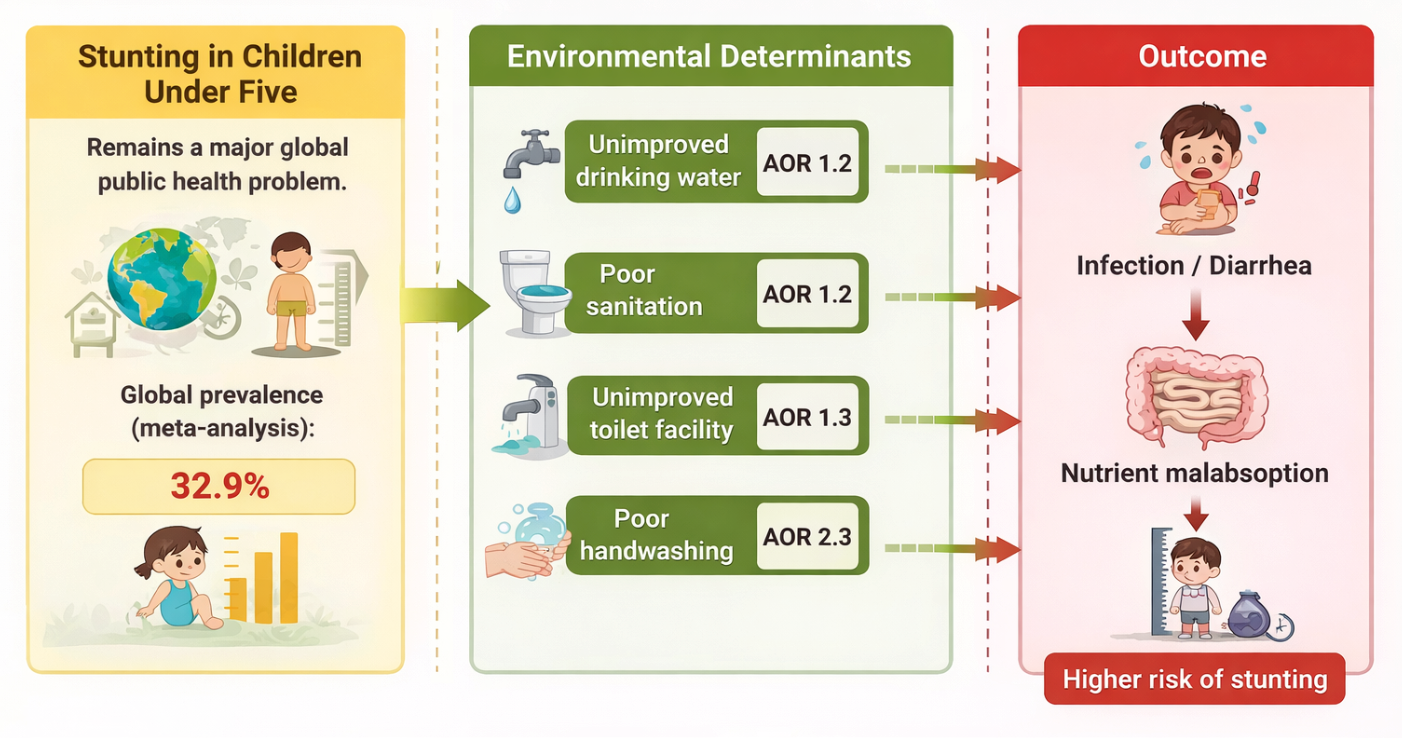
Results: Stunting prevalence was 32.9% (95% CI: 28.6–37.8; I2 = 99.5%). Children from households with inadequate sources of drinking water were at a 1.2-times higher risk of stunting (adjusted odds ratio (AOR) = 1.2; 95% CI: 1.0–1.4; I2 = 78.5%). Inadequate toilet facilities increased the risk by 1.3 times (AOR = 1.3; 95% CI: 1.0–1.6; I2 = 86.5%), poor sanitation by 1.2 times (AOR = 1.2; 95% CI: 1.0–1.4; I2 = 75.0%), and poor handwashing practices by 2.3 times (AOR = 2.3; 95% CI: 1.0–5.5; I2 = 68.1%).
Conclusion: Stunting prevalence was significantly associated with environmental determinants. Integrating interventions for such factors with nutrition programs is essential to controlling stunting, particularly in rural areas. Policy efforts should prioritize improving access to safe drinking water, providing adequate sanitation facilities, conducting hygiene promotion programs, and community-based nutritional interventions to support child growth and development.
Downloads
References
Wagnew F, Tesgera D, Mekonnen M, Abajobir AA. Predictors of mortality among under-five children with severe acute malnutrition, Northwest Ethiopia: an institution based retrospective cohort study. Arch Public Health 2018;76:64.
https://doi.org/10.1186/s13690-018-0309-x
Titaley CR, Ariawan I, Hapsari D, Muasyaroh A, Dibley MJ. Determinants of the stunting of children under two years old in indonesia: a multilevel analysis of the 2013 Indonesia basic health survey. Nutrients 2019;11:1106.
https://doi.org/10.3390/nu11051106
Mutiarasari D, Miranti M, Fitriana Y, Pakaya D, Sari P, Bohari B, et al. A Determinant analysis of stunting prevalence on under 5-year-old children to establish stunting management policy. Open Access Maced J Med Sci 2021;9:79-84.
https://doi.org/10.3889/oamjms.2021.5622
Elmighrabi NF, Fleming CAK, Agho KE. Factors associated with childhood stunting in four North African Countries: Evidence from multiple indicator cluster surveys, 2014-2019. Nutrients 2024;16:473.
https://doi.org/10.3390/nu16040473
Alam MA, Richard SA, Fahim SM, Mahfuz M, Nahar B, Das S, et al. Impact of early-onset persistent stunting on cognitive development at 5 years of age: Results from a multi-country cohort study. PLoS One 2020;15:e0227839.
https://doi.org/10.1371/journal.pone.0227839
Lestari E, Siregar A, Hidayat AK, Yusuf AA. Stunting and its association with education and cognitive outcomes in adulthood: A longitudinal study in Indonesia. PLoS One 2024;19:e0295380.
https://doi.org/10.1371/journal.pone.0295380
Kang Y, Aguayo VM, Campbell RK, West KP. Association between stunting and early childhood development among children aged 36-59 months in South Asia. Matern Child Nutr 2018;14 Suppl 4:e12684.
https://doi.org/10.1111/mcn.12684
Niragire F, Ndikumana C, Nyirahabimana MG, Mugemangango C. Child stunting and associated risk factors in selected food-insecure areas in Rwanda: an analytical cross-sectional study. Pan Afr Med J 2022;43:111.
https://doi.org/10.11604/pamj.2022.43.111.35100
Shaka MF, Woldie YB, Lola HM, Olkamo KY, Anbasse AT. Determinants of undernutrition among children under-five years old in southern Ethiopia: does pregnancy intention matter? A community-based unmatched case-control study. BMC Pediatr 2020;20:101.
https://doi.org/10.1186/s12887-020-2004-7
Usman S, Salma WO, Asriati A. Determinants of stunting incidence in children under five years of age at the Rumbia Health Center, Indonesia. J Client-centered Nurs Care 2021;7:295-302.
https://doi.org/10.32598/JCCNC.7.4.387.1
Hastuti VN, Afifah DN, Sugianto DN, Anjani G, Noer ER. Socio-demographics, dietary diversity score, and nutritional status of children aged 2-5 years: A cross-sectional study of Indonesian coastal areas. Clin Epidemiol Glob Health 2024;27:101599.
https://doi.org/10.1016/j.cegh.2024.101599
Abera L, Dejene T, Laelago T. Magnitude of stunting and its determinants in children aged 6-59 months among rural residents of Damot Gale district; southern Ethiopia. BMC Res Notes 2018;11:557.
https://doi.org/10.1186/s13104-018-3666-1
Mulaw GF, Adem OS, Belachew AB. Determinants of stunting among children aged 6-23 months of age in Pastoral Community, Afar Region, Ethiopia: unmatched case-control study. Int J Child Health Nutr 2020;9:191-201.
https://doi.org/10.6000/1929-4247.2020.09.04.6
Beal T, Le DT, Trinh TH, Burra DD, Huynh T, Duong TT, et al. Child stunting is associated with child, maternal, and environmental factors in Vietnam. Matern Child Nutr 2019;15:e12826.
https://doi.org/10.1111/mcn.12826
Halli SS, Biradar RA, Prasad JB. Low Birth weight, the differentiating risk factor for stunting among preschool children in India. Int J Environ Res Public Health 2022;19:3751.
https://doi.org/10.3390/ijerph19073751
Nasution SB, Sofia SE, Rahmat A, Sari M. The relationship of sanitation and refill water quality with stunting events in the work area of Community Health Centers Titi Papan in Medan Deli District. Int J Health 2022;2:162-7.
https://doi.org/10.51601/ijhp.v2i1.26
Aminin F, Damayanti M, Suria Saputri NA, Darwitri D. Determinants of stunting: A systematic review. Inter J Soc Sci 2022;1:1065-76.
https://doi.org/10.53625/ijss.v1i6.2425
Roediger R, Hendrixson DT, Manary MJ. A roadmap to reduce stunting. Am J Clin Nutr 2020;112 Suppl 2:773S-6S.
https://doi.org/10.1093/ajcn/nqaa205
Komarulzaman A, Andoyo R, Anna Z, Ghina AA, Halim PR, Napitupulu H, et al. Achieving zero stunting: a sustainable development goal interlinkage approach at district level. Sustainability 2023;15:8890.
https://doi.org/10.3390/su15118890
Baharom M, Ahmad N, Hod R, Abdul Manaf MR. Dengue early warning system as outbreak prediction tool: A systematic review. Risk Manag Healthc Policy 2022;15:871-86.
https://doi.org/10.2147/RMHP.S361106
Kassaw A, Kassie YT, Kefale D, Azmeraw M, Arage G, Asferi WN, et al. Pooled prevalence and its determinants of stunting among children during their critical period in Ethiopia: A systematic review and meta-analysis. PLoS One 2023;18:e0294689.
https://doi.org/10.1371/journal.pone.0294689
DerSimonian R, Laird N. Meta-analysis in clinical trials revisited. Contemp Clin Trials 2015;45:139-45.
https://doi.org/10.1016/j.cct.2015.09.002
Higgins JP, Thompson SG. Quantifying heterogeneity in a meta‐analysis. Stat Med 2002;21:1539-58.
https://doi.org/10.1002/sim.1186
Irwig L, Macaskill P, Berry G, Glasziou P. Bias in meta-analysis detected by a simple, graphical test. Graphical test is itself biased. BMJ 1998;316:470.
https://doi.org/10.1136/bmj.316.7129.469
Addae HY, Sulemana M, Yakubu T, Atosona A, Tahiru R, Azupogo F. Low birth weight, household socio-economic status, water and sanitation are associated with stunting and wasting among children aged 6-23 months: Results from a national survey in Ghana. PLoS One 2024;19:e0297698.
https://doi.org/10.1371/journal.pone.0297698
Derso T, Tariku A, Biks GA, Wassie MM. Stunting, wasting and associated factors among children aged 6-24 months in Dabat health and demographic surveillance system site: A community based cross-sectional study in Ethiopia. BMC Pediatr 2017;17:96.
https://doi.org/10.1186/s12887-017-0848-2
Fikrie A, Adula B, Beka J, Hailu D, Kitabo CA, Spigt M. Analysis of determinants of stunting and identifications of stunting risk profiles among under 2-year-old children in Ethiopia. A latent class analysis. Health Serv Res Manag Epidemiol 2024;11:23333928241271921.
https://doi.org/10.1177/23333928241271921
Sahiledengle B, Mwanri L, Petrucka P, Kumie A, Beressa G, Atlaw D, et al. Determinants of undernutrition among young children in Ethiopia. Sci Rep 2022;12:20945.
https://doi.org/10.1038/s41598-022-25160-y
Sewenet T, W/Selassie M, Zenebe Y, Yimam W, Woretaw L. Undernutrition and associated factors among children aged 6-23 months in dessie town, Northeastern Ethiopia, 2021: A community based cross-sectional study. Front Pediatr 2022;10:916726.
https://doi.org/10.3389/fped.2022.916726
Gebreayohanes M, Dessie A. Prevalence of stunting and its associated factors among children 6-59 months of age in pastoralist community, Northeast Ethiopia: A community-based cross-sectional study. PLoS One 2022;17:e0256722.
https://doi.org/10.1371/journal.pone.0256722
Woldesenbet B, Tolcha A, Tsegaye B. Water, hygiene and sanitation practices are associated with stunting among children of age 24-59 months in Lemo district, South Ethiopia, in 2021: community based cross sectional study. BMC Nutr 2023;9:17.
https://doi.org/10.1186/s40795-023-00677-1
Ademas A, Adane M, Keleb A, Berihun G, Tesfaw G. Water, sanitation, and hygiene as a priority intervention for stunting in under-five children in northwest Ethiopia: a community-based cross-sectional study. Ital J Pediatr 2021;47:174.
https://doi.org/10.1186/s13052-021-01128-y
Afolabi RF, Palamuleni ME. Exploring determinants of under-5 stunting in Malawi using a generalised linear mixed model. South Afr J Child Health 2021;15:18-24.
https://doi.org/10.7196/SAJCH.2021.v15i1.01756
Mzumara B, Bwembya P, Halwiindi H, Mugode R, Banda J. Factors associated with stunting among children below five years of age in Zambia: evidence from the 2014 Zambia demographic and health survey. BMC Nutr 2018;4:51.
https://doi.org/10.1186/s40795-018-0260-9
Chirande L, Charwe D, Mbwana H, Victor R, Kimboka S, Issaka AI, et al. Determinants of stunting and severe stunting among under-fives in Tanzania: evidence from the 2010 cross-sectional household survey. BMC Pediatr 2015;15:165.
https://doi.org/10.1186/s12887-015-0482-9
Jokhu LA, Syauqy A, Lin LY, Dieny FF, Rahadiyanti A. Determinants of stunting among children 6-23 months: a population-based study in Indonesia. Nutr Food Sci 2024;54:1369-82.
https://doi.org/10.1108/NFS-01-2024-0025
Atamou L, Rahmadiyah DC, Hassan H, Setiawan A. Analysis of the determinants of stunting among children aged below five years in stunting locus villages in Indonesia. Healthcare (Basel) 2023;11:810.
https://doi.org/10.3390/healthcare11060810
Dranesia A, Wanda D, Hayati H. Pressure to eat is the most determinant factor of stunting in children under 5 years of age in Kerinci region, Indonesia. Enferm Clin 2019;29:81-6.
https://doi.org/10.1016/j.enfcli.2019.04.013
Soofi SB, Khan A, Kureishy S, Hussain I, Habib MA, Umer M, et al. Determinants of Stunting among Children under Five in Pakistan. Nutrients 2023;15:3480.
https://doi.org/10.3390/nu15153480
Sarma H, Khan JR, Asaduzzaman M, Uddin F, Tarannum S, Hasan MdM, et al. Factors influencing the prevalence of stunting among children aged below five years in Bangladesh. Food Nutr Bull 2017;38:291-301.
https://doi.org/10.1177/0379572117710103
Mistry SK, Hossain MdB, Khanam F, Akter F, Parvez M, Yunus FM, et al. Individual - , maternal- and household-level factors associated with stunting among children aged 0-23 months in Bangladesh. Public Health Nutr 2019;22:85-94.
https://doi.org/10.1017/S1368980018002926
Dorsey JL, Manohar S, Neupane S, Shrestha B, Klemm RDW, West KP Jr. Individual, household, and community level risk factors of stunting in children younger than 5 years: Findings from a national surveillance system in Nepal. Matern Child Nutr 2018;14:e12434.
https://doi.org/10.1111/mcn.12434
Haron MZ, Rohana AJ, Hamid NAA, Omar MA, Abdullah NH. Stunting and its associated factors among children below 5 years old on the east coast of peninsular Malaysia: evidence from the national health and morbidity survey. Malays J Med Sci 2023;30:155-68.
https://doi.org/10.21315/mjms2023.30.5.13
Aguayo VM, Badgaiyan N, Paintal K. Determinants of child stunting in the Royal Kingdom of Bhutan: an in-depth analysis of nationally representative data. Matern Child Nutr 2015;11:333-45.
https://doi.org/10.1111/mcn.12168
Vaivada T, Akseer N, Akseer S, Somaskandan A, Stefopulos M, Bhutta ZA. Stunting in childhood: an overview of global burden, trends, determinants, and drivers of decline. Am J Clin Nutr 2020;112 Suppl 2:777S-91S.
https://doi.org/10.1093/ajcn/nqaa159
Khaliq A, Wraith D, Miller Y, Nambiar-Mann S. Prevalence, Trends, and socioeconomic Determinants of coexisting forms of malnutrition amongst children under five years of age in Pakistan. Nutrients 2021;13:4566.
https://doi.org/10.3390/nu13124566
Nsubuga EJ, Arinda Kato I, Lee S, Ssenyondo M, Isunju JB. Predictors of Stunting and Underweight Among Children Aged 6 to 59 months in Bussi Islands, Wakiso District, Uganda: A cross-sectional study. Nutr Metab Insights 2022;15:11786388221125107.
https://doi.org/10.1177/11786388221125107
Castro-Bedriñana J, Chirinos-Peinado D, De La Cruz-Calderón G. Predictive model of stunting in the Central Andean region of Peru based on socioeconomic and agri-food determinants. Public Health in Practice (Oxf) 2021;2:100112.
https://doi.org/10.1016/j.puhip.2021.100112
Liu J, Sun J, Huang J, Huo J. Prevalence of malnutrition and associated factors of stunting among 6-23-month-old infants in Central Rural China in 2019. Int J Environ Res Public Health 2021;18:8165.
https://doi.org/10.3390/ijerph18158165
Muhoozi GKM, Atukunda P, Diep LM, Mwadime R, Kaaya AN, Skaare AB, et al. Nutrition, hygiene, and stimulation education to improve growth, cognitive, language, and motor development among infants in Uganda: A cluster‐randomized trial. Matern Child Nutr 2018;14:e12527.
Downloads
Published
How to Cite
Issue
Section
License
Copyright (c) 2026 Chulalongkorn Medical Journal

This work is licensed under a Creative Commons Attribution-NonCommercial-NoDerivatives 4.0 International License.