Antibiotic resistance genes in diabetic foot ulcer microbiomes: Molecular mechanisms and clinical management strategies
Keywords:
Antibiotic resistance genes, antimicrobial resistance, diabetic foot ulcer, microbiome, resistomeAbstract
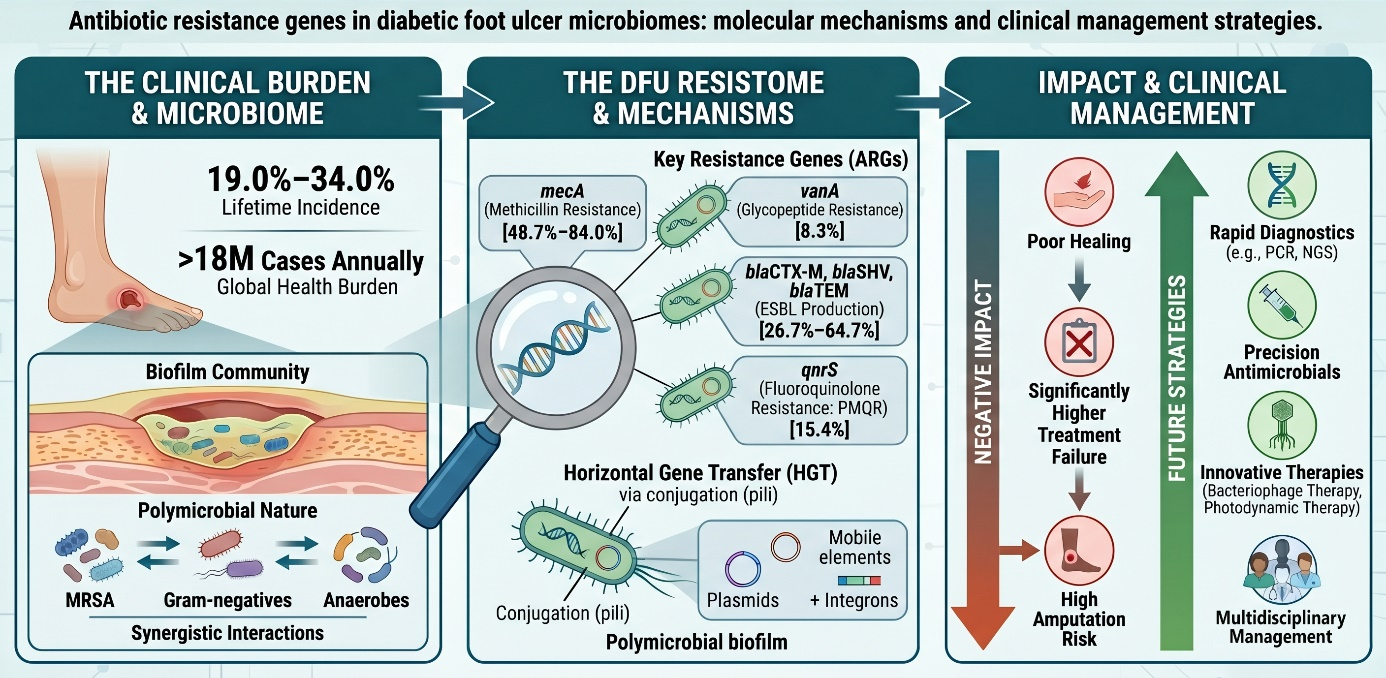
Background: Diabetic foot ulcers (DFUs) affect 19.0%–34.0% of patients with diabetes during their lifetime, representing a major global health burden with more than 18 million cases annually. The polymicrobial nature of DFU infections, combined with emerging antibiotic resistance genes, poses considerable clinical management challenges. Methicillin-resistant Staphylococcus aureus (MRSA) prevalence reached 84.0% and extended-spectrum beta-lactamase (ESBL) production exceeded 50.0% among gram-negative isolates in some regions, creating urgent therapeutic concerns.
Objectives: This comprehensive review examines the current understanding of microbial communities in DFUs and their associated resistome, analyzes the molecular mechanisms underlying antibiotic resistance, and evaluates the clinical implications to identify evidence-based management strategies.
Methods: A narrative review was conducted using systematic searches of PubMed/MEDLINE, Embase, Web of Science, and Google Scholar from 2014 to 2025. Search strategies utilized MeSH terms, including “diabetic foot ulcer,” “antibiotic resistance genes,” “microbiome,” and “resistome.”
Result(s): Analysis revealed extensive resistome diversity, with individual ulcers harboring dozens of distinct resistance determinants. The predominant resistance genes included mecA (methicillin resistance, 48.7%– 84.0%), blaCTX-M, blaSHV, blaTEM (ESBL production, 26.7%–64.7%), and various fluoroquinolone resistance genes (qnrS, 15.4%). Horizontal gene transfer mechanisms facilitate the rapid dissemination of resistance within polymicrobial biofilm communities, thereby substantially affecting treatment outcomes and increasing treatment failure rates.
Conclusion: Antibiotic resistance in DFUs poses a critical challenge that requires urgent, multifaceted approaches. Future directions should prioritize rapid diagnostic technologies, precision antimicrobial approaches, and innovative therapeutic interventions, including antimicrobial photodynamic therapy and bacteriophage treatment, to address this growing threat.
Downloads
References
Armstrong DG, Tan TW, Boulton AJM, Bus SA. Diabetic foot ulcers: A review. JAMA 2023;330:62-75.
https://doi.org/10.1001/jama.2023.10578
McDermott K, Fang M, Boulton AJM, Selvin E, Hicks CW. Etiology, epidemiology, and disparities in the burden of diabetic foot ulcers. Diabetes Care 2023;46:209-21.
https://doi.org/10.2337/dci22-0043
Armstrong DG, Swerdlow MA, Armstrong AA, Conte MS, Padula WV, Bus SA. Five year mortality and direct costs of care for people with diabetic foot complications are comparable to cancer. J Foot Ankle Res 2020;13:16.
https://doi.org/10.1186/s13047-020-00383-2
Holt RIG, Cockram CS, Ma RCW, Luk AOY. Diabetes and infection: Review of the epidemiology, mechanisms and principles of treatment. Diabetologia 2024;67:1168-80.
https://doi.org/10.1007/s00125-024-06102-x
Kalan L, Loesche M, Hodkinson BP, Heilmann K, Ruthel G, Gardner SE, et al. Redefining the chronic-wound microbiome: Fungal communities are prevalent, dynamic, and associated with delayed healing. mBio 2016;7:e01058-16.
https://doi.org/10.1128/mBio.01058-16
Moya-Salazar J, Chamana JM, Porras-Rivera D, Goicochea-Palomino EA, Salazar CR, Contreras-Pulache H. Increase in antibiotic resistance in diabetic foot infections among Peruvian patients: A single-center cross-sectional study. Front Endocrinol (Lausanne) 2023;14:1267699.
https://doi.org/10.3389/fendo.2023.1267699
Chaudhry WN, Badar R, Jamal M, Jeong J, Zafar J, Andleeb S. Clinico-microbiological study and antibiotic resistance profile of mecA and ESBL gene prevalence in patients with diabetic foot infections. Exp Ther Med 2016;11:1031-8.
https://doi.org/10.3892/etm.2016.2996
Guerrero-Flores S, Contreras-Peruyero H, Ibarra-Rodríguez JM, Lovaco-Flores JA, Nieto-de la Rosa FS, Fontove-Herrera F, et al. Topological data analysis captures horizontal gene transfer in antimicrobial resistance gene families among clinically relevant bacteria. Front Microbiol 2025;16:1461293.
https://doi.org/10.3389/fmicb.2025.1461293
Maity S, Leton N, Nayak N, Jha A, Anand N, Thompson K, et al. A systematic review of diabetic foot infections: Pathogenesis, diagnosis, and management strategies. Front Clin Diabetes Healthc 2024;5:1393309.
https://doi.org/10.3389/fcdhc.2024.1393309
Senneville É, Albalawi Z, van Asten SA, Abbas ZG, Allison G, Aragón-Sánchez J, et al. IWGDF/IDSA guidelines on the diagnosis and treatment of diabetes-related foot infections (IWGDF/IDSA 2023). Diabetes Metab Res Rev 2024;40:e3687.
https://doi.org/10.1002/dmrr.3687
Byrd AL, Belkaid Y, Segre JA. The human skin microbiome. Nat Rev Microbiol 2018;16:143-55.
https://doi.org/10.1038/nrmicro.2017.157
Gardiner M, Vicaretti M, Sparks J, Bansal S, Bush S, Liu M, et al. A longitudinal study of the diabetic skin and wound microbiome. PeerJ 2017;5:e3543.
https://doi.org/10.7717/peerj.3543
Coşkun B, Ayhan M, Ulusoy S, Guner R. Bacterial profile and antimicrobial resistance patterns of diabetic foot infections in a major research hospital of Turkey. Antibiotics (Basel) 2024;13:599.
https://doi.org/10.3390/antibiotics13070599
Zenelaj B, Bouvet C, Lipsky BA, Uçkay I. Do diabetic foot infections with methicillin-resistant Staphylococcus aureus differ from those with other pathogens? Int J Low Extrem Wounds 2014;13:263-72.
https://doi.org/10.1177/1534734614550311
Suludere MA, Öz OK, Rogers LC, Wukich DK, Malone M, Lavery LA. MRSA infection, re-infection and clinical outcomes in diabetic foot infections. Wound Repair Regen 2024;32:377-83.
https://doi.org/10.1111/wrr.13164
Daniel CP, Sittig KM, Wagner MJ, Cade C, Chriss W. Antibiotic treatment practices and microbial profile in diabetic foot ulcers: A retrospective cohort study. Cureus 2024;16:e67084.
https://doi.org/10.7759/cureus.67084
Sultana R, Ahmed I, Saima S, Salam MT, Sultana S. Diabetic foot ulcer - A systematic review on relevant microbial etiology and antibiotic resistance in Asian countries. Diabetes Metab Syndr 2023;17:102783.
https://doi.org/10.1016/j.dsx.2023.102783
Kifelew LG, Warner MS, Morales S, Gordon DL, Thomas N, Mitchell JG, et al. Lytic activity of phages against bacterial pathogens infecting diabetic foot ulcers. Sci Rep 2024;14:3515.
https://doi.org/10.1038/s41598-024-53317-4
Khan DM, Rao VI, Moosabba MS, MubarakAli D, Manzoor M. Antimicrobial resistance and prevalence of β-lactamase genes among multidrug-resistant acinetobacter baumannii isolates from infected diabetic foot ulcers. Bacteria 2025;4:24.
https://doi.org/10.3390/bacteria4020024
Khan DM, Moosabba MS, Rao IV. Changing Antibiogram Profile of Acinetobacter baumannii in Diabetic and Non-Diabetic Foot Ulcer Infections. J Clin Diagn Res 2018;12:12-6.
https://doi.org/10.7860/JCDR/2018/34462.11526
Fattah Hamid S, Bahadeen Taha A, Jamel Abdulwahid M. Distribution of blaTEM, blaSHV, blaCTX-M, blaOXA, and blaDHA in proteus mirabilis isolated from diabetic foot infections in Erbil, Iraq. Cell Mol Biol (Noisy-le-grand) 2020;66:88-94.
https://doi.org/10.14715/cmb/2019.66.1.15
Vardakas KZ, Horianopoulou M, Falagas ME. Factors associated with treatment failure in patients with diabetic foot infections: An analysis of data from randomized controlled trials. Diabetes Res Clin Pract 2008;80:341-51.
https://doi.org/10.1016/j.diabres.2008.01.009
Atlaw A, Kebede HB, Abdela AA, Woldeamanuel Y. Bacterial isolates from diabetic foot ulcers and their antimicrobial resistance profile from selected hospitals in Addis Ababa, Ethiopia. Front Endocrinol (Lausanne) 2022;13:987487.
https://doi.org/10.3389/fendo.2022.987487
Mottola C, Semedo-Lemsaddek T, Mendes JJ, Cavaco-Silva P, Tavares L, Oliveira M. Molecular typing, virulence traits and antimicrobial resistance of diabetic foot staphylococci. J Biomed Sci 2016;23:33.
https://doi.org/10.1186/s12929-016-0250-7
Mutonga DM, Mureithi MW, Ngugi NN, Otieno FC. Bacterial isolation and antibiotic susceptibility from diabetic foot ulcers in Kenya using microbiological tests and comparison with RT-PCR in detection of S. aureus and MRSA. BMC Res Notes 2019;12:244.
https://doi.org/10.1186/s13104-019-4278-0
Boschetti G, Sgarabotto D, Meloni M, Bruseghin M, Whisstock C, Marin M, et al. Antimicrobial resistance patterns in diabetic foot infections, an epidemiological study in northeastern Italy. Antibiotics (Basel) 2021;10:1241.
https://doi.org/10.3390/antibiotics10101241
Liu X, Ren Q, Zhai Y, Kong Y, Chen D, Chang B. Risk factors for multidrug-resistant organisms infection in diabetic foot ulcer. Infect Drug Resist 2022;15:1627-35.
https://doi.org/10.2147/IDR.S359157
Wada FW, Mekonnen MF, Sawiso ED, Kolato S, Woldegiorgis L, Kera GK, et al. Bacterial profile and antimicrobial resistance patterns of infected diabetic foot ulcers in sub-Saharan Africa: A systematic review and meta-analysis. Sci Rep 2023;13:14655.
https://doi.org/10.1038/s41598-023-41882-z
Arfaoui A, Martínez-Álvarez S, Abdullahi IN, Fethi M, Sayem N, Ben Khelifa Melki S, et al. Surveillance of Enterobacteriaceae from Diabetic Foot Infections in a Tunisian Hospital: Detection of E. coli-ST131-blaCTX-M-15 and K. pneumoniae-ST1-blaNDM-1 Strains. Microb Drug Resist 2024;30:341-9.
https://doi.org/10.1089/mdr.2023.0335
Lund D, Coertze RD, Parras-Moltó M, Berglund F, Flach CF, Johnning A, et al. Extensive screening reveals previously undiscovered aminoglycoside resistance genes in human pathogens. Commun Biol 2023;6:812.
https://doi.org/10.1038/s42003-023-05174-6
Shahi SK, Kumar A. Isolation and Genetic Analysis of Multidrug Resistant Bacteria from Diabetic Foot Ulcers. Front Microbiol 2016;6:1464.
https://doi.org/10.3389/fmicb.2015.01464
Perzon O, Cahn A, Gellman YN, Leibovitch M, Peled S, Elishoov O, et al. Enterococci in diabetic foot infections: Prevalence, clinical characteristics, and outcomes. Open Forum Infect Dis 2023;10:ofad238.
https://doi.org/10.1093/ofid/ofad238
Soleha TU, Sutyarso S, Sukohar A, Sumardi S, Hadi S. Identification of vanA gene on Vancomycin-Resistant Staphylococcus aureus from Diabetic Ulcer Isolate at Lampung Province. Biomed Pharmacol J 2024;17:409-16.
https://doi.org/10.13005/bpj/2868
Ahmad S, Khan MSA, Shah MH, Khan A, Bano R, Qazi M. Microbial profile and antimicrobial susceptibility pattern in diabetic foot ulcer patients attending a tertiary care hospital. Cureus 2022;14:e29770.
https://doi.org/10.7759/cureus.29770
Yan X, Song JF, Zhang L, Li X. Analysis of risk factors for multidrug-resistant organisms in diabetic foot infection. BMC Endocr Disord 2022;22:46.
https://doi.org/10.1186/s12902-022-00957-0
Mudrik-Zohar H, Carasso S, Gefen T, Zalmanovich A, Katzir M, Cohen Y, et al. Microbiome characterization of infected diabetic foot ulcers in association with clinical outcomes: Traditional cultures versus molecular sequencing methods. Front Cell Infect Microbiol 2022;12:836699.
https://doi.org/10.3389/fcimb.2022.836699
Schmidt BM. Emerging diabetic foot ulcer microbiome analysis using cutting edge technologies. J Diabetes Sci Technol 2021;16:353-63.
https://doi.org/10.1177/1932296821990097
Ramirez-Acuña JM, Cardenas-Cadena SA, Marquez-Salas PA, Garza-Veloz I, Perez-Favila A, Cid-Baez MA, et al. Diabetic Foot Ulcers: Current Advances in Antimicrobial Therapies and Emerging Treatments. Antibiotics (Basel) 2019;8:193.
https://doi.org/10.3390/antibiotics8040193
Young MJ, Hall LML, Merabishvilli M, Pirnay JP, Clark JR, Jones JD. Phage therapy for diabetic foot infection: A case series. Clin Ther 2023;45:797-801.
https://doi.org/10.1016/j.clinthera.2023.06.009
Holubová A, Chlupáčová L, Krocová J, Cetlová L, Peters LJF, Cremers NAJ, et al. The use of medical grade honey on infected chronic diabetic foot ulcers-A prospective case-control study. Antibiotics (Basel) 2023;12:1364.
https://doi.org/10.3390/antibiotics12091364
Jin Y, Zhu T, Cai X, Fu Z, Pan Q, Tu H, et al. Identification and treatment of Enterococcus avium-induced diabetic foot ulcer: A case report and microbiome analysis. Front Med (Lausanne) 2024;11:1502337.
https://doi.org/10.3389/fmed.2024.1502337
Shi H, Yuan X, Yang X, Huang R, Fan W, Liu G. A novel diabetic foot ulcer diagnostic model: Identification and analysis of genes related to glutamine metabolism and immune infiltration. BMC Genomics 2024;25:125.
Downloads
Published
How to Cite
Issue
Section
License
Copyright (c) 2026 Chulalongkorn Medical Journal

This work is licensed under a Creative Commons Attribution-NonCommercial-NoDerivatives 4.0 International License.