Assessment of chronic genotoxic effects in radiology technicians: A comparative study using the comet assay and γ-H2AX biomarker
Keywords:
Comet assay, DNA damage, ionizing radiation, occupational exposure, γ-H2AXAbstract
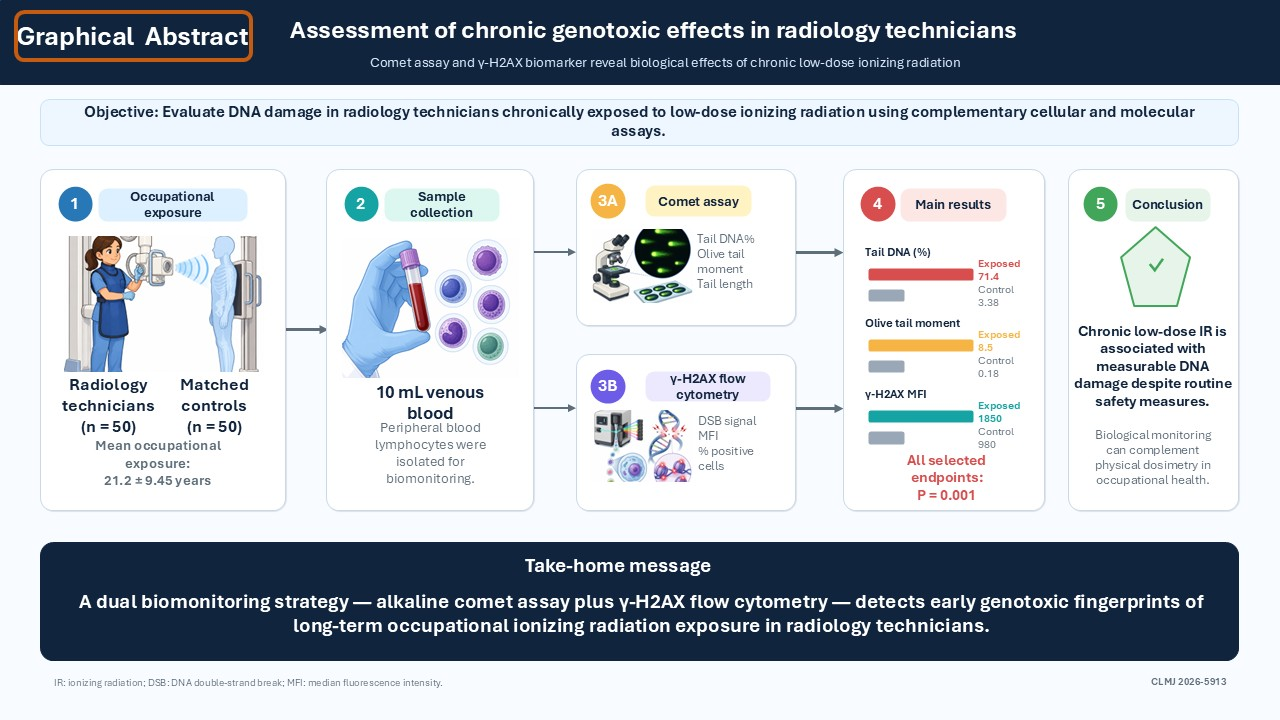
Background: Healthcare workers, particularly radiology technicians, are chronically exposed to low-dose ionizing radiation (IR). While physical dosimetry monitors external exposure, biological monitoring of early genotoxic effects is crucial for risk assessment.
Objectives: To evaluate DNA damage in radiology technicians occupationally exposed to low-dose IR compared to nonexposed controls.
Methods: This case-control study included 50 radiology technicians and 50 matched controls. DNA damage in peripheral blood lymphocytes was assessed using the alkaline comet assay. A subset of participants (10 exposed and 10 controls) underwent γ-H2AX flow cytometric analysis for detection of DNA doublestrand breaks.
Results: The exposed group showed significant increases in DNA damage parameters, particularly tail intensity, tail moment and head intensity (P < 0.001). Receiver operating characteristic (ROC) analysis demonstrated excellent diagnostic performance for tail moment and head intensity (area under the curve (AUC) = 1.000). γ-H2AX analysis showed significantly higher mean fluorescence intensity and percentage of positive cells among exposed workers (P < 0.001). DNA damage correlated positively with occupational exposure duration.
Conclusion: Our findings suggest a link between long-term exposure to low-dose infrared radiation and DNA damage even when standard safety precautions are followed.
Downloads
References
López PO, Dauer LT, Loose R, Martin CJ, Miller DL, Vañó E, et al. ICRP Publication 139: Occupational radiological protection in interventional procedures. Ann ICRP 2018;47:1-118.
https://doi.org/10.1177/0146645317750356
Vaiserman A, Koliada A, Zabuga O, Socol Y. Health impacts of low-dose ionizing radiation: Current scientific debates and regulatory issues. Dose Response 2018;16:1559325818796331.
https://doi.org/10.1177/1559325818796331
Bonner WM, Redon CE, Dickey JS, Nakamura AJ, Sedelnikova OA, Solier S, et al. Gamma-H2AX and cancer. Nat Rev Cancer 2008;8:957-67.
https://doi.org/10.1038/nrc2523
Ribeiro D. Genetic biomonitoring of professionals occupationally exposed to ionizing radiation: Theoretical concepts for scientific debate. Toxicol Ind Health 2020;36:743-4.
https://doi.org/10.1177/0748233720949485
Surniyantoro HNE, Yusuf D, Rahardjo T, Rahajeng N, Kisnanto T, Nurhayati S, et al. Assessment of hOGG1 genetic polymorphism (rs1052133) and DNA damage in radiation-exposed workers. Asian Pac J Cancer Prev 2022;23:4005-12.
https://doi.org/10.31557/APJCP.2022.23.12.4005
Ivashkevich A, Redon CE, Nakamura AJ, Martin RF, Martin OA. Use of the γ-H2AX assay to monitor DNA damage and repair in translational cancer research. Cancer Lett 2012;327:123-33.
https://doi.org/10.1016/j.canlet.2011.12.025
Singh NP, McCoy MT, Tice RR, Schneider EL. A simple technique for quantitation of low levels of DNA damage in individual cells. Exp Cell Res 1988;175:184-91.
https://doi.org/10.1016/0014-4827(88)90265-0
Aishwarya S, Dubagunta N, Nandhini K, Pattan S, Rangasami R, Srinivas SK, et al. Evidence for the lack of an increase in DNA damage in occupational healthcare workers exposed to ionizing radiation: An indication of radiation safety. J Occup Environ Hyg 2026;23:70-82.
https://doi.org/10.1080/15459624.2025.2555303
Cadet J, Davies KJA. Oxidative DNA damage and repair: An introduction. Free Radic Biol Med 2017;107:2-12.
https://doi.org/10.1016/j.freeradbiomed.2017.03.030
Collins AR. The comet assay for DNA damage and repair: Principles, applications, and limitations. Mol Biotechnol 2004;26:249-61.
https://doi.org/10.1385/MB:26:3:249
Banáth JP, Fushiki M, Olive PL. Rejoining of DNA single- and double-strand breaks in human white blood cells exposed to ionizing radiation. Int J Radiat Biol 1998;73:649-60.
https://doi.org/10.1080/095530098141906
Khan K, Tewari S, Awasthi NP, Mishra SP, Agarwal GR, Rastogi M, et al. Flow cytometric detection of γ-H2AX to evaluate DNA damage by low-dose diagnostic irradiation. Med Hypotheses 2018;115:22-8.
https://doi.org/10.1016/j.mehy.2018.03.016
Maluf SW, Passos DF, Bacelar A, Speit G, Erdtmann B. Assessment of DNA damage in lymphocytes of workers exposed to X-radiation using the micronucleus test and the comet assay. Environ Mol Mutagen 2001;38:311-5.
https://doi.org/10.1002/em.10029
Møller P, Knudsen LE, Loft S, Wallin H. The comet assay as a rapid test in biomonitoring occupational exposure to DNA-damaging agents and effect of confounding factors. Cancer Epidemiol Biomarkers Prev 2000;9:1005-15.
Kopjar N, Garaj-Vrhovac V. Assessment of DNA damage in nuclear medicine personnel: Comparative study with the alkaline comet assay and the chromosome aberration test. Int J Hyg Environ Health 2005;208:179-91.
https://doi.org/10.1016/j.ijheh.2005.01.027
Wang Y, Xu C, Du LQ, Cao J, Liu JX, Su X, et al. Evaluation of the comet assay for assessing the dose-response relationship of DNA damage induced by ionizing radiation. Int J Mol Sci 2013;14:22449-61.
https://doi.org/10.3390/ijms141122449
Zabarmawi Y. Assessment of DNA damage in healthcare workers occupationally exposed to low doses of ionizing radiation using the comet assay: A meta-analysis. J Radiat Res Appl Sci 2024;17:100864.
https://doi.org/10.1016/j.jrras.2024.100864
Surniyantoro HNE, Darlina, Rahardjo T. Alkaline comet assay as a predictor of DNA damage in medical radiation workers. J Phys Conf Ser 2020;1436:012023.
https://doi.org/10.1088/1742-6596/1436/1/012023
Prabhu KS, Kuttikrishnan S, Ahmad N, Habeeba U, Mariyam Z, Suleman M, et al. H2AX: A key player in DNA damage response and a promising target for cancer therapy. Biomed Pharmacother 2024;175:116663.
https://doi.org/10.1016/j.biopha.2024.116663
Valente D, Gentileschi MP, Guerrisi A, Bruzzaniti V, Morrone A, Soddu S, et al. Factors to consider for the correct use of γH2AX in the evaluation of DNA double-strand break damage caused by ionizing radiation. Cancers (Basel) 2022;14:6204.
https://doi.org/10.3390/cancers14246204
Fardid R, Janipour S, Haddadi G, Mahdavi M, Sharifzadeh S, Lotfi M, et al. Evaluation of the relationship between γ-H2AX biomarker levels and dose received after radiation exposure in abdominal-pelvic and chest CT scans. J Cancer Res Ther 2023;19:1392-7.
https://doi.org/10.4103/jcrt.jcrt_950_21
Gaetani S, Monaco F, Bracci M, Ciarapica V, Impollonia G, Valentino M, et al. DNA damage response in workers exposed to low-dose ionising radiation. Occup Environ Med 2018;75:724-9.
https://doi.org/10.1136/oemed-2018-105094
Rahim V, Haq NU, Tareen AK, Sultan IN, Khan SZ, Khan MW. Association between occupational exposure of laboratory technicians to ionizing radiation and its impact on blood biomarkers. Radiat Phys Chem 2025;233:112713.
Downloads
Published
How to Cite
Issue
Section
License
Copyright (c) 2026 Chulalongkorn Medical Journal

This work is licensed under a Creative Commons Attribution-NonCommercial-NoDerivatives 4.0 International License.