
Clinical Factors Associated With Abnormal Brain Computed Tomography Findings Among Moderate-Risk Patients With Mild Traumatic Brain Injury at Thungsong Hospital
Article Sidebar
Main Article Content
Abstract
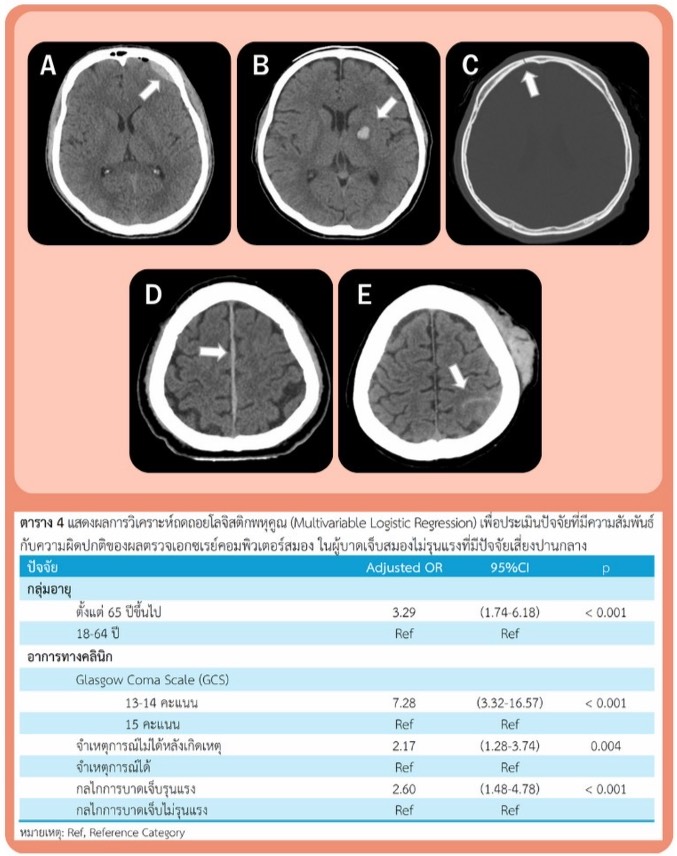
Traumatic brain injury remains a major global health problem. In recent years, the use of brain computed tomography (CT) among patients with mild traumatic brain injury (mTBI) has increased. Appropriate utilization of brain CT may improve patient care and promote efficient use of healthcare resources. This retrospective analytical study aimed to identify factors associated with abnormal brain CT findings in moderate-risk mTBI patients at Thungsong Hospital. A total of 442 moderate-risk mTBI patients who underwent brain CT at Thungsong Hospital between 1 September 2024 and 30 April 2025 were included. The sample size was calculated using Cochran’s formula. Data were collected from medical records and brain CT reports using a standardized data extraction form. Multivariable logistic regression was performed to determine factors associated with abnormal brain CT findings.
Factors significantly associated with abnormal brain CT findings (p < 0.05) were age ≥ 65 years (p < 0.001), Glasgow Coma Scale (GCS) score 13–14 (p < 0.001), post-traumatic amnesia (p = 0.004), and a severe mechanism (p < 0.001).
These findings may support clinical screening and appropriate CT decision-making, potentially reducing unnecessary brain CT examinations and improving healthcare resource allocation.
Article Details

This work is licensed under a Creative Commons Attribution-NonCommercial-NoDerivatives 4.0 International License.
The opinions and content expressed in the articles are solely those of the individual authors and do not necessarily reflect the views of the journal or the authors’ affiliated institutions. Authors are fully responsible for the accuracy and correctness of their work.
Any reuse, reproduction, or redistribution of the articles, content, data, or images in other forms requires prior written permission from the Journal of Medicine, Nursing and Public Health Research, Thungsong Hospital.
References
Zhong H, Feng Y, Shen J, Rao T, Dai H, Zhong W, et al. Global burden of traumatic brain injury in 204 countries and territories from 1990 to 2021. Am J Prev Med. 2025;68(4):754-63. doi:10.1016/j.amepre.2025.01.001.
ศูนย์ข้อมูลอุบัติเหตุ THAI RSC. ศูนย์ข้อมูลอุบัติเหตุเพื่อส่งเสริมวัฒนธรรมความปลอดภัยบนท้องถนน [อินเทอร์เน็ต]. [สืบค้นเมื่อ 5 มิ.ย. 2568]. เข้าถึงได้จาก: http://www.thairsc.com
นครชัย เพื่อนปฐม, ธีรเดช ศรีกิจวิไลกุล. แนวทางเวชปฏิบัติกรณีสมองบาดเจ็บ. กรุงเทพฯ: ราชวิทยาลัยประสาทศัลยแพทย์แห่งประเทศไทย, กรมการแพทย์ กระทรวงสาธารณสุข; 2562.
Cassidy JD, Carroll LJ, Peloso PM, Borg J, von Holst H, Holm L, et al. Incidence, risk factors and prevention of mild traumatic brain injury: Results of the WHO Collaborating Centre Task Force on Mild Traumatic Brain Injury. J Rehabil Med. 2004;(43 Suppl):28-60. doi:10.1080/16501960410023732.
Stiell IG, Wells GA, Vandemheen K, Clement C, Lesiuk H, Laupacis A, et al. The Canadian CT Head Rule for patients with minor head injury. Lancet. 2001;357(9266):1391-6. doi:10.1016/S0140-6736(00)04561-X.
พร้อมเพรียง ศรีชัยกุล. ความชุกและปัจจัยที่มีผลต่อภาวะผิดปกติในสมองของผู้บาดเจ็บสมองเล็กน้อยที่มารับบริการในห้องฉุกเฉิน โรงพยาบาลบางละมุง. วารสารศูนย์การศึกษาแพทยศาสตร์คลินิก โรงพยาบาลพระปกเกล้า. 2561;35(4):363-71.
วริษ คุปต์กาญจนากุล. ปัจจัยที่มีความสัมพันธ์กับผลการตรวจภาพรังสีคอมพิวเตอร์ของสมองในผู้บาดเจ็บสมองไม่รุนแรง โรงพยาบาลกระบี่. กระบี่เวชสาร. 2562;2(1):1-13.
Bonney PA, Briggs A, Briggs RG, Jarvis CA, Attenello F, Giannotta SL. Rate of intracranial hemorrhage after minor head injury. Cureus. 2020;12(9):e10653. doi:10.7759/cureus.10653.
Papa L, Mendes ME, Braga CF. Mild traumatic brain injury among the geriatric population. Curr Transl Geriatr Exp Gerontol Rep. 2012;1(3):135-42. doi:10.1007/s13670-012-0019-0.
Watcharakorn A, Romsaiyut T, Amnuaypattanapon K, Mingkwansook V. Clinical association factors for abnormal cranial CT scan in moderate-risk patients of mild traumatic brain injury. Asian Med J Altern Med. 2022;22(2):102-11.
Yuksen C, Sittichanbuncha Y, Patumanond J, Muengtaweepongsa S, Aramvanitch K, Supamas A, et al. Clinical factors predictive for intracranial hemorrhage in mild head injury. Neurol Res Int. 2017;2017:5385613. doi:10.1155/2017/5385613.
Molaei-Langroudi R, Alizadeh A, Kazemnejad-Leili E, Monsef-Kasmaie V, Moshirian SY. Evaluation of clinical criteria for performing brain CT-scan in patients with mild traumatic brain injury: A new diagnostic probe. Bull Emerg Trauma. 2019;7(3):269-77.
Sharif-Alhoseini M, Khodadadi H, Chardoli M, Rahimi-Movaghar V. Indications for brain computed tomography scan after minor head injury. J Emerg Trauma Shock. 2011;4(4):472-6.
ขวัญชนก คันธชาติ. ปัจจัยที่มีผลต่อภาวะเลือดออกในกะโหลกศีรษะของผู้บาดเจ็บสมองไม่รุนแรงที่เข้ารับบริการที่ห้องฉุกเฉิน โรงพยาบาลกันทรลักษ์. วารสารวิจัยและพัฒนาสุขภาพศรีสะเกษ. 2567;3(3):42-53.
