Quantum technologies in healthcare: A narrative review of foundational innovations, biomedical applications, and regulatory horizons
Keywords:
Biomedical simulation, drug discovery, healthcare innovation, personalized medicine, quantum computing, quantum cryptography, quantum machine learning, quantum sensingAbstract
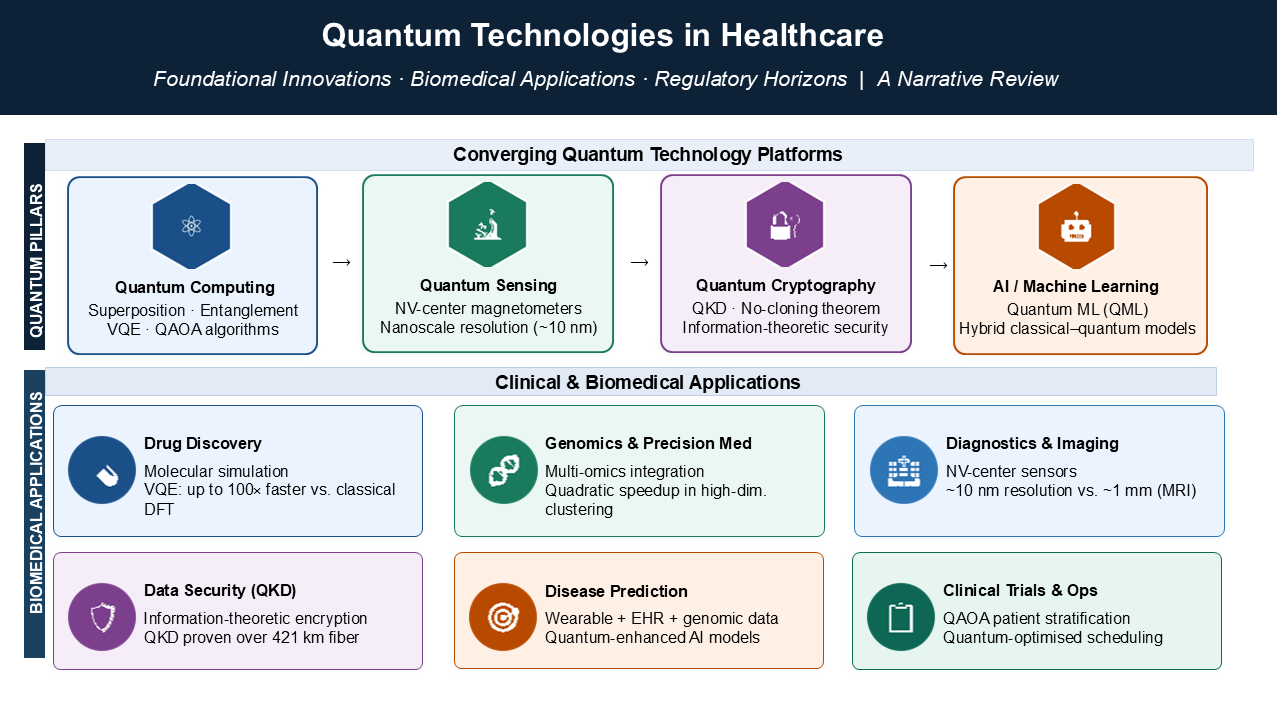
Quantum technologies are transforming healthcare by enhancing the fields of diagnostics, therapeutics, data security, and clinical decision-making through principles such as superposition, entanglement, and quantum tunneling. This review highlights the foundational concepts, key biomedical applications, and regulatory perspectives regarding the integration of quantum technologies into modern healthcare systems. A narrative literature review was conducted using the PubMed, Scopus, and Web of Science databases. Articles published up to August 2025 on quantum computing, sensing, and cryptography and their healthcare applications were critically analyzed. The search terms included “quantum computing,” “quantum sensing,” “quantum cryptography,” and “quantum machine learning” combined with “healthcare,” “drug discovery,” and “genomics.” Peer-reviewed articles written in English with direct biomedical relevance were included, while conference abstracts and non-peer-reviewed sources were excluded. Quantum computing enables advanced molecular simulations for drug discovery, the efficient analysis of large-scale omics data, and optimized models for personalized medicine. In addition, quantum sensing supports ultra-sensitive biomarker detection, high-resolution imaging, and early disease diagnosis. Moreover, quantum cryptography ensures robust security for medical data and supports compliance with data protection regulations. Its integration with artificial intelligence further accelerates the clinical translation of these innovations. Quantum technologies present substantial opportunities for predictive, personalized, and secure healthcare delivery. However, technical constraints, integration challenges, and regulatory gaps need to be addressed through interdisciplinary collaboration, infrastructure development, and adaptive policy frameworks to realize its full clinical potential.
Downloads
References
Durant TJS, Knight E, Nelson B, Dudgeon S, Lee SJ, Walliman D et al. A primer for quantum computing and its applications to healthcare and biomedical research. J Am Med Inform Assoc 2024;31:1774.
https://doi.org/10.1093/jamia/ocae149
Shams M, Choudhari J, Reyes K, Prentzas S, Gapizov A, Shehryar A, et al. The quantum-medical nexus: understanding the impact of quantum technologies on Healthcare. Cureus 2023;15:e48077.
https://doi.org/10.7759/cureus.48077
How ML, Cheah SM. Forging the future: strategic approaches to quantum ai integration for industry transformation. AI 2024; 5:290-323.
https://doi.org/10.3390/ai5010015
Thacharodi A, Singh P, Meenatchi R, Tawfeeq Ahmed ZH, Kumar RRS, Neha V et al. Revolutionizing healthcare and medicine: the impact of modern technologies for a healthier future-a comprehensive review. Health Care Sci 2024;3:329-49.
https://doi.org/10.1002/hcs2.115
Olawade DB, Ige AO, Olaremu AG, Ijiwade JO, Adeola AO. The synergy of artificial intelligence and nanotechnology towards advancing innovation and sustainability - a mini-review. Nano Trends 2024;8:100052.
https://doi.org/10.1016/j.nwnano.2024.100052
Zhang K, Zhou HY, Baptista-Hon DT, Gao Y, Liu X, Oermann E, et al. Concepts and applications of digital twins in healthcare and medicine. Patterns (N Y) 2024;5:101028.
https://doi.org/10.1016/j.patter.2024.101028
Jeyaraman M, Jeyaraman N, Yadav S, Nallakumarasamy A, Iyengar KP, Jain V. Impact of excessive noise generation in orthopaedic operating theatres: a comprehensive review. Cureus 2024;16:e54469.
https://doi.org/10.7759/cureus.54469
Suvvari TK, Konakanchi VSBP, Muppavarapu RS, Arigapudi N. The potential role of quantum computing in biomedicine and healthcare: the next frontier beyond artificial intelligence. Cureus 2025;17:e82759.
https://doi.org/10.7759/cureus.82759
Wolinsky H. Paths to acceptance. the advancement of scientific knowledge is an uphill struggle against 'accepted wisdom'. EMBO Rep 2008;9:416-8.
https://doi.org/10.1038/embor.2008.65
Grössing G, Pascasio JM, Schwabl H. A classical explanation of quantization. Found Phys 2011;41:1437-53.
https://doi.org/10.1007/s10701-011-9556-1
Ma XS, Kofler J, Zeilinger A. Delayed-choice gedanken experiments and their realizations. Rev Mod Phys 2016;88:015005.
https://doi.org/10.1103/RevModPhys.88.015005
Aslam N, Pfender M, Neumann P, Reuter R, Zappe A, De Oliveira FF, et al. Nanoscale nuclear magnetic resonance with chemical resolution. Science 2017;357:67-71.
https://doi.org/10.1126/science.aam8697
Hennig J. The historical documentation of scientific developments: Scientists should participate. J Magn Reson Imaging 2004;20:181-2.
https://doi.org/10.1002/jmri.20122
Giovannetti V, Lloyd S, Maccone L. Quantum-enhanced measurements: beating the standard quantum limit. Science 2004;306:1330-6.
https://doi.org/10.1126/science.1104149
Zhang S, Bian K, Jiang Y. Perspective: nanoscale electric sensing and imaging based on quantum sensors. Quantum Front 2023;2:1-13.
https://doi.org/10.1007/s44214-023-00045-x
Hoffmann M, Poschenrieder JM, Incudini M, Baier S, Fritz A, Maier A, et al. Network medicine-based epistasis detection in complex diseases: ready for quantum computing. Nucleic Acids Res 2024;52:10144-60.
https://doi.org/10.1093/nar/gkae697
Aslam N, Zhou H, Urbach EK, Turner MJ, Walsworth RL, Lukin MD, et al. Quantum sensors for biomedical applications. Nat Rev Phys 2023;5:157-69.
https://doi.org/10.1038/s42254-023-00558-3
Gupta RS, Wood CE, Engstrom T, Pole JD, Shrapnel S. A systematic review of quantum machine learning for digital health. NPJ Digit Med 2025;8:237.
https://doi.org/10.1038/s41746-025-01597-z
Braga DM, Rawal B. Harnessing AI and quantum computing for revolutionizing drug discovery and approval processes: case example for collagen toxicity. JMIR Bioinform Biotech 2025;6:e69800.
Hughes A, Shandhi MMH, Master H, Dunn J, Brittain E. Wearable devices in cardiovascular medicine. Circ Res 2023;132:652.
https://doi.org/10.1161/CIRCRESAHA.122.322389
Santagati R, Aspuru-Guzik A, Babbush R, Degroote M, González L, Kyoseva E, et al. Drug design on quantum computers. Nat Phys 2024;20:549-57.
https://doi.org/10.1038/s41567-024-02411-5
Lim H, Kang DH, Kim J, Pellow-Jarman A, McFarthing S, Pellow-Jarman R et al. Fragment molecular orbital-based variational quantum eigensolver for quantum chemistry in the age of quantum computing. Sci Rep 2024;14:2422.
https://doi.org/10.1038/s41598-024-52926-3
Spassov DS. Binding affinity determination in drug design: insights from lock and key, induced fit, conformational selection, and inhibitor trapping models. Int J Mol Sci 2024;25:7124.
https://doi.org/10.3390/ijms25137124
Naeij HR, Mahmoudi E, Yeganeh HD, Akbari M. Molecular electronic structure calculation via a quantum computer. Comput Theor Chem 2024;1242:114945.
https://doi.org/10.1016/j.comptc.2024.114945
Kulkarni S. Patil PS, Patil RD. Quantum computing in drug discovery: a review of foundations and emerging applications. 2025. doi:10.2139/SSRN.5310140.
https://doi.org/10.2139/ssrn.5310140
Jeyaraman N, Jeyaraman M, Yadav S, Ramasubramanian S, Balaji S. Revolutionizing healthcare: the emerging role of quantum computing in enhancing medical technology and treatment. Cureus 2024;16:e67486.
https://doi.org/10.7759/cureus.67486
Li W, Yin Z, Li X, Ma D, Yi S, Zhang Z, et al. A hybrid quantum computing pipeline for real world drug discovery. Sci Rep 2024;14:16942.
https://doi.org/10.1038/s41598-024-67897-8
Arodola OA, Soliman ME. Quantum mechanics implementation in drug-design workflows: does it really help? Drug Des Devel Ther 2017;11:2551-64.
https://doi.org/10.2147/DDDT.S126344
Venkataraman M, Rao GC, Madavareddi JK, Maddi SR. Leveraging machine learning models in evaluating ADMET properties for drug discovery and development. ADMET DMPK 2025;13:2772.
https://doi.org/10.5599/admet.2772
Hossain MS, Hussain MH. Multi‐Target drug design in alzheimer's disease treatment: emerging technologies, advantages, challenges, and limitations. Pharmacol Res Perspect 2025;13:e70131.
https://doi.org/10.1002/prp2.70131
Memon QA, Al Ahmad M, Pecht M. Quantum computing: navigating the future of computation, challenges, and technological breakthroughs. Quantum Rep 2024;6:627-63.
https://doi.org/10.3390/quantum6040039
Rikala P, Braun G, Järvinen M, Stahre J, Hämäläinen R. Understanding and measuring skill gaps in industry 4.0 - a review. Technol Forecast Soc Change 2024;201:123206.
https://doi.org/10.1016/j.techfore.2024.123206
Tarasov VE. Fractional Dynamics of Open Quantum Systems. In: Tarasov VE, editor. Fractional Dynamics: Nonlinear Physical Science. Berlin, Heidelberg: Springer; 2010. p. 467-490.
https://doi.org/10.1007/978-3-642-14003-7_20
Padalhin A, Chung P-S, Woo SH. Quantum technology: a beacon of light for next-generation healthcare. Med Lasers 2023;12:212-9.
https://doi.org/10.25289/ML.23.043
Huang YJ, Chen CH, Yang HC. AI-enhanced integration of genetic and medical imaging data for risk assessment of Type 2 diabetes. Nat Commun 2024;15:4230.
https://doi.org/10.1038/s41467-024-48618-1
Krzyszczyk P, Acevedo A, Davidoff EJ, Timmins LM, Marrero-Berrios I, Patel M, et al. The growing role of precision and personalized medicine for cancer treatment. Technology (Singap World Sci) 2019;6:79-100.
https://doi.org/10.1142/S2339547818300020
Giang V. Quantum computing and its applications in healthcare. OUR J: ODU Undergrad Res J 2023;10. doi:10.25778/46q5-sj29.
Solenov D, Brieler J, Scherrer JF. The potential of quantum computing and machine learning to advance clinical research and change the practice of medicine. Mo Med 2018;115:463-7.
Flöther FF. The state of quantum computing applications in health and medicine. Res Directions: Quantum Technol 2023;1:e10.
https://doi.org/10.1017/qut.2023.1
Durant TJS, Knight E, Nelson B, Dudgeon S, Lee SJ, Walliman D, et al. A primer for quantum computing and its applications to healthcare and biomedical research. J Am Med Inform Assoc 2024;31:1774-84.
https://doi.org/10.1093/jamia/ocae149
Solenov D, Brieler J, Scherrer JF. The potential of quantum computing and machine learning to advance clinical research and change the practice of medicine. Mo Med 2018;115:463-7.
Bonde B, Patil P, Choubey B. The Future of Drug Development with Quantum Computing. Methods Mol Biol 2023; 2716: 153-179.
https://doi.org/10.1007/978-1-0716-3449-3_7
Pei Z. Computer-aided drug discovery: From traditional simulation methods to language models and quantum computing. Cell Rep Phys Sci 2024;5:102334.
https://doi.org/10.1016/j.xcrp.2024.102334
Nguyen PN. Biomarker discovery with quantum neural networks: a case-study in CTLA4-activation pathways. BMC Bioinformatics 2024; 25: 1-22.
https://doi.org/10.1186/s12859-024-05755-0
Marengo A, Santamato V. Quantum algorithms and complexity in healthcare applications: a systematic review with machine learning-optimized analysis. Front Comput Sci 2025;7:1584114.
https://doi.org/10.3389/fcomp.2025.1584114
Chow JCL. Quantum computing and machine learning in medical decision-making: a comprehensive review. Algorithms 2025;18:156.
https://doi.org/10.3390/a18030156
Doga H, Bose A, Sahin ME, Bettencourt-Silva J, Pham A, Kim E, et al. How can quantum computing be applied in clinical trial design and optimization? Trends Pharmacol Sci 2024;45:880-91.
https://doi.org/10.1016/j.tips.2024.08.005
Al Harbi S, Aljohani B, Elmasry L, Baldovino FL, Raviz KB, Altowairqi L, et al. Streamlining patient flow and enhancing operational efficiency through case management implementation. BMJ Open Qual 2024;13:e002484.
https://doi.org/10.1136/bmjoq-2023-002484
Fallatah DI, Adekola HA. Digital epidemiology: harnessing big data for early detection and monitoring of viral outbreaks. Infect Prev Pract 2024;6:100382.
https://doi.org/10.1016/j.infpip.2024.100382
Villanueva-Miranda I, Xiao G, Xie Y. Artificial intelligence in early warning systems for infectious disease surveillance: a systematic review. Front Public Health 2025;13:1609615.
https://doi.org/10.3389/fpubh.2025.1609615
Li Y, Chen L. Big biological data: Challenges and opportunities. Genomics Proteomics Bioinformatics 2014;12:187-9.
https://doi.org/10.1016/j.gpb.2014.10.001
Bedi P, Das S, Goyal SB, Rajawat AS, Islam SMN. Cybersecurity in the Quantum Era: Advancements and Challenges in Quantum Cryptography and Post-Quantum Solutions. In: Goyal SB, Kumar V, Islam SMN, Ghai D, editors. Quantum Computing, Cyber Security and Cryptography. Singapore: Springer; 2025. p. 239-266.
https://doi.org/10.1007/978-981-96-4948-8_10
Dritsas E, Trigka M. Exploring the Intersection of machine learning and big data: a survey. Mach Learn Knowl Extr 2025;7:13.
https://doi.org/10.3390/make7010013
Boulebnane S, Lucas X, Meyder A, Adaszewski S, Montanaro A. Peptide conformational sampling using the Quantum Approximate Optimization Algorithm. NPJ Quantum Inf 2023;9:70.
https://doi.org/10.1038/s41534-023-00733-5
Zhang YJ, Mu XD, Liu XW, Wang XY, Zhang X, Li K, et al. Applying the quantum approximate optimization algorithm to the minimum vertex cover problem. Appl Soft Comput 2022;118:108554.
https://doi.org/10.1016/j.asoc.2022.108554
Segawa TF, Igarashi R. Nanoscale quantum sensing with Nitrogen-Vacancy centers in nanodiamonds - a magnetic resonance perspective. Prog Nucl Magn Reson Spectrosc 2023;134-135:20-38.
https://doi.org/10.1016/j.pnmrs.2022.12.001
Aslam N, Zhou H, Urbach EK, Turner MJ, Walsworth RL, Lukin MD, et al. Quantum sensors for biomedical applications. Nat Rev Phys 2023;5:157-69.
https://doi.org/10.1038/s42254-023-00558-3
Gill SS, Buyya R. Transforming research with quantum computing. J Economy Technol 2026;4:1-8.
Downloads
Published
How to Cite
Issue
Section
License
Copyright (c) 2026 Chulalongkorn Medical Journal

This work is licensed under a Creative Commons Attribution-NonCommercial-NoDerivatives 4.0 International License.