Clinical Outcomes and Factors Associated with Mortality in Premature Infants with Moderate to Severe Respiratory Distress Syndrome Receiving Surfactant Therapy at Chumphon Khet Udomsakdi Hospital
Article Sidebar
Main Article Content
Abstract
Background: Respiratory distress syndrome (RDS) results from decreased production and secretion of pulmonary surfactant. This study aimed to evaluate clinical outcomes of surfactant therapy and factors associated with mortality in preterm infants with RDS.
Methods: A retrospective descriptive study was conducted at Chumphon Khet Udomsakdi Hospital. Medical records of preterm infants with moderate to severe RDS treated with surfactant between October 2019 and September 2025 were reviewed. Demographic characteristics, clinical outcomes, and mortality-associated factors were analyzed.
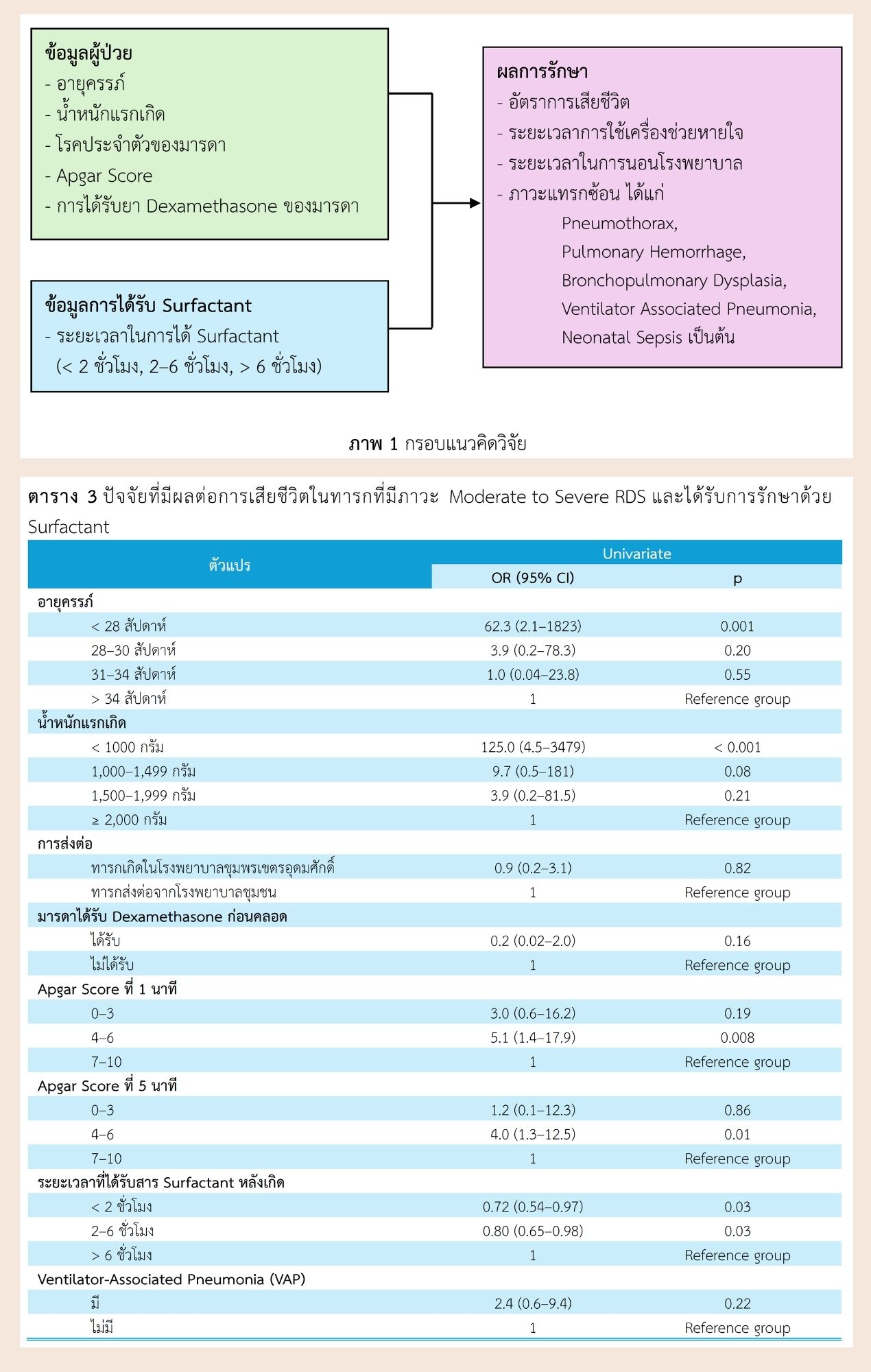
Results: A total of 78 neonates received surfactant therapy. Mean gestational age and birth weight were 30.4 weeks (SD 2.6) and 1,513 g (SD 456), respectively. The overall survival rate was 75.6%. Mean durations of mechanical ventilation and length of stay were 8.3 days and 39.3 days, respectively. Surfactant administration within 2 hours after birth was significantly associated with lower mortality.
Conclusion: Early surfactant replacement therapy, administered within the first 2 hours after birth, was associated with significantly lower mortality in neonates with moderate to severe RDS. Prompt diagnosis and timely surfactant administration may improve survival outcomes in this high-risk population.
Article Details

This work is licensed under a Creative Commons Attribution-NonCommercial-NoDerivatives 4.0 International License.
The opinions and content expressed in the articles are solely those of the individual authors and do not necessarily reflect the views of the journal or the authors’ affiliated institutions. Authors are fully responsible for the accuracy and correctness of their work.
Any reuse, reproduction, or redistribution of the articles, content, data, or images in other forms requires prior written permission from the Journal of Medicine, Nursing and Public Health Research, Thungsong Hospital.
References
Dyess N, Kinsella J, Parker T. Acute neonatal respiratory disorders. In: Gleason CA, Sawyer T, editors. Avery’s diseases of the newborn. 11th ed. Philadelphia: Elsevier; 2023. p. 594–603.
Sprecher A, Acharya K, Cohen S. Respiratory distress syndrome (Hyaline membrane disease). In: Kliegman R, St Geme III J, Blum N, Tasker R, Wilson K, Schuh A, et al, editors. Nelson textbook of pediatrics. 22nd ed. Philadelphia: Elsevier; 2025. p. 1077–82.
สุนทร ฮ้อเผ่าพันธ์. Respiratory distress and respiratory distress syndrome. ใน: วราภรณ์ แสงทวีสิน, วิบูลย์ กาญจนพัฒนกุล, สุนทร ฮ้อเผ่าพันธุ์, บรรณาธิการ. ปัญหาทารกแรกเกิด. กรุงเทพฯ: ธนาเพรส; 2550. หน้า 97–111.
ธานินทร์ พิรุณเนตร. Update in RDS management. ใน: สันติ ปุณณะหิตานนท์, บรรณาธิการ. Smart practice in neonatal care. กรุงเทพฯ: แอคทีฟพริ้นท์; 2563. หน้า 285–325.
Fujiwara T, Maeta H, Chida S, Morita T, Watabe Y, Abe T. Artificial surfactant therapy in hyaline-membrane disease. Lancet. 1980;1(8159):55–9. doi: 10.1016/s0140-6736(80)90489-4
Halliday HL. Surfactants: past, present and future. J Perinatol. 2008;28 (Suppl 1):S47–56. doi: 10.1038/jp.2008.50
Pattnaik P, Adebisi K, Lee B. Neonatal Respiratory Distress Syndrome. In: StatPearls [Internet]. Treasure Island (FL): StatPearls Publishing; 2026 [cited 2026 Jun 3]. Available from: http://www.ncbi.nlm.nih.gov/books/NBK560779/
สันติ ปุณณะหิตานนท์. การรักษาด้วยสารลดแรงตึงผิวในปอด Update in Surfactant Replacement Therapy. ใน: สันติ ปุณณะหิตานนท์, โสภาพรรณ เงินฉ่ำ, อัญชลี ลิ้มรังสิกุล, บรรณาธิการ. Highlights in Neonatal Problem. กรุงเทพฯ: แอคทีฟพริ้นท์; 2561. หน้า 176-191.
Jensen EA, Dysart K, Gantz MG, McDonald S, Bamat NA, Keszler M, et al. The Diagnosis of Bronchopulmonary Dysplasia in Very Preterm Infants. An Evidence-based Approach. Am J Respir Crit Care Med. 2019;200(6):751–9. doi: 10.1164/rccm.201812-2348OC
Papile LA, Burstein J, Burstein R, Koffler H. Incidence and evolution of subependymal and intraventricular hemorrhage: a study of infants with birth weights less than 1,500 gm. J Pediatr. 1978;92(4):529–34. doi: 10.1016/s0022-3476(78)80282-0
Bell MJ, Ternberg JL, Feigin RD, Keating JP, Marshall R, Barton L, et al. Neonatal necrotizing enterocolitis. Therapeutic decisions based upon clinical staging. Ann Surg. 1978;187(1):1–7. doi: 10.1097/00000658-197801000-00001
Chiang MF, Quinn GE, Fielder AR, Ostmo SR, Chan RVP, Berrocal A, et al. International Classification of Retinopathy of Prematurity, Third Edition. Ophthalmology. 2021;128(10):e51–68. doi: 10.1016/j.ophtha.2021.05.031
Centers for Disease Control and Prevention. Pneumonia (Ventilator-associated [VAP] and non-ventilator-associated Pneumonia [PNEU]) Event [Internet]. Atlanta: CDC; 2026 [cited 2026 Aug 12]. Available from: https://www.cdc.gov/nhsn/psc/pneu/index.html
กระทรวงสาธารณสุข กรมควบคุมโรค สถาบันบำราศนราดูร. Updating IPC Guidelines for Thailand 2024 [อินเทอร์เน็ต]. นนทบุรี: สถาบันบำราศนราดูร; 2566 [เข้าถึงเมื่อ 12 สิงหาคม 2569]. เข้าถึงได้จาก: https://ddc.moph.go.th/bidi/pagecontent.php?page=515&dept=bidi
จุไรรัตน์ ตรีวัฒนาวงศ์. ผลการรักษาภาวะ Respiratory distress syndrome โดยใช้ Surfactant ในโรงพยาบาลพระนารายณ์มหาราช. วารสารสิ่งแวดล้อมศึกษาการแพทย์และสุขภาพ. 2563;5(4):136–43. เข้าถึงได้จาก: https://so06.tci-thaijo.org/index.php/hej/article/view/252890
นพวรรณ พงษ์โสภา. ผลการรักษาภาวะ Respiratory distress syndrome โดยใช้ Surfactant ในโรงพยาบาลสุราษฎร์ธานี. วารสารวิชาการแพทย์เขต 11. 2558;29(4):505–13.
วไลพร โรจน์สง่า. ผลของการใช้ Surfactant ในทารกแรกเกิดก่อนกำหนดที่เป็น Respiratory distress syndrome ของโรงพยาบาลอุดรธานี. วารสารการแพทย์โรงพยาบาลอุดรธานี. 2561;26(1):56–63. เข้าถึงได้จาก: https://he02.tci-thaijo.org/index.php/udhhosmj/article/view/159100
Bahadue FL, Soll R. Early versus delayed selective surfactant treatment for neonatal respiratory distress syndrome. Cochrane Database Syst Rev. 2012;11(11):CD001456. doi: 10.1002/14651858.CD001456.pub2
Forsblad K, Källén K, Marsál K, Hellström-Westas L. Apgar score predicts short-term outcome in infants born at 25 gestational weeks. Acta Paediatr. 2007;96(2):166–71. doi: 10.1111/j.1651-2227.2007.00099.x
