Comparative analysis of oxidative stress biomarkers (SOD, MDA, and NRF2) in osteoarthritic and non-osteoarthritic human knee articular cartilage
Keywords:
Articular cartilage, malondialdehyde, NRF2, osteoarthritis, superoxide dismutaseAbstract
Background: Oxidative stress is a key contributor to cartilage degeneration in osteoarthritis; however, direct evidence from human articular cartilage remains limited. Understanding redox imbalance in native human tissue is essential to advance translational strategies for cartilage preservation.
Objectives: This study compared the levels of superoxide dismutase (SOD), malondialdehyde (MDA), and nuclear factor erythroid 2-related factor 2 (NRF2) between osteoarthritic and healthy human knee articular cartilage to determine oxidative stress-related alterations at the tissue level.
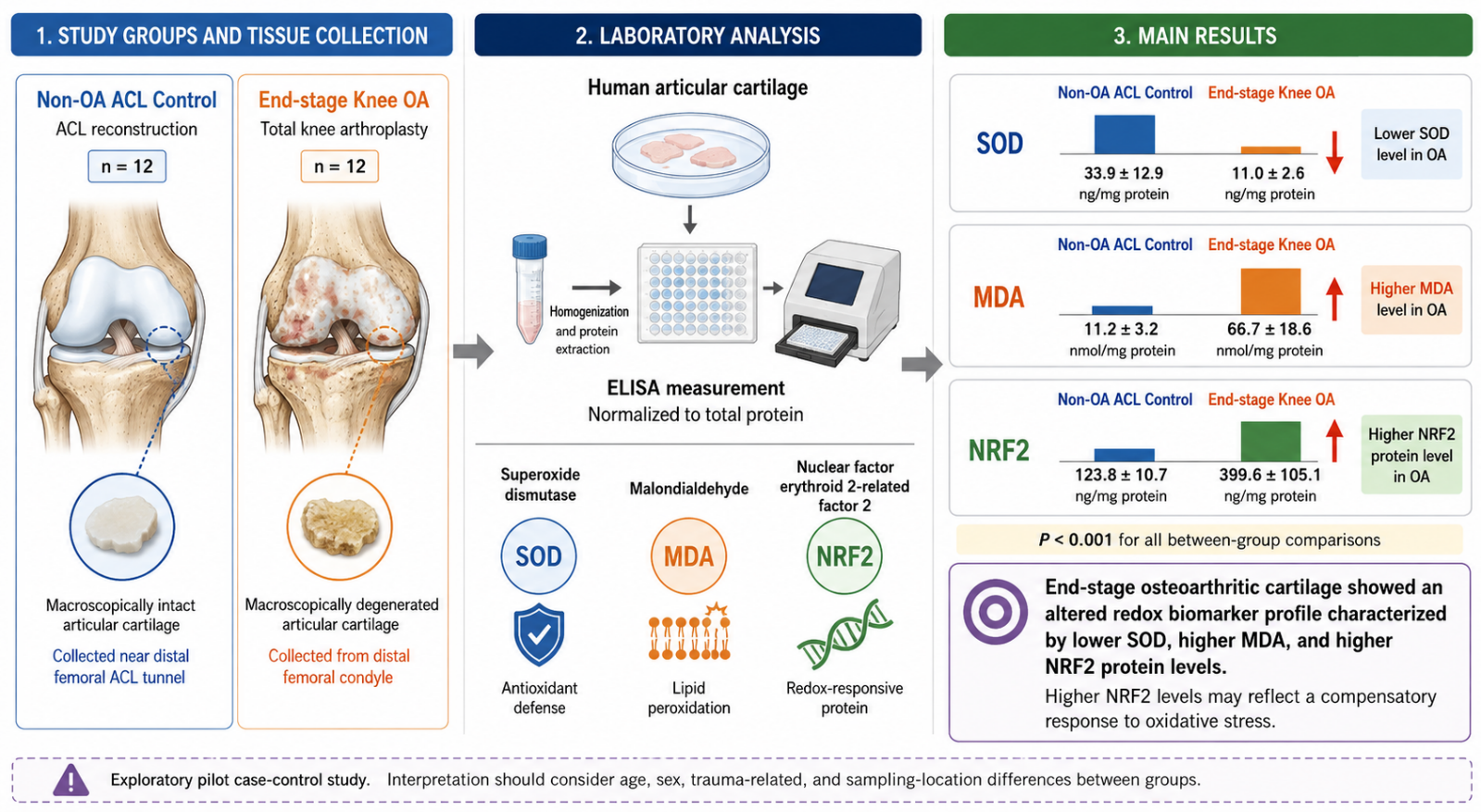
Methods: This observational case–control study analyzed knee articular cartilage from patients with endstage osteoarthritis undergoing total knee arthroplasty and non-osteoarthritic controls undergoing anterior cruciate ligament reconstruction. The levels of SOD, MDA, and NRF2 were quantified using an enzymelinked immunosorbent assay, with results expressed as mean ± standard deviation and 95% confidence intervals.
Results: Osteoarthritic cartilage showed significantly reduced SOD levels compared with healthy controls (11.0 ± 2.6 vs. 33.9 ± 12.9 ng/mg protein; P < 0.001), along with markedly elevated MDA concentrations (66.7 ± 18.6 vs. 11.2 ± 3.2 nmol/mg protein; P < 0.001), thus reflecting increased lipid peroxidation. Moreover, NRF2 expression was significantly elevated in the osteoarthritic group (399.6 ± 105.1 vs. 123.8 ± 10.7 ng/mg protein; P < 0.001). All between-group differences were significant with large effect sizes, indicating biologically meaningful separation between groups.
Conclusion: Human osteoarthritic knee cartilage exhibits profound redox imbalance that is characterized by antioxidant failure, increased lipid peroxidation, and insufficient compensatory NRF2 activation. These findings provide direct human tissue-based evidence that supports oxidative stress as a central pathological mechanism in osteoarthritis.
Downloads
References
1. Kloppenburg M, Berenbaum F. Osteoarthritis year in review 2019: epidemiology and therapy. Osteoarthritis Cartilage 2020;28:242-8.
https://doi.org/10.1016/j.joca.2020.01.002
2. Hunter DJ, Bierma-Zeinstra S. Osteoarthritis. Lancet 2019;3931745-59.
https://doi.org/10.1016/S0140-6736(19)30417-9
3. Henrotin Y, Kurz B, Aigner T. Oxygen and reactive oxygen species in cartilage degradation: friends or foes? Osteoarthritis Cartilage 2005;13:643-54.
https://doi.org/10.1016/j.joca.2005.04.002
4. Bolduc JA, Collins JA, Loeser RF. Reactive oxygen species, aging and articular cartilage homeostasis. Free Radic Biol Med 2019;132:73-82.
https://doi.org/10.1016/j.freeradbiomed.2018.08.038
5. Scott JL, Gabrielides C, Davidson RK, Swingler TE, Clark IM, Wallis GA, et al. Superoxide dismutase downregulation in osteoarthritis progression and end-stage disease. Ann Rheum Dis 2010;69:1502-10.
https://doi.org/10.1136/ard.2009.119966
6. Gavriilidis C, Miwa S, von Zglinicki T, Taylor RW, Young DA. Mitochondrial dysfunction in osteoarthritis is associated with down-regulation of superoxide dismutase 2. Arthritis Rheum 2013;65:378-87.
https://doi.org/10.1002/art.37782
7. Saha S, Buttari B, Panieri E, Profumo E, Saso L. An overview of Nrf2 signaling pathway and its role in inflammation. Molecules 2020;25:5474.
https://doi.org/10.3390/molecules25225474
8. Saha S, Rebouh NY. Anti-osteoarthritis mechanism of the Nrf2 signaling pathway. Biomedicines 2023;11:3176.
https://doi.org/10.3390/biomedicines11123176
9. Cai D, Yin S, Yang J, Jiang Q, Cao W. Histone deacetylase inhibition activates Nrf2 and protects against osteoarthritis. Arthritis Res Ther 2015;17:269.
https://doi.org/10.1186/s13075-015-0774-3
10. Ma Z, Lu H, Feng X, Du T, Li J, Zhang Q, et al. Nrf2 protects against cartilage endplate degeneration through inhibiting NCOA4-mediated ferritinophagy. Int J Mol Med 2024;53:15.
https://doi.org/10.3892/ijmm.2023.5339
11. Goldring MB, Otero M. Inflammation in osteoarthritis. Curr Opin Rheumatol 2011;23:471-8.
https://doi.org/10.1097/BOR.0b013e328349c2b1
12. Mobasheri A, Batt M. An update on the pathophysiology of osteoarthritis. Ann Phys Rehabil Med 2016;59:333-9.
https://doi.org/10.1016/j.rehab.2016.07.004
13. Engvall E, Perlmann P. Enzyme-linked immunosorbent assay (ELISA): quantitative assay of immunoglobulin G. Immunochemistry 1971;8:871-4.
https://doi.org/10.1016/0019-2791(71)90454-X
14. Mahmood T, Yang PC. Western blot: technique, theory, and trouble shooting. N Am J Med Sci 2012;4:429-34.
https://doi.org/10.4103/1947-2714.100998
15. Regan E, Flannelly J, Bowler R, Tran K, Nicks M, Carbone BD, et al. Extracellular superoxide dismutase and oxidant damage in osteoarthritis. Arthritis Rheum 2005;52:3479-91.
https://doi.org/10.1002/art.21387
16. López-Armada MJ, Fernández-Rodríguez JA, Blanco FJ. Mitochondrial dysfunction and oxidative stress in rheumatoid arthritis. Antioxidants (Basel) 2022;11:1151.
https://doi.org/10.3390/antiox11061151
17. Zahan OM, Serban O, Gherman C, Fodor D. The evaluation of oxidative stress in osteoarthritis. Med Pharm Rep 2020;93:12-22.
https://doi.org/10.15386/mpr-1422
18. Merino de Paz N, Quevedo-Abeledo JC, Gómez-Bernal F, de Vera-González A, Abreu-González P, Martín-González C, et al. Malondialdehyde serum levels in a fully characterized series of 430 rheumatoid arthritis patients. J Clin Med 2024;13:901.
https://doi.org/10.3390/jcm13030901
19. Zhang X, Hou L, Guo Z, Wang G, Xu J, Zheng Z, et al. Lipid peroxidation in osteoarthritis: focusing on 4-hydroxynonenal, malondialdehyde, and ferroptosis. Cell Death Discov 2023;9:320.
https://doi.org/10.1038/s41420-023-01613-9
20. Tiku ML, Allison GT, Naik K, Karry SK. Malondialdehyde oxidation of cartilage collagen by chondrocytes. Osteoarthritis Cartilage 2003;11:159-66.
https://doi.org/10.1016/S1063-4584(02)00348-5
21. Lin L, Wu Q, Lu F, Lei J, Zhou Y, Liu Y, et al. Nrf2 signaling pathway: current status and potential therapeutic targetable role in human cancers. Front Oncol 2023;13:1184079.
https://doi.org/10.3389/fonc.2023.1184079
22. Del Carlo M Jr, Loeser RF. Increased oxidative stress with aging reduces chondrocyte survival: correlation with intracellular glutathione levels. Arthritis Rheum 2003;48:3419-30.
https://doi.org/10.1002/art.11338
23. Bannuru RR, Osani MC, Vaysbrot EE, Arden NK, Bennell K, Bierma-Zeinstra SMA, et al. OARSI guidelines for the non-surgical management of knee, hip, and polyarticular osteoarthritis. Osteoarthritis Cartilage 2019;27:1578-89.
https://doi.org/10.1016/j.joca.2019.06.011
24. Peshkova M, Lychagin A, Lipina M, Di Matteo B, Anzillotti G, Ronzoni F, et al. Gender-related aspects in osteoarthritis development and progression: a review. Int J Mol Sci 2022;23:2767.
Downloads
Published
How to Cite
Issue
Section
License
Copyright (c) 2026 Chulalongkorn Medical Journal

This work is licensed under a Creative Commons Attribution-NonCommercial-NoDerivatives 4.0 International License.