Development of a Model for Intravenous Catheter Securement and Care in Pediatric Patients in the Pediatric Ward at Phatthalung Hospital
Article Sidebar
Main Article Content
Abstract
Background: Intravenous (IV) therapy in pediatric patients is often associated with complications, including catheter dislodgement, occlusion, swelling, and other infusion-related complications. These problems may necessitate repeated venipuncture, increase pain and discomfort in children, and add to nurses’ workloads. This study aimed to develop a model for securing and maintaining intravenous infusion sites in pediatric patients at the pediatric ward, Phatthalung Hospital, Thailand.
Methods: This research and development study consisted of three phases. Phase 1 explored the current situation and problems related to IV site securement and care in pediatric patients using a survey combined with qualitative research methods. Phase 2 involved reviewing nursing guidelines for patients receiving intravenous therapy, IV site securement guidelines, and relevant research. Findings from Phase 1 were used to develop a preliminary model, which was reviewed for accuracy and appropriateness by experts and subsequently pilot-tested. Phase 3 evaluated the model using a quasi-experimental, posttest-only, two-group design, combined with a survey. Data were analyzed using descriptive statistics, including frequencies, percentages, means, and standard deviations, as well as inferential statistics, including Fisher’s exact test and Pearson’s chi-square test.
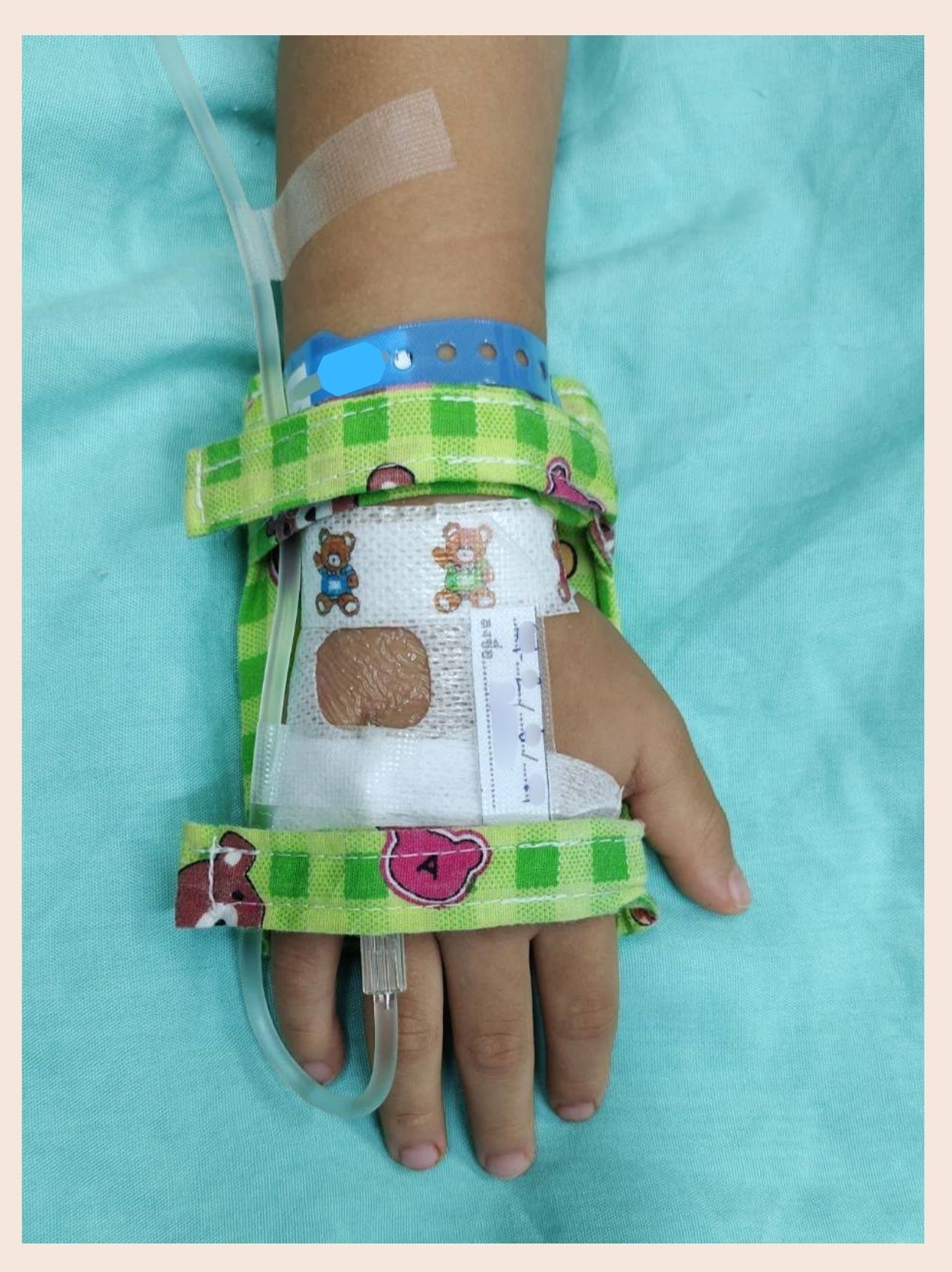
Results: The initial assessment revealed that successful IV site securement and care were achieved in 43.01% of cases, while only 6.45% of IV sites remained intact for 96 hours. The developed model comprised three components: (1) effective securement following catheter insertion combined with a “Safe Splint” device; (2) provision of information to parents or caregivers; and (3) ongoing IV site care by nurses. Following implementation, the incidence of dressing detachment decreased from 40.00% to 0.00%, while blood stains or visible contamination beneath the dressing decreased from 26.70% to 0.00%. These differences were statistically significant at the 0.05 level. Successful IV site securement increased from 40.00% to 60.00%; however, the difference was not statistically significant. Parents’ and nurses’ satisfaction with the model was rated at high to highest levels.
Conclusion: The developed model for IV site securement and care in pediatric patients reduced problems and complications associated with intravenous therapy, improved the rate of successful securement, and promoted nursing care quality and patient safety.
Article Details

This work is licensed under a Creative Commons Attribution-NonCommercial-NoDerivatives 4.0 International License.
The opinions and content expressed in the articles are solely those of the individual authors and do not necessarily reflect the views of the journal or the authors’ affiliated institutions. Authors are fully responsible for the accuracy and correctness of their work.
Any reuse, reproduction, or redistribution of the articles, content, data, or images in other forms requires prior written permission from the Journal of Medicine, Nursing and Public Health Research, Thungsong Hospital.
References
1. Huang LS, Huang Y, Hu J. Current practices of peripheral intravenous catheter fixation in pediatric patients and factors influencing pediatric nurses’ knowledge, attitude and practice concerning peripheral intravenous catheter fixation: a cross-sectional study. BMC Nurs. 2021;20(1):236. doi: 10.1186/s12912-021-00758-1
2. Kleidon TM, Schults J, Rickard CM, Ullman AJ. Techniques and technologies to improve peripheral intravenous catheter outcomes in pediatric patients: a systematic review and meta-analysis. J Hosp Med. 2021;16(12):742–50. doi: 10.12788/jhm.3718
3. Charters B, Foster K, Lawton B, Lee L, Byrnes J, Mihala G, et al. Novel peripheral intravenous catheter securement for children and catheter failure reduction: a randomized clinical trial. JAMA Pediatr. 2024;178(5):437–45. doi: 10.1001/jamapediatrics.2024.0167
4. Chaerunnisa A, Madhuvu A, Najm D, Fooladi E, Team V. The evidence of effectiveness and safety of peripheral intravenous catheter dressings and securement devices: a systematic review and meta-analysis protocol. Journal of Wound Management. 2025;26(1):29–38. doi: 10.35279/jowm2025.26.01.08
5. คณะทำงานพยาบาล IV Team ประจำหน่วยงาน. แนวปฏิบัติการพยาบาลผู้ป่วยให้สารน้ำทางหลอดเลือดดำส่วนปลาย โรงพยาบาลพัทลุง. พัทลุง: โรงพยาบาลพัทลุง; 2567.
6. Molenda M. In search of the elusive ADDIE model. Perform Improv. 2003;42(5):34–6. doi: 10.1002/pfi.4930420508
7. Branch RM. Instructional Design: The ADDIE Approach. New York: Springer; 2009. doi: 10.1007/978-0-387-09506-6
8. Nickel B, Gorski L, Kleidon T, Kyes A, DeVries M, Keogh S, et al. Infusion therapy standards of practice. 9th edition. J Infus Nurs. 2024;47(1S Suppl 1):S1–S285. doi:10.1097/NAN.0000000000000532
9. จิราพร เชาว์โพธิ์ทอง, ภัทรารัตน์ ตันนุกิจ, สุวดี สุขีนิตย์, บรรณาธิการ. แนวทางการพยาบาลผู้ป่วยได้รับสารน้ำทางหลอดเลือดดำ. กรุงเทพฯ: สมาคมเครือข่ายพยาบาลผู้ให้สารน้ำทางหลอดเลือดดำ, 2567.
10. Yamane T. Statistics: an introductory analysis. 3rd ed. New York: Harper & Row; 1973.
11. Bernard HR. Social research methods: qualitative and quantitative approaches. Thousand Oaks (CA): SAGE Publications; 2000.
12. Indarwati F, Mathew S, Munday J, Keogh S. Incidence of peripheral intravenous catheter failure and complications in paediatric patients: Systematic review and meta-analysis. Int J Nurs Stud. 2020;102:103488. doi: 10.1016/j.ijnurstu.2019.103488
13. Kleidon TM, Rickard CM, Gibson V, Mihala G, Schults JA, Xu HG, et al. Smile-secure my intravenous line effectively: A pilot randomised controlled trial of peripheral intravenous catheter securement in paediatrics. J Tissue Viability. 2020;29(2):82–90. doi: 10.1016/j.jtv.2020.03.006
14. สุรีย์พร กุมภคาม, บุญเรือน ชุ่มแจ่ม, วณิชชา เรืองศรี, นภสร จั่นเพ็ชร, นุชนารถ เขียนนุกูล. การพัฒนาระบบการพยาบาลผู้ป่วยได้รับสารน้ำทางหลอดเลือดดำส่วนปลาย โรงพยาบาลนพรัตนราชธานี. วารสารกองการพยาบาล. 2565;49(2):37–52. เข้าถึงได้จาก: https://he01.tci-thaijo.org/index.php/JND/article/view/259285
15. นภสร ดวงสมสา. การพัฒนาแนวปฏิบัติทางการพยาบาลเพื่อป้องกันการติดเชื้อจากการให้สารน้ำทางหลอดเลือดดำส่วนปลาย. วารสารวิทยาศาสตร์สุขภาพ วิทยาลัยพยาบาลบรมราชชนนี สรรพสิทธิประสงค์. 2561;2(1):64–81. เข้าถึงได้จาก: https://he01.tci-thaijo.org/index.php/bcnsp/article/view/193168
16. Watterson K, Hauck MJ, Auker A, Burns R, Greider J, Marlin M, et al. S.T.I.C.K.: A quality improvement pediatric IV infiltration prevention bundle. J Pediatr Nurs. 2018;41:38–41. doi: 10.1016/j.pedn.2018.01.003
17. World Health Organization. Guidelines for the prevention of bloodstream infections and other infections associated with the use of intravascular catheters: part I: peripheral catheters [Internet]. Geneva: World Health Organization; 2024 [cited 2026 Aug 4]. Available from: https://www.who.int/publications/i/item/9789240093829
18. Thompson J, Steinheiser MM, Hotchkiss JB, Davis J, DeVries M, Frate K, et al. Standards of care for peripheral intravenous catheters: evidence-based expert consensus. Br J Nurs. 2024;33(21):S32–S46. doi: 10.12968/bjon.2024.0422
19. Bettencourt A, Ruppel H, Bonafide CP. Advancing evidence-based peripheral intravenous catheter securement. JAMA Pediatr. 2024;178(5):435–6. doi: 10.1001/jamapediatrics.2024.0177
20. ณีรนุช วงค์เจริญ, พิมพ์ใจ ลังการ์พินธุ์, พัชรินทร์ ไชยบาล, ทัพพ์ขวัญ ศรีรัตยาวงค์, พรทิพย์ ปาอิน, วิชานีย์ ใจมาลัย และคณะ. ประสิทธิผลของนวัตกรรม Save IV Line. วารสารสิ่งแวดล้อมศึกษาการแพทย์และสุขภาพ. 2567;9(2):259–66. เข้าถึงได้จาก: https://so06.tci-thaijo.org/index.php/hej/article/view/274629
21. สุกัญญา ฆารสินธุ์, อลงกรณ์ ทิพรักษ์, สุพวรรณ ชะนะภู. การวิจัยและพัฒนานวัตกรรม “อุปกรณ์ผูกยึดเข็ม IV (3 in 1)” ในผู้ป่วยเด็กที่ได้รับสารละลายทางหลอดเลือดดำ. ใน: การประชุมวิชาการและนำเสนอผลงานวิจัยระดับชาติ ราชธานีวิชาการ ครั้งที่ 3: นวัตกรรมที่พลิกโฉมสังคมโลก. อุบลราชธานี: มหาวิทยาลัยอุบลราชธานี; 2562. หน้า 489–99.